PS3 A new method for delidding the Cell?

ragen-fio

Member
Ciao! I don't know if it is the right section, but in case of error please a moderator to move the discussion to the appropriate section, and sorry for my english! :)

Lately I have been interested in the delidding of the Cell using the most popular techniques such as paint spatulas, various blades and metallic objects, methods that seemed quite risky and slow although I managed to successfully delidding two processors.

Then I started thinking about some other methods, if not faster, at least safer, so I tried with the dental floss, sliding it between the IHS and the processor to cut the glue, but with great difficulty because it broke too much easily.

So I started to think about using some kind of quite resistant thin metal wire, until one day on AliExpress I saw the metal wire used to separate the LCD screens of smartphones and I immediately bought some rolls of various thickness 0.08mm and 0.1mm. What can I say?

With the 0.08mm wire I delidded the Cell of a COK-002 in a very short time compared to spatulas and blades and with practically 0 risks, even if it is a tecnique that requires a little practice to prevent the wire from being break. Next time I'll try with the 0.1mm one maybe heating it with the special tip for the soldering iron.
I don't know if it is a method that has already been used, I have not found information about it, however I was pleased to share it with you. :D

 
Last edited by a moderator:
Ciao! I don't know if it is the right section, but in case of error please a moderator to move the discussion to the appropriate section, and sorry for my english! :)

Lately I have been interested in the delidding of the Cell using the most popular techniques such as paint spatulas, various blades and metallic objects, methods that seemed quite risky and slow although I managed to successfully delidding two processors.

Then I started thinking about some other methods, if not faster, at least safer, so I tried with the dental floss, sliding it between the IHS and the processor to cut the glue, but with great difficulty because it broke too much easily.

So I started to think about using some kind of quite resistant thin metal wire, until one day on AliExpress I saw the metal wire used to separate the LCD screens of smartphones and I immediately bought some rolls of various thickness 0.08mm and 0.1mm. What can I say?

With the 0.08mm wire I delidded the Cell of a COK-002 in a very short time compared to spatulas and blades and with practically 0 risks, even if it is a tecnique that requires a little practice to prevent the wire from being break. Next time I'll try with the 0.1mm one maybe heating it with the special tip for the soldering iron.
I don't know if it is a method that has already been used, I have not found information about it, however I was pleased to share it with you. :D

Not sure where you got the idea of using the dental floss, but i was talking about it here in the forum because i tryed it at some point, so maybe it was me, and i have to say it was not a good idea. I just tryed it because it was the only kind of "line" i had at home and because i knew is harmless
The problem is that is made with some kind of "fibers", and that fibers starts breaking individually everytime you try to "cut" the silicone with it

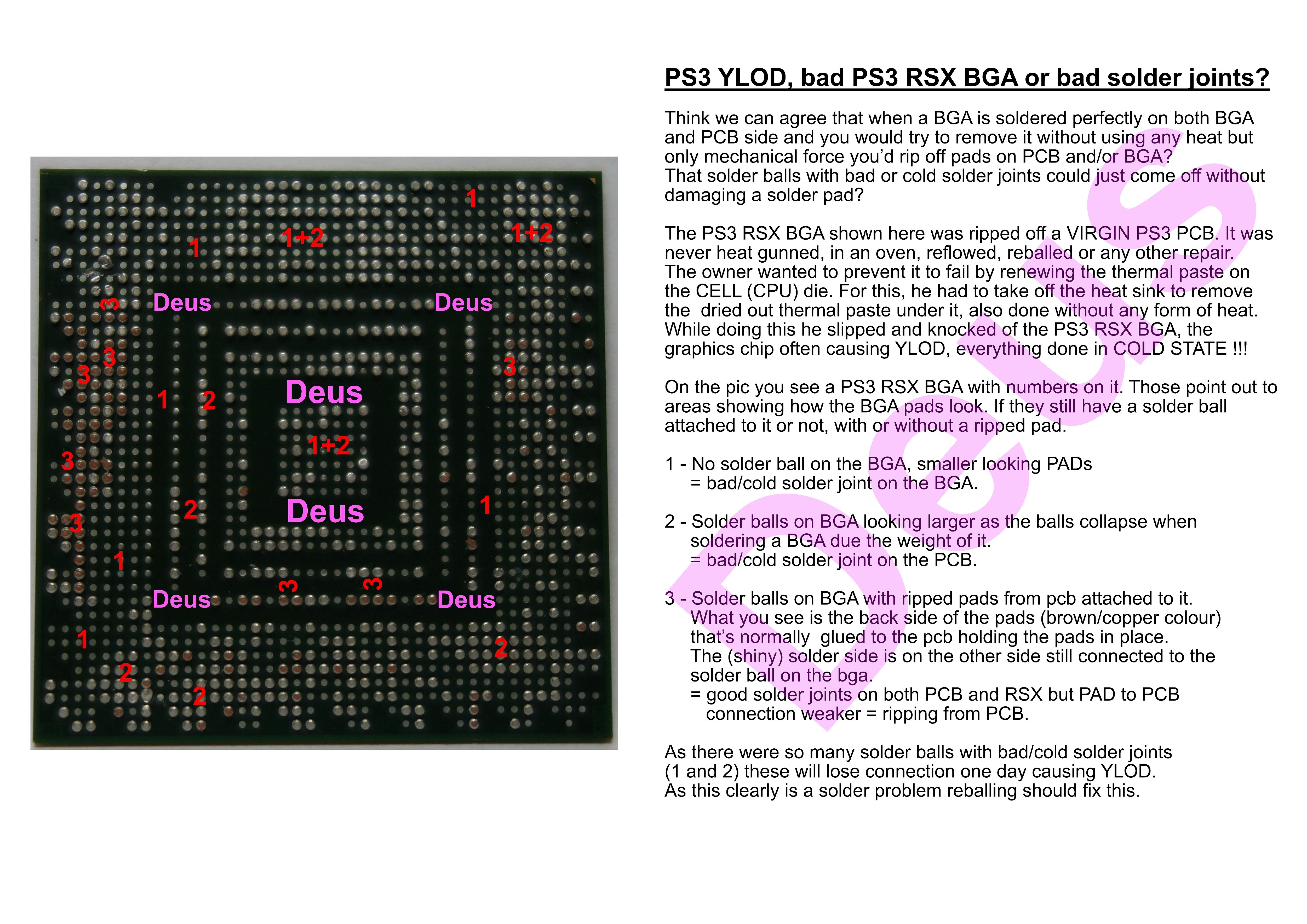
About doing it in a harmless way, the most important thing is to "ballance" the horizontal forces by placing the thumbs at the other side of the IHS. The goal is to prevent what can be seen in this photo
Is a RSX ripped from the motherboard by a single lateral hit (so it was insta-ripped in a milisecond), but if you apply the same amount of lateral force lets say... along 5 seconds the result is going to be exactly the same !
Q7OMR7.jpg


The point is... if you dont ballance the forces when you are pushing or pulling the CELL/RSX laterally then the forces are going to be applyed in every BGA solder causing a shear stress in all them, think in the BGA solder balls like in this image:
stress_types.gif


A fishing line made of nylon works fine, and can be made also with stainless steel (like the ones used in some musical isntruments, like guitars)

I have some precission meassure instruments, and when i was doing the experiments with the dental floss (and other materials) i was able to meassure the gap in between IHS and the substrate in decimals of milimeters, i dont remember the exact size right now... but i remember i wrote it here in the forum in the most accurate way posible... so try to search for it, or i will try later to find that info i posted

I moved the tread to the "hardware mods" subforum, the forum where you wrote the thread originally was fine, but i think is better to move it to the hardware subforum because is interesting and could generate a nice talk :encouragement:
 
Ciao sandungas, thanks for the interesting reply and for moving the thread in the appropriate section. :encouragement:

About the use of dental floss it was just an idea that i have some months ago, i discovered this forum a few days ago and I haven't had the opportunity to read your experiences about it, but i will do. Maybe we have similar neural pathways. :D :D :D
Jokes aside, i had the same problems as you with the fiber, and I thought that being a rough wire it could have cut the silicone more easily, but the excess of friction made it break after a short time. So after some attempts i've abandoned the idea.

About doing it in a harmless way, the most important thing is to "ballance" the horizontal forces by placing the thumbs at the other side of the IHS. The goal is to prevent what can be seen in this photo
Is a RSX ripped from the motherboard by a single lateral hit (so it was insta-ripped in a milisecond), but if you apply the same amount of lateral force lets say... along 5 seconds the result is going to be exactly the same !
Q7OMR7.jpg


The point is... if you dont ballance the forces when you are pushing or pulling the CELL/RSX laterally then the forces are going to be applyed in every BGA solder causing a shear stress in all them, think in the BGA solder balls like in this image:
stress_types.gif


This is a very very good point that I honestly hadn't thought of and will pay attention to in the future, in this regard I have always tried to make the metallic wire work by sliding it against the silicone using the friction to cut it, rather than simply pulling the wire, which would have required more force and stressed much more the BGA solder balls. But, i repeat, i will pay much attention in the future, thanks for the advice! :)

I had also thought about the fishing line, but it seemed too smooth to generate that minimum friction that could cut the silicone, but I will try in the future just for my curiosity. :)

I noticed that the space between the IHS and the substrate varies (of course) according to the Cell model used between the various versions of the PS3, I have 3 fat a CECHC04, a CECHG04, a CECHK04 in which the gap seems similar to me but I have not measured it, and 3 superslim 2 CECH 4004A, in which between the IHS and the substrate there is a plastic spacer - as you can see in the photo below of a previous delid that made me struggle a lot :D - and a minor gap compared to the Cells of the FAT ones, and a CECH 4304A where the IHS and the substrate are practically united and there is no space between them... But in the future I will better study the situation for a delid of this 4304A. :D
In short, I understood that depending on the processor model, a different approach is needed. :encouragement:

 
Hmmm...
I have a crap-ton of stainless steel wire for vaping. Will deffo give this a go when I need to delid again.
Currently use the "paint spatula" method.
 
Not sure where you got the idea of using the dental floss, but i was talking about it here in the forum because i tryed it at some point, so maybe it was me, and i have to say it was not a good idea. I just tryed it because it was the only kind of "line" i had at home and because i knew is harmless
The problem is that is made with some kind of "fibers", and that fibers starts breaking individually everytime you try to "cut" the silicone with it

About doing it in a harmless way, the most important thing is to "ballance" the horizontal forces by placing the thumbs at the other side of the IHS. The goal is to prevent what can be seen in this photo
Is a RSX ripped from the motherboard by a single lateral hit (so it was insta-ripped in a milisecond), but if you apply the same amount of lateral force lets say... along 5 seconds the result is going to be exactly the same !
Q7OMR7.jpg


The point is... if you dont ballance the forces when you are pushing or pulling the CELL/RSX laterally then the forces are going to be applyed in every BGA solder causing a shear stress in all them, think in the BGA solder balls like in this image:
stress_types.gif


A fishing line made of nylon works fine, and can be made also with stainless steel (like the ones used in some musical isntruments, like guitars)

I have some precission meassure instruments, and when i was doing the experiments with the dental floss (and other materials) i was able to meassure the gap in between IHS and the substrate in decimals of milimeters, i dont remember the exact size right now... but i remember i wrote it here in the forum in the most accurate way posible... so try to search for it, or i will try later to find that info i posted

I moved the tread to the "hardware mods" subforum, the forum where you wrote the thread originally was fine, but i think is better to move it to the hardware subforum because is interesting and could generate a nice talk :encouragement:


Actually, i also worry about breaking/cracking of solder balls while delidding. I think we need a very sharp and slim tool to access & cut silicon under IHS. A blunt tool like slim painting knife may slid under IHS but it will strain CELL & break/crack solder joints while cutting. Maybe sharpening one edge of painting knife will be more effective.

The more you strain to cut silicon, the more chances that you will break solder balls. I am thinking of sharpening one of this metal edges. Sharpen it from one side, slide it under IHS & try to smoothly cut silicon.

index.jpeg


I haven't got my own hand on this. I have to see if its solid enough. I don't want anything that is too flexible that may get deformed during the delidding process. The tool should be firmly in control of hand and usable with precision.
 
Actually, i also worry about breaking/cracking of solder balls while delidding. I think we need a very sharp and slim tool to access & cut silicon under IHS. A blunt tool like slim painting knife may slid under IHS but it will strain CELL & break/crack solder joints while cutting. Maybe sharpening one edge of painting knife will be more effective.

The more you strain to cut silicon, the more chances that you will break solder balls. I am thinking of sharpening one of this metal edges. Sharpen it from one side, slide it under IHS & try to smoothly cut silicon.

View attachment 26578


I haven't got my own hand on this. I have to see if its solid enough. I don't want anything that is too flexible that may get deformed during the delidding process. The tool should be firmly in control of hand and usable with precision.

This feeler gauge could also work, obviously the thicker the "blade" the stronger it will and bend less, but I personally avoid using metal tools, if it's possible, to not scratching the processor or damage the DIE.

I usually add a little heat to the mix also, to loosen the paste up a little

I do it too, I forgot to write it. :encouragement:
 
The gauge blade will be bent around 1 cm at its end. So it will become an L shaped with small 1 cm edge that will be slid under IHS. This edge will only reach sufficiently to cut silicon. It won't reach the CELL die. I am more worried about accidental abrasion on one of those small circuit connections on the chip itself. One small scratch and CELL is dead.
 
I saw a similar method on YouTube where they use a properly sharpened L-shaped nail file, and I also tried it on an old motherboard, but it didn't seem like a fast and safe method for the chip (i had your same concerns), at least for me who was the first time i tried. However I am satisfied with the metal wire and will continue to use it improving the technique. :)
 
I have some precission meassure instruments, and when i was doing the experiments with the dental floss (and other materials) i was able to meassure the gap in between IHS and the substrate in decimals of milimeters, i dont remember the exact size right now... but i remember i wrote it here in the forum in the most accurate way posible... so try to search for it, or i will try later to find that info i posted
Found it :)
https://www.psx-place.com/threads/my-ps3-now-sounds-like-a-vacuum-cleaner.22051/page-2#post-152708
Take a read at the whole thread, i guess you are going to find some interesting details from my brainstormings, the important thing are this sentences
My results...
The gap in between IHS and fiberglass surface is 1.2mm ... this means the "tool" you use to "cut" the silicone should not be bigger than this thickness, that "painting palettes" are good because have the edges rounded and are made of metal so are strong, but if you are going to buy one you should ask about the thickness, and remember... 1.2mm max

I was able to cut a couple of centimeters in the CELL corners by using plastic sheets of 1.3mm (yeah it works), but it took me lot of time to cut that couple of centimeters, and i had to replace the plastic sheet multiple times... because i was cutting it with different shapes, and also because the plastic sheets was "bending" (and after bended you need a new one)

Edit:
More weird experiments...
That day i tryed to use waxed dental floss... and you are going to crucifix me to say this but... it works
It helped me in removing a few of the silicone (im completly sure because the line was changing his color to grey because it was removing the silicone)
The problem is it needs lot of work (i hurted my hands and fingers for insisting in using it because was working... slow but working)
Also, the waxed dental floss i had at home was 1.3mm thickness or so (i meassured it with the micrometer for comparison purposes)
I can assure you this meassurements was made very accuratelly, and i meassured it several times by different means to verify that my meassures was the most accurate posibles

The point is... we have 1.2mm of gap in between IHS and the substrate in a CECH-25xx PS3 model
In other PS3 models could be a different gap, im not sure, but i dont think
Also, is needed to consider i was taking the meassures after removing all the silicone because i was repeating the same "cutting" movement many times. The fact is the first time you try to "cut" probably there is going to be some silicone that refuses to be "unsticked"... so dunno, maybe 1mm works better than 1.2mm

The point of using 1.2mm is because this way the line is stronger and doesnt breaks, if i had to choose i would try with 1.2mm first
And about the material... i really thing the stainless steel is going to give you a more feeling like "cutting butter" (it cuts better than nylon from a fishing line), is just is going to be more prone to break
The nylon is going to resist better the deformations and curvatures... and the stainless tell is not going to resist them so well because is a metal (stronger, but more fragile)

Anyway... stainless steel or nylon... both are going to work nice, i know because i was able to do it (partially aceptable) with a shitty dental floss, lol that is far away from the ideal tool we need to use (it was bigger than 1.2mm and his fibers was breaking constantly, but still... it was working)


----------
The other experiment i was doing with a plastic sheet taken from one of that food boxes was working fine too... is just i had the bad luck to not find any food box using plastic sheet with 1.2mm
Someone mentioned to check the boxes used in pasta, i was checking them, and other food products of bakery (and i ate them all in revenge) but no luck :crybaby:
Anyway... i stll think is a good idea to do it with a plastic sheet... is a lot more robust so it cuts better (is a bit like using a saw), i was also creating "dents" in the border of the palstic sheet creating cuts with a razor blade like in a real saw, and this was working too
 
Last edited:
About the use of dental floss it was just an idea that i have some months ago, i discovered this forum a few days ago and I haven't had the opportunity to read your experiences about it, but i will do. Maybe we have similar neural pathways. :D :D :D
Jokes aside, i had the same problems as you with the fiber, and I thought that being a rough wire it could have cut the silicone more easily, but the excess of friction made it break after a short time. So after some attempts i've abandoned the idea.
I had the same feeling, it was working partially but it was not worthy to continue because at that point i had a proof that the dental floss was not good enought
And with the plastic sheets was happening the same, the idea was working but the thickness of the plastic sheets i was finding was bigger than 1.2mm and also i was not sure about the chemical composition of the plastics
You know... in a idealistic world we would need to use a plastic sheet wth a chemical composition to achieve the highest strenght posible, but the plastic materials used in the boxes of food products are not intended to that purpose, also the thickness of the plastic sheets used in that boxes at the time we buy them is unknown... and we cant follow any rule... is just a matter of buying lot of that food products and try to see if the plastic sheet of some of them fits... so is not a good solution for us, because is not standard
We cant tell other people to buy a box of a specific product, like... "giovanni pressto bolognesa" because they are not going to find it in his countries

I had also thought about the fishing line, but it seemed too smooth to generate that minimum friction that could cut the silicone, but I will try in the future just for my curiosity. :)
Is also needed to consider that the "sawing" movement overheats the line a bit, the friction causes heat, i could notice it by touching it, not excesive, but i guess enought to create deformations in the nylon fishing line
The stainless stell is going to resist much better than nylon that deformations caused by the heat

All and all... nylon or stainless stell both have his pros and contras but overall is the same... even from the point of view of safety, a fishing line made of nylon or a guitar cord made of stainless stell have a perfet circular section... so is imposible to create any scratch in the substrate
I noticed that the space between the IHS and the substrate varies (of course) according to the Cell model used between the various versions of the PS3, I have 3 fat a CECHC04, a CECHG04, a CECHK04 in which the gap seems similar to me but I have not measured it, and 3 superslim 2 CECH 4004A, in which between the IHS and the substrate there is a plastic spacer - as you can see in the photo below of a previous delid that made me struggle a lot :D - and a minor gap compared to the Cells of the FAT ones, and a CECH 4304A where the IHS and the substrate are practically united and there is no space between them... But in the future I will better study the situation for a delid of this 4304A. :D
In short, I understood that depending on the processor model, a different approach is needed. :encouragement:
I dont remember right now which model is it (i think is since the latest produced CECH-30xx models) where sony started using thermal glue in the die (located at the center and made from silicon mineral)
That thermal glue they used at factory is very strong, up to the point that there is some people that broke the die (fractured like a rock) by pulling up the IHS, so be carefull with them, this ones doesnt allows to delid the IHS
But the fact is sticked so hardly it means we dont really need to delid them... the heat transfer in this ones where the DIE is sticked to the IHS with thermal glue is good

They can be recognized because the substrate have some "domes" (like circlular bumps) all around the border
As far i remember are 2 or 3 "domes" in every border
So.... if you start cutting and you notice that "bumps"... just stop cutting and forget abot the delidding
 
Last edited:
Actually, i also worry about breaking/cracking of solder balls while delidding. I think we need a very sharp and slim tool to access & cut silicon under IHS. A blunt tool like slim painting knife may slid under IHS but it will strain CELL & break/crack solder joints while cutting. Maybe sharpening one edge of painting knife will be more effective.

The more you strain to cut silicon, the more chances that you will break solder balls. I am thinking of sharpening one of this metal edges. Sharpen it from one side, slide it under IHS & try to smoothly cut silicon.

View attachment 26578


I haven't got my own hand on this. I have to see if its solid enough. I don't want anything that is too flexible that may get deformed during the delidding process. The tool should be firmly in control of hand and usable with precision.
The good thing of that gauges is that are calibrated to a high precission (of 2 decimals as far i remember), the bad thing is if you want to use them to delid a PS3 IHS you need to bend them to create an angle of 45º degrees or so
You can bend them, not a problem, but that gauges are the kind of precission tool that you should store and use with extreme care... and bending them is a sin, lol
We could say you are breaking them when you bend them, and are not cheap
As said... is ok but is weird. And sharping the edge of them is weird too

Incase of using something with a sharped edge is way better to use a razor blade, i know some people that does it in a professional way with razor blades... but i guess is mostly because they doesnt wants to spend time in doing it in a harmless way... also they have lot of experience doing it (and killed some PS3's while practising)
The golden rule is to have the edge of the razor blade always aiming to the IHS... this way in the worst scenario posible the razor blade is going to touch the IHS (metal versus metal) so no damage
Of course telling it is way easyer than doing it :D but this is very hard to achieve, an small disalignment or a bending with a razor blade is a game over
I prefer the stainless stell line (or fishing line) because is a lot more safer, the only thing you need to worry is to ballance forces to prevent the shear effect
 
Last edited:
What size of steel wire will fit under IHS? 0.2 sq mm?

By the way if you wanna use steel wire to cut IHS silicon. Have you seen replacement of Car windshield? It uses same method of cutting windshield sealant and removing the damaged windshield.

The cutting wire are not actually a single wire, but few thin wires wrapped around each other. So that the wire has more strength and also rubbing them on Sealant produces more abrasive cut. I wonder if you have seen this in action.


So you need at least 2 thin wires wrapped around one another.

How about this? Will it work?

https://www.amazon.in/Stainless-Ste...=1&keywords=Steel+Wire&qid=1593859333&sr=8-29


By the way, is copper wire strong enough? Look at this. If i can wrap 2-3 such thin wires, will the do the job?

https://www.amazon.in/ART-IFACT-Meters-Bare-Copper/dp/B07LBS9N3V/ref=sr_1_3?dchild=1&keywords=0.6+mm+Wire&qid=1593860762&sr=8-3&th=1

Another possible option?

https://www.amazon.in/ART-IFACT-Res...keywords=mm+Steel+Wire&qid=1593861282&sr=8-43
 
Last edited:
I dont remember right now which model is it (i think is since the latest produced CECH-30xx models) where sony started using thermal glue in the die (located at the center and made from silicon mineral)
That thermal glue they used at factory is very strong, up to the point that there is some people that broke the die (fractured like a rock) by pulling up the IHS, so be carefull with them, this ones doesnt allows to delid the IHS
But the fact is sticked so hardly it means we dont really need to delid them... the heat transfer in this ones where the DIE is sticked to the IHS with thermal glue is good

They can be recognized because the substrate have some "domes" (like circlular bumps) all around the border
As far i remember are 2 or 3 "domes" in every border
So.... if you start cutting and you notice that "bumps"... just stop cutting and forget abot the delidding

If you look at the last image I posted of a Cell of a 4004A you can see the plastic thickness with the small domes you refer to and that made me sweat to cut the silicone, and there was no thermal glue or similar but the classic thermal paste, old and dry. I replaced it with the Noctua NT-H1 and had temperatures lower of about 4-5°C measured in MultiMAN. I'm very satisfied and it was worth delidding it. :)

What size of steel wire will fit under IHS? 0.2 sq mm?

By the way if you wanna use steel wire to cut IHS silicon. Have you seen replacement of Car windshield? It uses same method of cutting windshield sealant and removing the damaged windshield.

The cutting wire are not actually a single wire, but few thin wires wrapped around each other. So that the wire has more strength and also rubbing them on Sealant produces more abrasive cut. I wonder if you have seen this in action.

I use the wire to cut the glue of the LCD screens, I don't know if these others work the same.
 
What size of steel wire will fit under IHS? 0.2 sq mm?
The gap is 1.2mm diameter... for the CELL of a CECH-25xx
If you look at the last image I posted of a Cell of a 4004A you can see the plastic thickness with the small domes you refer to and that made me sweat to cut the silicone, and there was no thermal glue or similar but the classic thermal paste, old and dry. I replaced it with the Noctua NT-H1 and had temperatures lower of about 4-5°C measured in MultiMAN. I'm very satisfied and it was worth delidding it. :)
You mean the photo in your first post of this thread ?
Btw, the photo is not displayed for me... i just realized there is a link to a photo after you mentioned it (and because i clicked in your post to see the original raw text)

What i mentioned about some CELL models with the domes and using thermal glue is mostly a coincidence, and is not a strict rule because it could be something they was only doing "by factory"... with this i mean... the thermal compound could be different in every factory, also some factories introduces manufacturing changes sooner than other factories

At some point sony made a new revision of CELL with the domes in the substrate, and additionally (around that same dates), they started using thermal glue in the die
It happened around the ending of the production of CECH-30xx

As far i remember you are the first one to report to have one of that CELL models with the domes but without thermal glue
But im not sure how frequent are that domes in the latest CELL models used in superslim
All i know is 100% of the photos/videos i saw with a broken CELL die glued to the IHS had the infamous domes, this is what made me think all/most of the CELL models with domes are using thermal glue
Anyway, if the CELL have that domes be careful, are scary because could indicate the presence of thermal glue, also are an obstacle when trying to cut the silicone :/
 
Last edited:
Btw, just a tip to DIY
Some of that display removal tools for smartphones using a wire have 2 rings at the endings to insert your fingers in them
image.php


That rings are very useful to dont hurt your fingers
If you try to move the wire back and forth doing a "cutting" movement repeated many times, and holding the wire with your bare hands you are going to be hurted (really, im not exaggerating, is the kind of damage in the skin that you dont realize until is too late)

So if someone is going to buy only the wire... try to imagine how to attach it to a couple of rings... or to a stick like in the photo posted by @ragen-fio where can be seen the toolkit he bought
 
Last edited:
The gap is 1.2mm diameter... for the CELL of a CECH-25xx

You mean the photo in your first post of this thread ?
Btw, the photo is not displayed for me... i just realized there is a link to a photo after you mentioned it (and because i clicked in your post to see the original raw text)

What i mentioned about some RSX models with the domes and using thermal glue is mostly a coincidence, and is not a strict rule because it could be something they was only doing "by factory"... with this i mean... the thermal compound could be different in every factory, also some factories introduces manufacturing changes sooner than other factories

At some point sony made a new revision of RSX with the domes in the substrate, and additionally (around that same dates), they started using thermal glue in the die
It happened around the ending of the production of CECH-30xx

As far i remember you are the first one to report to have one of that RSX models with the domes but without thermal glue
But im not sure how frequent are that domes in the latest RSX models used in superslim
All i know is 100% of the photos/videos i saw with a broken RSX die glued to the IHS had the infamous domes, this is what made me think all/most of the RSX models with domes are using thermal glue
Anyway, if the RSX have that domes be careful, are scary because could indicate the presence of thermal glue, also are an obstacle when trying to cut the silicone :/


Wait a minute, but are you talking about the RSX that is the video card (GPU) of the PS3? In the whole thread I refer only to the Cell which is the processor. :)

The domes to which you refer where the thermal glue is used are the GPU RAM chips, which in the case of the PS3 Superslim (applies to all versions of the motherboard) is factory delidded and has no IHS.
While on the PS3 FAT I know 100% that thermal glue is used on the RAM chips of the GPU to lock the IHS, because I have delidded some of them, and I also know that you have to be careful as you say. On the Slim I don't know because I don't have this model, but judging from the images of the motherboards I would say that thermal glue for the IHS of the GPU is also used for them.

I uploaded the photo (of one of my Superslim) directly to the forum to see if we understood each other, with the domes circled in red.
 

Attachments

  • 100050424_10222466561043712_3928611692367314944_o.jpg
    100050424_10222466561043712_3928611692367314944_o.jpg
    837.8 KB · Views: 8,081
I been talking all the time about the CELL, the domes i was talking about are the small bumps that can be seen at the right at your photo in CELL, there are 5 bumps in each side of CELL as far i can see in that photo (16 in total, right ?), but it looks you was able to remove a few of the bumps, how it happened ?, you cutted them ?
100050424_10222466561043712_3928611692367314944_o-jpg.26628


Edit:
Sorry, i just realized i mentioned RSX several times in my previous post by mistake... but i was meaning CELL, im going to edit my post to dont create confussion
 
Let me show you what i mean when i said there are some CELL models with thermal glue in the DIE
This is a photo from this thread ---> https://www.psx-place.com/threads/cech2501a-delid-gone-bad.29324/
img_20200425_111104__01-jpg.25530

And this is a frame taken from a youtube video we was discussing here ---> https://www.psx-place.com/threads/temperatures-for-slim-cech-2504b.21377/page-6#post-208145
OAnyoDr.jpg


In both cases the cord of silicone all around CELL was cutted correctly... but after that the IHS was not moving
So they started pulling the IHS up... a bit more.. a bit more... a bit more... and shit happened :(

This doesnt happens with normal thermal paste... is some kind of thermal glue
 
Ah OK! Since you were talking about RSX, I got it wrong, but now it's clear. :D

Yes I cut them because this is a delid that I previously made using a cutter blade, long before trying with the metal wire, but still it is a normal thick ring made of some type of plastic it has no function other than to act as a spacer between the substrate of the Cell and the IHS and as a base for the silicone. It is not a functional electronic part of the Cell and it is not part of the substrate, it is only glued on it. :encouragement:

I don't know how others managed to destroy the Cell, perhaps with the latest revision of the motherboard (REX-001) the die and the IHS are soldered together as for some computer CPUs. :confused3:
 
Back
Top