PS3 Delidding: Tutorial with a mix of different ideas (easy, safe and fast!)

@sandungas , man, you write A LOT! :D Long time no see, btw. Well, uh, where do I start? I don't have much to say about this to be honest, the wire I used is 0.1mm I believe, is this very same: https://http2.mlstatic.com/D_NQ_NP_722617-MLA46756542988_072021-O.webp

Since I only used it to "cut" only corners, it didn't brake a lot, maybe a couple of times, 'cause I applied too much force in the worng way, maybe. A wire of that diameter is strong enough to do the kind of job I did on my delids, but if you want to go without heat, then you'll need to use your hands (and your brain too) to cut all that concret gap that in this case should be only silicone. The lubricant idea @Mello_1993 brougth to the table is really good, it avoids heat. I saw that technic also in a brazilian video, and If I recall well, the guy used a piece of metal sheet (cola can) and some thinner. Didn't think in use those 'cause I wanted to do it my way :D

Keep in mind that the more you saw, the more you need to work on the CELL, and that means more movement on those old lady bgas. In my case I remember that I had troubles with the wire being really thick, many times the wire was touching (or going) against the IHS, instead of the silicone/pcb side. Trying to do it in the correct way it's a little bit complicated, one of the reasons I dismissed this option. (don't like to waste too much time I guess).

About your other wire options, Sunshine is a really good chinese brand, if we can call it "good", same as Yaxun, Mechanic.. I don't know about the others. The reason why wires are thinner now is because noone is using UV glue anymore. Everything use OCA sheets now, and that has a thinner gap in between the glass and the screen/digitizer/module, so thick wires are not that useful now. Also, we are talking about a really thin tape, instead of glue, and not even mention concrete! haha.

I have a colleague that works exclusively with screens, I could ask him what size of wire he generally uses. But I think 0.1mm is just enough for this job, and the material is called "gold"? Well, that kind of colour.

Finally, your slim delidding project, hmm.. there're two kind of slims with bumps, right? The ones that can be delid, and the ones that don't.

https://i.imgur.com/aAdVLkY.jpeg
(I think you edited this pic lol)


In this case a strong wire is mandatory, or maybe you'll need something solid like a thin blade like most people use, due the wire being weak against the bumps, you'll have to try it. Remember that if it is thicker than needed, the wire is going to touch the IHS more than you think.

The other day I was looking for something thin, like this: https://es.aliexpress.com/item/4000601357150.html

And damn, that crap is expensive over here! I need to fix those spaguetties some day anyway :D
 
@sandungas , man, you write A LOT! :D Long time no see, btw. Well, uh, where do I start? I don't have much to say about this to be honest, the wire I used is 0.1mm I believe, is this very same: https://http2.mlstatic.com/D_NQ_NP_722617-MLA46756542988_072021-O.webp

Since I only used it to "cut" only corners, it didn't brake a lot, maybe a couple of times, 'cause I applied too much force in the worng way, maybe. A wire of that diameter is strong enough to do the kind of job I did on my delids, but if you want to go without heat, then you'll need to use your hands (and your brain too) to cut all that concret gap that in this case should be only silicone. The lubricant idea @Mello_1993 brougth to the table is really good, it avoids heat. I saw that technic also in a brazilian video, and If I recall well, the guy used a piece of metal sheet (cola can) and some thinner. Didn't think in use those 'cause I wanted to do it my way :D
I like to make my way too, but not reinventing the wheel in this case, lets say... im trying to optimize the trick by figuring the biggest diameter we can use and the best metal alloy for the wire
Is nice to know that you was able to do it with a diameter of 0.1mm (and @Mello_1993 with 0.08mm) but i think it can be made with bigger diameters (something in between 0.1mm and 0.2mm), the real problem is that wires to remove smartphone screen are made only up to 0.1mm :'(

Btw, for the record, in a previous post i mentioned the wires with "tungsten", and we was talking about them months ago too, but this is not what we need, i was reading about it, this kind of wires are intended to be heated with a electric field (can handle up to 1400ºC as far i remember) and usually are shipped in tapes of 3000m with prices over 50$ because are used in industrial equipment (CNC machines)
Sunshine manufacturer have some wires made with tungsten in small tapes of 50 or 100 meters and labeled to use them for LCD screen removals, but i think it was a bad idea, probably are not much popular, i think everybody is using wires made with molybden

And yeah, the lubricant idea is something handy, im trying to figure which is the best lubricant we can use (not problematic, easy to apply, that doesnt causes much dirty, etc...)

Keep in mind that the more you saw, the more you need to work on the CELL, and that means more movement on those old lady bgas. In my case I remember that I had troubles with the wire being really thick, many times the wire was touching (or going) against the IHS, instead of the silicone/pcb side. Trying to do it in the correct way it's a little bit complicated, one of the reasons I dismissed this option. (don't like to waste too much time I guess).
I noticed that too, is because the IHS have 2 heights, so it could happen that we are moving the wire but is like trying to "cut" the IHS metal (imposible)
The trick i found (after removing a bit of the silicone of a corner)... is that we can "feel" where the metal ends by grabbing the wire with some tension in a corner and moving it up and down several times... you are going to feel a "tac" when the wire enters in the gap
Is hard to explain with words :D
About your other wire options, Sunshine is a really good chinese brand, if we can call it "good", same as Yaxun, Mechanic.. I don't know about the others. The reason why wires are thinner now is because noone is using UV glue anymore. Everything use OCA sheets now, and that has a thinner gap in between the glass and the screen/digitizer/module, so thick wires are not that useful now. Also, we are talking about a really thin tape, instead of glue, and not even mention concrete! haha.

I have a colleague that works exclusively with screens, I could ask him what size of wire he generally uses. But I think 0.1mm is just enough for this job, and the material is called "gold"? Well, that kind of colour.
The names are weird, sometimes are named "gold wire" (but the wire doesnt have any gold), or "diamond wire" (but the wire doesnt have any diamonds, lol)
As far i saw the most populars are the wires made of molybdenum, let me add a couple more brands, there is one named RELIEF (or RELIFE or something like that), and another where the wire tapes have the word AMOLED that seems to be good quality, good price, and easy to find, and something interesting bout it is if you take a look at the photos you are going to see the label of the tape is generic, and they adds a mark in it for the diameter and lenght... and it can be seen they was manufacturing this wires in diameter 0.12mm !!!
https://es.aliexpress.com/item/1005...28-6&pdp_ext_f={"sku_id":"12000021755141451"}
But... is imposible to find that exact product in eliexpress or ebay with diameter 0.12mm,, i wonder if this was another "bad idea" and they stopped manufacturing them because nobody was buying them with diameter 0.12mm :'(

And yeah... it seems most of the people that does smartphone screen removals (to replace the digityzer) are trying to use the thinnest diameter posible, because breaking a screen is a disaster (is half the price of the phone, lol), they doesnt wants to take that risk
Finally, your slim delidding project, hmm.. there're two kind of slims with bumps, right? The ones that can be delid, and the ones that don't.

https://i.imgur.com/aAdVLkY.jpeg
(I think you edited this pic lol)


In this case a strong wire is mandatory, or maybe you'll need something solid like a thin blade like most people use, due the wire being weak against the bumps, you'll have to try it. Remember that if it is thicker than needed, the wire is going to touch the IHS more than you think.
Yes i made that drawing to convince people that the DIE is not soldered to the IHS... is just some thermal glue with light grey color (or better said, thermal adhesive that sounds a bit more soft... is just grammar), i guess this thermal adhesive at the center of the most modern CELL revisions could be cutted with the wire too, not sure... but in any case DONT FORCE the IHS, if the cutting doesnt works and the IHS is still not going loose better stop the adventure in there :D

The CELL of the photo with a "spacer" made of black plastic is safe to be delided with a sharp blade... because the blade is going to enter in between the black plasticspacer and the IHS metal, so there is no risk to scratch the substrate, in this models using a wire is a bit pointless
The black plastic spacer can be seen from outside btw, actually its corners have a "bevel" that seems to be intended to insert the blade in them (thx sony)

The CELL of my CECH-25xx doesnt have the black plastic spacer, and i dont want to use a blade, i think the wire is better
The other day I was looking for something thin, like this: https://es.aliexpress.com/item/4000601357150.html

And damn, that crap is expensive over here! I need to fix those spaguetties some day anyway :D
You mean to repair the scratched traces on the substrate ?, yeah, looks nice, the thinner the better, also the solder attaches very well to the silver... probably is the same effect like the "kynar" wires that have a core of copper but have a"bath" of silver, that bath of silver helps a lot
The sunshine wire you are mentioning have the silver in the alloy, is not just a bath, maybe this is why is so expensive :D

Edit:
Last (but not least).. take a look at the photos of this announce https://www.ebay.com/itm/233581377377?hash=item366288f761:g:yRIAAOSw6hNcP-0E
Forget about the wire, im not showing the link for it
What lighted my spark is the "tool" that is included to grab the wire... is pretty much a bolt + nut... we can do that tool at home :)

I was doing it with leather globes... but is like the proverb that says "cat with globes doesnt hunts mice"... not good enought
What was working for me was to roll some tape around my index fingers of the two hands... is fine but a bit meh, i still had problems
 
Last edited:
I like to make my way too, but not reinventing the wheel in this case, lets say... im trying to optimize the trick by figuring the biggest diameter we can use and the best metal alloy for the wire
Is nice to know that you was able to do it with a diameter of 0.1mm (and @Mello_1993 with 0.08mm) but i think it can be made with bigger diameters (something in between 0.1mm and 0.2mm), the real problem is that wires to remove smartphone screen are made only up to 0.1mm :'(

Btw, for the record, in a previous post i mentioned the wires with "tungsten", and we was talking about them months ago too, but this is not what we need, i was reading about it, this kind of wires are intended to be heated with a electric field (can handle up to 1400ºC as far i remember) and usually are shipped in tapes of 3000m with prices over 50$ because are used in industrial equipment (CNC machines)
Sunshine manufacturer have some wires made with tungsten in small tapes of 50 or 100 meters and labeled to use them for LCD screen removals, but i think it was a bad idea, probably are not much popular, i think everybody is using wires made with molybden

And yeah, the lubricant idea is something handy, im trying to figure which is the best lubricant we can use (not problematic, easy to apply, that doesnt causes much dirty, etc...)
But wouldn't be better to use less diameter (easier cut) and the best alloy to avoid wire breaking? I believe using a bigger diameter would improve in strenght of the wire, but cutting will be harder. If you want to go to the edge of the IHS with a wider wire, the problem like you said, is going to find it :/

The names are weird, sometimes are named "gold wire" (but the wire doesnt have any gold), or "diamond wire" (but the wire doesnt have any diamonds, lol)
As far i saw the most populars are the wires made of molybdenum, let me add a couple more brands, there is one named RELIEF (or RELIFE or something like that), and another where the wire tapes have the word AMOLED that seems to be good quality, good price, and easy to find, and something interesting bout it is if you take a look at the photos you are going to see the label of the tape is generic, and they adds a mark in it for the diameter and lenght... and it can be seen they was manufacturing this wires in diameter 0.12mm !!!
https://es.aliexpress.com/item/1005...28-6&pdp_ext_f={"sku_id":"12000021755141451"}
But... is imposible to find that exact product in eliexpress or ebay with diameter 0.12mm,, i wonder if this was another "bad idea" and they stopped manufacturing them because nobody was buying them with diameter 0.12mm :'(

And yeah... it seems most of the people that does smartphone screen removals (to replace the digityzer) are trying to use the thinnest diameter posible, because breaking a screen is a disaster (is half the price of the phone, lol), they doesnt wants to take that risk
Amen to that, when you are doing a S20 glass removal, the last thing you want to avoid is damage anything lol. There're a lot of generic products that are labeled with different brands, even though they're the same. Same happens with a lot of electronics, as we all know. Relife though is another good brand that I know, I'm planning to buy this to improve my chef skills, you know it ;)

https://http2.mlstatic.com/D_NQ_NP_736451-MEC45536135171_042021-O.webp (this one is awesome)

0.12mm isn't so far away from 0.1, you won't notice the difference when making the cut in my opinion. And probably the future of modules' glass removal will be something like this:


Yes i made that drawing to convince people that the DIE is not soldered to the IHS... is just some thermal glue with light grey color (or better said, thermal adhesive that sounds a bit more soft... is just grammar), i guess this thermal adhesive at the center of the most modern CELL revisions could be cutted with the wire too, not sure... but in any case DONT FORCE the IHS, if the cutting doesnt works and the IHS is still not going loose better stop the adventure in there :D

The CELL of the photo with a "spacer" made of black plastic is safe to be delided with a sharp blade... because the blade is going to enter in between the black plasticspacer and the IHS metal, so there is no risk to scratch the substrate, in this models using a wire is a bit pointless
The black plastic spacer can be seen from outside btw, actually its corners have a "bevel" that seems to be intended to insert the blade in them (thx sony)

The CELL of my CECH-25xx doesnt have the black plastic spacer, and i dont want to use a blade, i think the wire is better

So you can't know which is the glued CELL until you removed all the silicone and the IHS is still attached? What about 3xxx? The first time I saw somthing like this was with an old Pentium 4 2.6ghz, the damn thing shutdowned after a few minutes. I removed the silicone nicely but the IHS was still attached, after applying force, it ended like those damaged CELL on those pics. That damn thermal glue is cancer, the micro was overheating even with it.

You mean to repair the scratched traces on the substrate ?, yeah, looks nice, the thinner the better, also the solder attaches very well to the silver... probably is the same effect like the "kynar" wires that have a core of copper but have a"bath" of silver, that bath of silver helps a lot
The sunshine wire you are mentioning have the silver in the alloy, is not just a bath, maybe this is why is so expensive :D

Edit:
Last (but not least).. take a look at the photos of this announce https://www.ebay.com/itm/233581377377?hash=item366288f761:g:yRIAAOSw6hNcP-0E
Forget about the wire, im not showing the link for it
What lighted my spark is the "tool" that is included to grab the wire... is pretty much a bolt + nut... we can do that tool at home :)

I was doing it with leather globes... but is like the proverb that says "cat with globes doesnt hunts mice"... not good enought
What was working for me was to roll some tape around my index fingers of the two hands... is fine but a bit meh, i still had problems
Yeah, sure it is, t's freaking expensive for being only a meaningless coil of wire :/:/:/

Yeah, I'm planning to do it like a pro one day :D Just need the equipment haha. I even have the green UV protection to leave it nicely done :D

That last wire you posted is something similar to this: https://http2.mlstatic.com/D_NQ_NP_793111-MLA41451626552_042020-O.jpg

I can confirm that this doesn't work, at least it didn't for me, it breaks a lot more. You can't apply force with precision, meaning that sometimes you're going to be applying +/- force than you want it. Also, when using that, you have your both hands bussy, and the CELL's bgas are saying (hey, there's a party, let's go dance). No bueno.

Are you using your thumbs to push the CELL?

aFrOslo.png


LOL Impossible getting a better example.


My advice is getting a good pair of gloves, like those used in phones repairing, it's better than nothing. And do it the hard way :cool2:

You'll feel pain, then take a rest, and keep it up. It's difficult but not impossible @Mello_1993 proved it.
 
So you can't know which is the glued CELL until you removed all the silicone and the IHS is still attached? What about 3xxx? The first time I saw somthing like this was with an old Pentium 4 2.6ghz, the damn thing shutdowned after a few minutes. I removed the silicone nicely but the IHS was still attached, after applying force, it ended like those damaged CELL on those pics. That damn thermal glue is cancer, the micro was overheating even with it.
As far i know im afraid that is not posible to know if the DIE have thermal adhesive in PS3 models over CECH-300xx or so
There was a thread in the forum where we was discussing this and at some point someone mentioned (i think it was @finalman ) he found 2 CELLs of the same exact model, but one of them had the thermal glue and the other just standard thermal paste

Dunno, at that point i was trying to make a list of which CELL models had the thermal adhesive but there was some contradictions and we was not able to do it
I can confirm that this doesn't work, at least it didn't for me, it breaks a lot more. You can't apply force with precision, meaning that sometimes you're going to be applying +/- force than you want it. Also, when using that, you have your both hands bussy, and the CELL's bgas are saying (hey, there's a party, let's go dance). No bueno.

Are you using your thumbs to push the CELL?

aFrOslo.png


LOL Impossible getting a better example.


My advice is getting a good pair of gloves, like those used in phones repairing, it's better than nothing. And do it the hard way :cool2:

You'll feel pain, then take a rest, and keep it up. It's difficult but not impossible @Mello_1993 proved it.
Lol @ the image, is almost perfect to show where the thumbs needs to be located :encouragement:
Yeah, i was trying to achieve that posture (what im going to say applyes to both hands)
1) The thumb in the opposite corner you are cutting... to neutralize the "forces" transfered to the BGA balls
2) The index finger (covered with tape) to guide the wire
3) the other 3 fingers to grab the reel of wire... and the bolt +nut
4) move your index fingers left and right... like an insect

*The bolt + nut is the new idea i got the other day, is not intended to be used as an stick to guide the wire, but mostly as something easy to grab with the 3 little fingers from step 3, i have not tryed it yet though but i guess it should work fine for the way i was doing it
 
What is the piece of metal used after the cutting wire? I can't find that item.
What I use it's a metal piece of a regular calendar, it's made of a metal alloy, malleable for the hand, maybe Al+Zn, but you can use whatever you find, you only need a metal piece really thin (0.3 mm) and you must be able to bend it like this:

https://i.imgur.com/ZSTfhaW.jpg

That's where is the safe part of the thing.
 
I am going to attempt this method in the next couple days with a 0.03mm wire. I'll post my results when I get to it :chuncky: but my questions is about after the fact. after I'm done removing all that glue, dry thermal paste and silicone, how do I put it back? I've seen comments about using super glue but that sounds like it'd be a problem in case I ever wanted to do another delid.
 
I am going to attempt this method in the next couple days with a 0.03mm wire. I'll post my results when I get to it :chuncky: but my questions is about after the fact. after I'm done removing all that glue, dry thermal paste and silicone, how do I put it back? I've seen comments about using super glue but that sounds like it'd be a problem in case I ever wanted to do another delid.
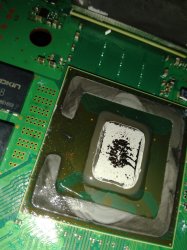
Yeah, your intuition is right, never use superglue. Is actually a triple fail because the intitial idea of achieving a superstrong attachement is not going to allow you to replace the thermal paste ever again. Is also a fail because after some tenths of heating cycles it becomes "crackable"... like melted sugar, very fragile
Also when the superglue is heated it emits some vapours that are toxic and corrosive, that vapours could damage other components

There are other thermal adhesives that becomes rock solid when cured... but thats another bad idea because doesnt allows to replace the thermal paste ever
Additionally... if you made some mistake when applying/curing the thermal adhesive (lets say... some part displaced a couple of milimeters) you are done, lol, because is imposible to "unglue" it
Is the kind of mod that cant be reverted

So you need to use some silicone similar to the factory one, there is no need to get picky and spend lot of money with it, the only goal is to keep the metal IHS in his place (and being soft enought to cut it easilly the next time you have to replace the thermal paste)
I use to suggest a silicone used in automotive to seal engines, is non-electrical conductive, resists the heat very well, and have a good density... and is cheap and very easy to find locally, the brand doesnt matters
 
Yeah, your intuition is right, never use superglue. Is actually a triple fail because the intitial idea of achieving a superstrong attachement is not going to allow you to replace the thermal paste ever again. Is also a fail because after some tenths of heating cycles it becomes "crackable"... like melted sugar, very fragile
Also when the superglue is heated it emits some vapours that are toxic and corrosive, that vapours could damage other components

There are other thermal adhesives that becomes rock solid when cured... but thats another bad idea because doesnt allows to replace the thermal paste ever
Additionally... if you made some mistake when applying/curing the thermal adhesive (lets say... some part displaced a couple of milimeters) you are done, lol, because is imposible to "unglue" it
Is the kind of mod that cant be reverted

So you need to use some silicone similar to the factory one, there is no need to get picky and spend lot of money with it, the only goal is to keep the metal IHS in his place (and being soft enought to cut it easilly the next time you have to replace the thermal paste)
I use to suggest a silicone used in automotive to seal engines, is non-electrical conductive, resists the heat very well, and have a good density... and is cheap and very easy to find locally, the brand doesnt matters

I just watched this video


it seems like adding thermal paste between the heat spreader and the heat sink and pressing on it is a good alternative. I'll try this first it seems simpler especially in case of needing a rework, though putting pressure on it will probably be the hardest part, as we gotta make sure the heat spreader won't move at all
 
I just watched this video


it seems like adding thermal paste between the heat spreader and the heat sink and pressing on it is a good alternative. I'll try this first it seems simpler especially in case of needing a rework, though putting pressure on it will probably be the hardest part, as we gotta make sure the heat spreader won't move at all
I was going to look for that video haha. It's the same method I use with all my consoles, I know that some people will not agree with this with several arguments as "bgas not having the same "stiffnes" " but I like to have a flotant IHS on my processors, imo bgas are less prominet to suffer deformations in that way, but I obviously could be wrong..
 
I just watched this video


it seems like adding thermal paste between the heat spreader and the heat sink and pressing on it is a good alternative. I'll try this first it seems simpler especially in case of needing a rework, though putting pressure on it will probably be the hardest part, as we gotta make sure the heat spreader won't move at all
In general i would say is fine, because the layers of thermal paste are very thin, so the thermal transfer in between the metal pieces is very efficient

That adhesive effect is pretty much the same that happens if you take 2 glasses (kind of flat glases used in windows) and you join them together with a water drop... after that is very hard to separate them because the water is doing a "suction" effect... maybe a bad example becuse the water would evaporate at some point, but with some other material more dense (like honey, or thermal paste) the attachement is super strong

I was going to look for that video haha. It's the same method I use with all my consoles, I know that some people will not agree with this with several arguments as "bgas not having the same "stiffnes" " but I like to have a flotant IHS on my processors, imo bgas are less prominet to suffer deformations in that way, but I obviously could be wrong..
Yeah, thats the argument against it, in the factory design there is some of the pressure "spreaded" to the borders, but in this mod 100% of the pressure is applyed to the DIE (so the borders of the substrate are "floating" and are going to be a bit more prone to wrap)
 
So I did this today.

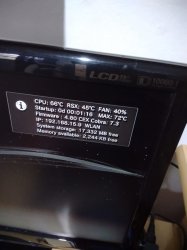
The good news is that it worked great - deliding was flawless and the console went from reaching 85ºC in 30s to keeping a "cool" 67ºC on the XMB.
The bad news is that its YLOD came back :\ I tried turning it on yesterday evening to see if I had to delid the RSX as well, but it turned itself off within seconds, flashing a yellow light for 1 second and then blinking red, which I attributed to the overheating. After I was finished today I tried turning it on again and I got the same behavior, unfortunately. I tried like a dozen of times until it eventually booted, so that's how I know it's running better temps now. Unfortunately it turns itself off without warning or anything after a few seconds, a minute at most. I was tracking the temp and it the CELL never surpassed 70º, and the RSX didn't get hotter than 45ºC, so it's definitely not overheating. This unit (a CECHL) had had YLOD like 5 years ago, but it was different - at the time, it either didn't turn on at all and the LED kept blinking yellow, or it would turn on and function normally.Guess its age finally got to it.
I'll post a few pictures and tips later when I'm feeling less defeated. I loved this method, though, it's completely fail-safe in my view.
 
Okay, I want to share my experience here because I thought it was really interesting and hopefully it'll help someone in the future.
This is a CECHL01 unit I got as a teenager in 2009, but it had been YLOD'ing on-and-off since 2013-14 IIRC. After I put CFW on it the YLOD wasn't as much of a problem, but then it started overheating. Now that I solved overheating YLOD became a problem again xD Anyways, before delidding it reached 80-85ºC in a matter of seconds after booting.
So, for the procedure I first disassembled my PS3 - damn, there's a lot of screws! I forgot how many times I did this already. some screws are almost stripped already, a sign of how many times I've used a bad screwdriver to take them out. After cleaning the CELL IHS, I put on some gloves and started cutting. I lost a bit of time here because I didn't realize that the IHS has a little "step" so I kept rubbing wire on the IHS thinking it was silicone hahaha. After I realized this, I was surprised at how fast it was - maybe 20-30 minutes was enough to make a good >5mm entry in each corner.
After working through the corners a bit I tried to "link" these cuts I had made by cutting on the sides. The problem is that on the sides the contact area is too big, so it becomes hard to move the wire back and forth - the end result is that the wire breaks. A LOT. I made a bunch of pauses to go to the bathroom, lunch etc but if I had to guess I probably lost 1h30 on this part of the process alone. It was only then that I realized that I could use WD 40 as someone mentioned. I wish I had used it sooner! After using WD40 it took me maybe 20 minutes tops to finish the job. The way I did it was spray WD 40 to a side and immediately put the wire on that side so it would lubricate. It broke only once, because I hadn't lubricated enough. Seriously, it was THAT helpful and I wish I had used it from the beginning. You can feel when the side has been cut as the wire makes a small jump. I didn't even need to use a cutter or anything to try and pry the IHS off, the wire cut right through the silicone and the IHS just popped out of place.
after finish.jpeg
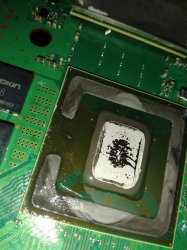
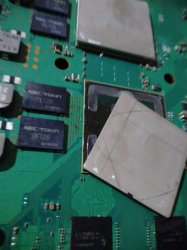
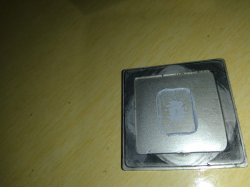
This is right after cutting. WD 40 residues aside, it's amazing how CLEAN this cut it. there was barely any trace of silicone on the IHS.
IHS inner.jpeg
You can see just how BAD the thermal paste was on the chip, there was barely any left, too.
terrible paste.jpeg
And... the final result. It didn't get much hotter than this, althought it wasn't turned on for a long time either.
temp.jpeg

To conclude, I really liked doing this. Although I wish I had used wd40 sooner, it was worth it as it pretty much solved my overheating problems. To solve the YLOD I think I'll try replacing the NEC TOKIN capacitors next, when I feel like it. Not like I have much of an alternative anyway!
 
Nice photos, and yeah kudos for the delidding with a wire, it seems it went very well :encouragement:
The only critic i would say is that is not needed to spray WD40 so rudelly... i think is a lot better to drop a good amount of lube somewhere else (lets say, a cap from a bottle or some flat surface) and then "wet" the wire in it as many times is needed
You know... cut a bit for 2 minutes... then take the wire out to "wet" it all along... and return to the cutting for another 2 minutes... and so on

I dont remember if i mentioned it in this thread, but there is a solid vaseline sold in tubes easy to find in a local drugstore. It have the density of a cream (so you can drop a bit in a plastic to wet the wire in it) and is chemically neutral so is not going to cause any damage to the electronics
Incase of abusing with the lube (either because the work was frustrating or just because was not made with much care) you could cleanup the motherboard with isopropil alcohol, this doesnt causes any damage either and is always good to remove any substance because otherway it would attract dust

About the YLOD... well, there are no strict rules, but if is intermitent (sometimes the console boots, but sometimes doesnt) it could indicate that is related with power components... and the tokins are critical in the power lines, lets say... with bad tokins the power lines of CELL/RSX becomes unestable
Usually this kind of failure displays a YLOD in every boot... but your case could be a bit special, lets say... your power lines are in the borderline of what is considered "good" or "bad" so sometimes boots and sometimes doesnt
The weird detail is you are telling it was doing randoms YLODs many time ago, if we consider it was a unestable state is imposible to stay in this exact same state for many time
 
Nice photos, and yeah kudos for the delidding with a wire, it seems it went very well :encouragement:
The only critic i would say is that is not needed to spray WD40 so rudelly... i think is a lot better to drop a good amount of lube somewhere else (lets say, a cap from a bottle or some flat surface) and then "wet" the wire in it as many times is needed
You know... cut a bit for 2 minutes... then take the wire out to "wet" it all along... and return to the cutting for another 2 minutes... and so on

I dont remember if i mentioned it in this thread, but there is a solid vaseline sold in tubes easy to find in a local drugstore. It have the density of a cream (so you can drop a bit in a plastic to wet the wire in it) and is chemically neutral so is not going to cause any damage to the electronics
Incase of abusing with the lube (either because the work was frustrating or just because was not made with much care) you could cleanup the motherboard with isopropil alcohol, this doesnt causes any damage either and is always good to remove any substance because otherway it would attract dust

About the YLOD... well, there are no strict rules, but if is intermitent (sometimes the console boots, but sometimes doesnt) it could indicate that is related with power components... and the tokins are critical in the power lines, lets say... with bad tokins the power lines of CELL/RSX becomes unestable
Usually this kind of failure displays a YLOD in every boot... but your case could be a bit special, lets say... your power lines are in the borderline of what is considered "good" or "bad" so sometimes boots and sometimes doesnt
The weird detail is you are telling it was doing randoms YLODs many time ago, if we consider it was a unestable state is imposible to stay in this exact same state for many time

you are right, I made a mess! I tried spraying just a little but I'm not very gentle so I ended up soaking the whole thing. I did clean up with alcohol afterwards to completely remove the lubricant, I think there may be some solvents there that aren't great for the components.
Your idea about using vaseline or putting the lubricant in another container is a good tip and would be much better to avoid making a mess like I did.

From what I've read around here, it seems I do have a chance to fix this by changing the capacitors. I've seen other people mention that their PS3s had similar behavior before changing the caps. I do think it is power related. Another possibility could be the PSU, but I'm not sure how prone to failure they are, so it seems the caps are the most likely culprits. Since this unit is pretty much useless as it is right now, I don't think I have much of a choice hahaha
 
Yeah, thats the argument against it, in the factory design there is some of the pressure "spreaded" to the borders, but in this mod 100% of the pressure is applyed to the DIE (so the borders of the substrate are "floating" and are going to be a bit more prone to wrap)
Hmm, from what "I could see", the area contact is still the same, but now the IHS is "loose", and now it can slide from all over the pcb, but since we're sticking it to the heatsinks, it's the same effect in my oppinion. By doing this we get two advantages:

1) We're reducing the gap die/IHS, and reducing the amount of tim, which will prevent the old CELL overheating issue, at least it will give you a wider window of time compared to the factory design, which is crap along with many aspects of the console, as disipation design, OG tdp and of course our beloved friends, the NTokins.

2) Forget about destroying the bgas or wasting a lot of good quality compound when opening the console, even more if you need to fix something else.

Btw, if you present the IHS over die without the thermal compound, you'll notice the IHS is still making contact with all the pcb periferia, by no any means your releasing all the pressure over the die, same as the RSX. At least is what I saw.

When putting the clamps again, these go down as always, I guess.

_____________________________

@pguisa It seems you experienced what I experienced. It felt like a deja vu to me :D

It looks like you have bad tokins, you can confirm this with the syscon analysis.

37044-c6fd17e3ef6e021c3309715cc44b8b22.jpg


The infamous air mattress.
 
Btw, if you present the IHS over die without the thermal compound, you'll notice the IHS is still making contact with all the pcb periferia, by no any means your releasing all the pressure over the die, same as the RSX. At least is what I saw.
But not completly, there is a gap of 0.1mm or 0.2mm (a bit bigger than the diameter of the wire we use to insert in that same gap)
In the factory design that gap is filled with the silicone all around... that have a good density... but is flexible
In theory the silicone helps the substrate a bit to remain flat because it spreads the pressure a bit to the peripheral... but this is controversial, personally im not so sure

Anyway... thats the reason why RIP-Felix was considering in building some kind of "stiffener" made of solid plastic
When i was discussing this with him i mentioned that there are 2 ways to do it, either filling this "gap" we are talking about... or by trying to preserve also the gap of the BGA balls (distance in between the substrate and motherboard surface), this way we could prevent the BGA balls to get squeezed or streched
But as i said in the other discussion im not so sure if this kind of stiffeners could work as expected because we are talking about fractions of milimeters, on paper is sounds good but in the practise is almost imposible to achieve this kind of precission adjustments
 
What about putting it all back together? How do you make the lid stay in place after pasting? I'm thinking maybe a little dot of glue in each corner on top of the silicone.
 
What about putting it all back together? How do you make the lid stay in place after pasting? I'm thinking maybe a little dot of glue in each corner on top of the silicone.
Yep, for CELL you can drop 4 dots of silicone at the corners, or a ribbon all around (in the same way is made at factory), but i prefer the dots because are easy to "cut" them later incase is needed to repaste it

RSX have 4 VRAM chips at the corners, from factory it have dots of (solid) thermal paste in them, but the silicone is good enought

Use a silicone designed to resist high temepratures btw, i use to mention there are some used in car engines cheap and easy to find locally
There are some thermal silicones with metal particles (electrical conductive), with good thermal transfer but better dont use them because could be risky
And dont confuse silicone with silicon (a mineral)
 
Yep, for CELL you can drop 4 dots of silicone at the corners, or a ribbon all around (in the same way is made at factory), but i prefer the dots because are easy to "cut" them later incase is needed to repaste it

RSX have 4 VRAM chips at the corners, from factory it have dots of (solid) thermal paste in them, but the silicone is good enought

Use a silicone designed to resist high temepratures btw, i use to mention there are some used in car engines cheap and easy to find locally
There are some thermal silicones with metal particles (electrical conductive), with good thermal transfer but better dont use them because could be risky
And dont confuse silicone with silicon (a mineral)
Thanks bro. Guess I'll be heading over to my local auto parts store for some high temp engine silicone.
 

Similar threads

Back
Top