PS3 Fault finding YLOD with the SYSCON - First steps and Error reporting

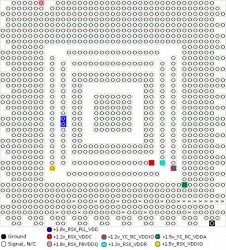
I updated the following RSX Pinouts to have the same color code. It was confusing to use them for cross-reference before.
RSX Pinout MB View.jpg
RSX Pinout RSX View.jpg
RSX PWR.jpg

Also here are some resistance measurements I took of a 90nm and 40nm RSX. I can't guarantee they are good, but they look okay. I also added a 65nm RSX that looked OK, thanks to @SkaziChris who measured it. Please note that these were probed at the following testpoints...
RSX Ohm Test Points.jpg
RSX Ohm Test Results (40nm vs 90nm).JPG
mb_ohm_test_points-jpg.36295
 
Last edited:
@SkaziChris's voltages:
+1.2V_RSX_VDDC = 2.5 Ohm :)
+1.2V_RSX_VDDR = 0.53 kOhm :)
+1.2V_YC_RC_VDDIO = 1.44 kOhm :concern:
+1.5V_RSX_VDDIO = 0.815 kOhm :concern:
+1.5V_YC_RC_VDDA = 0.264 MOhm :concern:

+1.8V_RSX_PLL_VDD = 0.63 MOhm :concern:
+1.8V_RSX_FBVDDQ = 25 Ohm :(

@SkaziChris FBVDDQ is the RSX VRAM. Your reading is significantly lower than either of mine. I think that is good evidence of the BAD VRAM hypothesis. The first two look fine. The rest are suspicious. But there is a lot of variance between readings, meters, even which pad you probe. So IDK. I would say that VDDQ concerns me the most, given my readings and your console's history.
 
Well neither myself couldn't save 2 cok001 that been previous reworked. One special glod and is bumping around rsx, one bumped around xdr. Now will look for further boards, hopefully I get something around Europe. I thought would be like cok002 but seems like still pretty hard board to bring them back to life.
 
@SkaziChris's voltages:
+1.2V_RSX_VDDC = 2.5 Ohm :)
+1.2V_RSX_VDDR = 0.53 kOhm :)
+1.2V_YC_RC_VDDIO = 1.44 kOhm :concern:
+1.5V_RSX_VDDIO = 0.815 kOhm :concern:
+1.5V_YC_RC_VDDA = 0.264 MOhm :concern:

+1.8V_RSX_PLL_VDD = 0.63 MOhm :concern:
+1.8V_RSX_FBVDDQ = 25 Ohm :(

@SkaziChris FBVDDQ is the RSX VRAM. Your reading is significantly lower than either of mine. I think that is good evidence of the BAD VRAM hypothesis. The first two look fine. The rest are suspicious. But there is a lot of variance between readings, meters, even which pad you probe. So IDK. I would say that VDDQ concerns me the most, given my readings and your console's history.

Many thanks for that!!!
This is very useful for diagnostics - and time saving too!!!
I will let you know the readings of other RSXes once they arrive.

You can also look at that comparison:
https://docs.google.com/spreadsheets/d/1H9BguAR31xjSQVEFq1GERWioeHLlv7XShEVBeuZG3dQ/edit?usp=sharing


PS.
How did you guys remove the ram chips from RSX?
By scraping the chip off mechanically with a grinder or sth?
When I tried it once in the past... with hotair... well the RSX just turned to popcorn.

The only way I could think of... is to mechanically grind it out of the RSX, carefully... not to damage the rsx soldermask...
Then remove the balls, clean the pads, and just place new rams onto RSX.
They would get resoldered together with the rsx and the mobo...

Please let me know your experience with this part.
Thanks!
 
Last edited:
Many thanks for that!!!
This is very useful for diagnostics - and time saving too!!!
I will let you know the readings of other RSXes once they arrive.

You can also look at that comparison:
https://docs.google.com/spreadsheets/d/1H9BguAR31xjSQVEFq1GERWioeHLlv7XShEVBeuZG3dQ/edit?usp=sharing


PS.
How did you guys remove the ram chips from RSX?
By scraping the chip off mechanically with a grinder or sth?
When I tried it once in the past... with hotair... well the RSX just turned to popcorn.

The only way I could think of... is to mechanically grind it out of the RSX, carefully... not to damage the rsx soldermask...
Then remove the balls, clean the pads, and just place new rams onto RSX.
They would get resoldered together with the rsx and the mobo...

Please let me know your experience with this part.
Thanks!
Awesome, actual data! Yes, that's a good idea. The more measurments we have of different model RSXs, the better we can estimat what the normal range of resistance is. I like your legend that color codes them. I think I'll do something similar using formulas to automatically color code it.

I've never messed with the VRAM modules, but I think I remember someone did (@vyktormvmpay25 or @botakompong, I don't remember). The problem is the underfill requires too high a temperature to soften. You'll delaminate for sure.

You could try freeze shock. IDK how easy it is to get dry ice for you (in US we can get it in a supermarket). When super cold its easier to shear off. It might work, but I suspect a high risk of ripped pads. Dremmel is the probably the safest method.

But IDK how feasable replacing the VRAM modules is. Seems like alot of useless work, when you can just replace it with another one. There are NOS RSX's and you may as well install a CXD5301 using the Frankenstein mod. We dont need the 90nm RSX anymore.
 
Yes I've tried to erase rsx ram(with dremel and MF-70)but that is too sensitive. It takes to long. Is either work from first time or leave it aside. I am considering like that otherwise I'm in a loop with many fixes in queue.
Plus my selling company that I have to handle in same time.
 
Awesome, actual data! Yes, that's a good idea. The more measurments we have of different model RSXs, the better we can estimat what the normal range of resistance is. I like your legend that color codes them. I think I'll do something similar using formulas to automatically color code it.

I've never messed with the VRAM modules, but I think I remember someone did (@vyktormvmpay25 or @botakompong, I don't remember). The problem is the underfill requires too high a temperature to soften. You'll delaminate for sure.

You could try freeze shock. IDK how easy it is to get dry ice for you (in US we can get it in a supermarket). When super cold its easier to shear off. It might work, but I suspect a high risk of ripped pads. Dremmel is the probably the safest method.

But IDK how feasable replacing the VRAM modules is. Seems like alot of useless work, when you can just replace it with another one. There are NOS RSX's and you may as well install a CXD5301 using the Frankenstein mod. We dont need the 90nm RSX anymore.

Would it be possible to identify these pads marked in my post on other places on the motherboard?
I mean, places other than the pads themselves. Places around the rsx, or on the other side of the board.
You know... so that we could save time, and diagnose eg. too low resistance on the rsx core, or on rsx rams WITHOUT desoldering it.
I will try on the current board with the continuity mode...

I will try to look it up on the schematics.
 
We dont have schematics of the RSX itself. So the SMDs on the topside of the interposer is unkown territory. It would be great if we could probe them Rsx to find which pad is in continuity, but that would take a long time.

What we need is an LGA socket dev/service board so we can test every pad at once. Its possable, but expensive.
 
You can use "paint remover" to remove the epoxy resine... there are many kind of paint removers but i mean a bottle like this
Is the kind of thing used to remove paint from wooden doors or windows and well... any paint on metal or whatever
00822965.jpg

The density is like jelly (not liquid), you need to apply it in the epoxy and wait 30 minutes or so
After 30 minutes take a look to see if the epoxy was weakened (it becomes like wax)
If is not weakened after 30 minutes you need to wait another 15 minutes and take another look... and another 15 minutes if needed

You know... is an slow process but you need to stay alert to the timings... otherway if you apply it and forget about it (up to the next day) it could cause some damage because is very "aggresive" chemically
Is like a solvent that is going to "eat" the materials generating some toxic vapours, so be careful

-----
Some revisions of the disc drive reader from the XBOX360 had a chip where you could solder a couple of wires to install one of the custom firmwares made by Commodore4Eva, microsoft realized it was a security flaw so in the next revisions of the XBOX360 they decided to cover the chip with black epoxy... and some time later people figured how to remove the epoxy with paint removal and the XBOX360 was hacked again
I think is a funny story because they was not really solving the problem... they was just dropping epoxy on top of it to "hide the security hole", lol
This method to counterfeit hackers by "hiding" traces sometimes works, but it needs to be made way better, lets say... a trace from a BGA pad that goes directly to an intermediate layer of a multilayered PCB board and only "emerges" under a BGA pad of a different chip, this way is imposible to probe or to solder a wire to it because is not visible at all, but what microsoft did with the epoxy is laughable
 
I've been testing years different paint/epoxy removal solutions, none can do it, years ago see iPhone 3g cloud removal was to erase with cnc one ic in epoxy (kind similar), if I find that video again from ages ago I'll refer it.
Last test was mg chemicals did not work.
23e450e67cb60aab9c895dd469076ac7.jpg
 
Hah, that's a good idea.
Totally forgot about the chemical ways to remove that...

Good thing I can test that out on faulty rsx'es before I attempt that on the "promising" one - just for fun... and knowledge.
 
Wow those RSX readings are awesome, I just did my first successful RSX reball on a E01 console and I am ecstatic. The second one I reballed was a GLOD and then it turned into a RLOD with 3034 RSX Syscon code. I would love to contribute to the research and work being done here as I thoroughly enjoy working on these consoles. I am extremely appreciative of all the info you guys give out and all the work you do. After now just finding these recent posts with RSX readings for the power lines and such I will be doing that after removing the chip and replacing. I generally live stream these repairs and hopefully I can also contribute to the data you are collecting. You can find my streams on youtube I go by "Computer Booter", any way I can contribute I would love to. I do know how to do the syscon readings and generally do them before any repair, I also have an oscilliscope but I honestly have no idea how to use it for the most part. Maybe one of you will pop into my live streams one day and bless me with some knowledge! :-)
 
I think we need to measure RSX and CPU power line resistances from working boards and put them into spreadsheet,
so that we can diagnose the fault without the need of desoldering the IC from the board (time consuming, risky, problematic).


If anybody has some readings from working boards (VER-001, SEM-001, COK... etc...),
please post them/gather them and I'd love to put them in the spreadsheet.

Somebody already started with similar stuff...

Os7GS51.jpg
 
I think that paint stripper gel is DCM (dichloromethane). We have all kinds of slovents at work I could try, but I really don't see the point. Alot of extra work for no upside. Just replace the whole RSX if VRAM goes bad. And replace with a more reliable/available model.

I finished collating the error codes posted on the syscon thread. Now Im going through the Tokin thread for codes posted there. Been noticing some trends. For one, certain 1802's = dead RSX (seems to depend on the step number). 2120/3013 = dead cpu (also depending on the step number). Once I'm finished with data collection and power topology I'll present my findings. Its just a big project and taking much longer than I anticipated.

About the SMDs around the RSX, yes you can probe them to get an idea of wherther or not that line is healthy, but it includes EVERYTHING in that line. So an unhealthy measurement doesn't narrow down the list much more than measuring voltages and using error codes. You should definaty chec them for continuity, to rule out shorts. That should be one of the first toubleshooting steps, along with checking fuses.
 
As best tool to test good 65nm and 40nm rsx on different boards swapping you can order these Frankenstein modchip orbis. Just faster than waiting for different parts or boards to match exactly. Easy to install with good microscope camera.
Once again when you install this modchip error 3034 and 4002 is confirmed to be wrong setup for modchip in my last dia002 with 40nm.
There also jig support for boards whenever someone work on caps or reflow /reball board should be kept as straight as possible. Otherwise it comes deformed and more work to desolder cell/rsx and bring back to straight position board before reball them back.
 
Last edited:
As best tool to test good 65nm and 40nm rsx on different boards swapping you can order these Frankenstein modchip orbis. Just faster than waiting for different parts or boards to match exactly. Easy to install with good microscope camera.
Once again when you install this modchip error 3034 and 4002 is confirmed to be wrong setup for modchip in my last dia002 with 40nm.
There also jig support for boards whenever someone work on caps or reflow /reball board should be kept as straight as possible. Otherwise it comes deformed and more work to desolder cell/rsx and bring back to straight position board before reball them back.

So... by rephrasing what you said...

In case I would want to diagnose that the RSX is the root cause of not working console,
I would attach a Frankenstain modchip
and if it starts working, then it is a 100% bad RSX?

I think not...
How does that rule out bad solder joints under RSX?
 
So... by rephrasing what you said...

In case I would want to diagnose that the RSX is the root cause of not working console,
I would attach a Frankenstain modchip
and if it starts working, then it is a 100% bad RSX?

I think not...
How does that rule out bad solder joints under RSX?
Well depends on what you want to test, not as permanent fix, just în case you want test different models to different boards. Examples 40nm are less sensitive to heat, you can add it on any bord.
Anyway your right there is no point using it if you are good with this type of work daily.
I'm not going to bother you with my advices.
 
I probed a couple more chips, another 40nm and 90nm. But I noticed a difference between them that confused me before. So I thought I would take a closer look. Apparently, the locations labeled PLL in blue are a bit different between these model revisions...
2.jpg

As you can see the 40nm reads OL in a couple of spots that the 90nm doesn't. So I made this probing chart to simplify the locations to test, so it'll always return a comparable value.
RSX Ohm Test Points.jpg
 
Last edited:
So... by rephrasing what you said...

In case I would want to diagnose that the RSX is the root cause of not working console,
I would attach a Frankenstain modchip
and if it starts working, then it is a 100% bad RSX?

I think not...
How does that rule out bad solder joints under RSX?
I think what he means is you can use the ORBIS modchip to install a more reliable 40nm or 65nm RSX on a 90nm MB. It spoofs the RSX ID at the right moment over SPI, tricking the SYSCON into believing the 90nm is still installed.

It's easier to source working 65nm and 40nm RSX's because there were more of these models manufactured. And there's still NOS CXD5301s available.
 

Similar threads

Back
Top