nevermind that sucksno cells are not pin compatible. different pinout between 90 65 45nm


nevermind that sucksno cells are not pin compatible. different pinout between 90 65 45nm

Just want to post this here. I may have before IDK. It's an update from the OP.It was a busy week, sorry for the delay. Nevertheless, I'm back with kind-of-hi-res photos of needed spots. And measurements.
Voltage divider:
View attachment 35007
R2002 is not black, it's a deep shade of blue, but certainly not light blue like two resistors below.
- R2001 - gone
- R2002 - 15.11 kΩ
VDDR:
View attachment 35008
Also 1, 2, 5 and 6 look like they have been resoldered.
- 1.237 kΩ (R6219)
- 1.241 kΩ (R6214)
- 294.5 kΩ (this must be a cap, C6207)
- 220.6 Ω (R6211)
- 1.354 kΩ (R6222)
- 1.571 kΩ (R6216)
Diagonal resistor is 9.96 kΩ.
Hope this helps!

Just want to post this here. I may have before IDK. It's an update from the OP.

As for cok001 Japan model it seems to work, i assume if one ps2 game started it should work for all of them? later probably user will add here in forum more details.
Rsx 40nm vdd line was 2 .1 ohms , botakompong compared with me and I agree that can work fine(rare case in kte001).Set on syscon fan to understand real potential,unit will stand at 28% cell wont pass 68 Celsius,rsx bearly reaching 50 celsius.This is kind of refusbished unit for untouched boards.
http://s.go.ro/ex9cncpb
no cells are not pin compatible. different pinout between 90 65 45nm
This is not correct as far as I'm aware. They are pin compatible but the reason it wont work is because the CELL is paired to other components on the board which CANNOT be swapped such as the NOR/NAND and syscon which are completely different.nevermind that sucks
Can the pairing key be extracted from decrypted syscon and then written to another with a cell graft? My dream would be to move the 25xx parts over into an A01 systemThis is not correct as far as I'm aware. They are pin compatible but the reason it wont work is because the CELL is paired to other components on the board which CANNOT be swapped such as the NOR/NAND and syscon which are completely different.
Just a quick note on this, I'm about 90% sure the reason they have that metal support bracket around them is just to protect the components from damage since they no longer use an IHS. The only anomaly there is the original 360s which originally didn't have an IHS, then they added them for the Trinity and Corona revisions, then removed it again for the Winchester rev.View attachment 35615
Has it escaped anyone else's attention that the PS4/5 APU has a support bracket around the edge of the interposer?
What do we know about the PS3? Oh yeah, it had issues with the YLOD! Hmm...
I just want to point out that the edges of the chip is where we are seeing the most BGA defects (FlexIO and VDDIO errors). Perhaps the purpose of this bracket (which add cost to the BOM BTW) is to provide support to the solderballs underneath.
Effectively there are 2 problems that cause YLOD:
For comparison sake...
- Bump failures = reduced to acceptable levels with better underfill and cooling. Perhaps by abandoning the diamond pattern that could cause tortional stresses as the interposer twists from the geometry mismatch.
- BGA failures = reduced with interposer support bracket, better soldering process, and better cooling.
View attachment 35616
Why is the PS3 CPU reliable then, you ask?
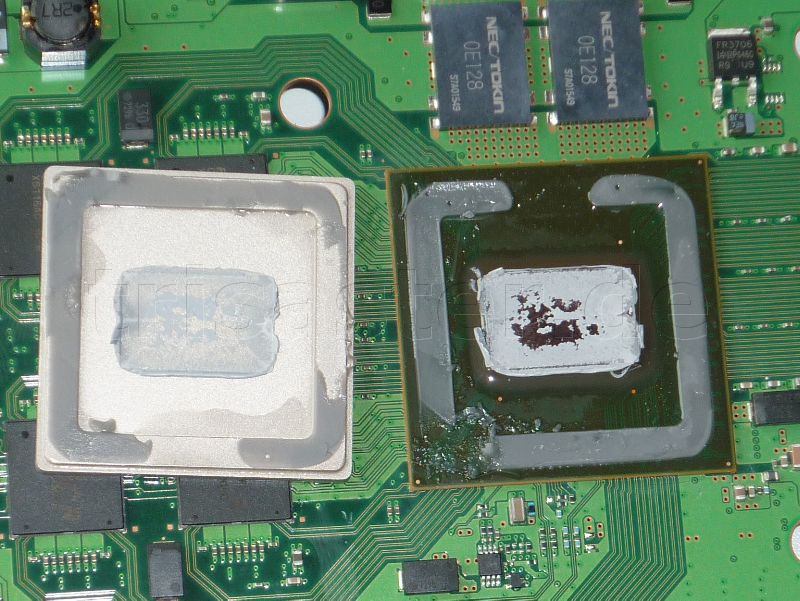
The CPU IHS has a ring and is silconed around the edge, effectively providing support.
This brings up a serious oversight and concern about delidding! We really should be gluing the IHS back on after repasting. Both the RSX and CPU IHS! With that in mind, then it changes the TIC decision for me immensely! I think a graphite thermal pad is the way to go. It can be taped (kapton) to the IHS so it never moves out of position and shorts anything out. It prevents die hot spots by transferring thermals laterally extremely fast. And it never degrades. It will perform the same forever, so the IHS can be glued down and never delidded again. You may even be able to silicone the RSX IHS down, to provide extra support for the interposer. Perhaps that wiould make the RSX more reliable. The downside is that graphite thermal pads don't transfer heat to the IHS as well as high quality pastes do. They're a few C worse. Not bad, mind you! They are still good, just not great.
You can do it on a device of the same model EG. COK-001 to COK-001 since they use the same syscon, NAND, and CELL but that doesn't matter for a 25XX or really any other model since they switched not only the syscon but also the NAND to NOR, both of which are NOT pin compatible.Can the pairing key be extracted from decrypted syscon and then written to another with a cell graft? My dream would be to move the 25xx parts over into an A01 system
This is not correct as far as I'm aware. They are pin compatible but the reason it wont work is because the CELL is paired to other components on the board which CANNOT be swapped such as the NOR/NAND and syscon which are completely different.
Oh yeah, that reminds me, they switched from a BGA setup on the original syscons to a QFP on the later models so you'd also need an interposer for that.Some of the pins functions were changed even in a 65nm Cell comparing to 90nm. So that would require an interposer
That may be a fringe benifit, but I'm sure the purpose is to stiffen the package against warpage. Every direct die cooled chip I've seen lately has one. XB360 was the only one without anything. RSX at least had the IHS glued to the VRAM for support. It's not enough, but it was better.Just a quick note on this, I'm about 90% sure the reason they have that metal support bracket around them is just to protect the components from damage since they no longer use an IHS. The only anomaly there is the original 360s which originally didn't have an IHS, then they added them for the Trinity and Corona revisions, then removed it again for the Winchester rev.
A support bracket is the best middle ground between protection for the die from cracking due to the weight and pressure from the heatsink, and the removal of the IHS for more direct cooling and a lower cost per chip.
The die on the PS3 doesn't actually touch the IHS directly due to the ~0.2mm (IDK what the actual value is) of thermal adhesive on the VRAM chips, if you remove this glue however the die does sit almost flush on the RSX.

You might want to take a look at more devices then, some do and some don't, it seems almost random.That may be a fringe benifit, but I'm sure the purpose is to stiffen the package against warpage. Every direct die cooled chip I've seen lately has one. XB360 was the only one without anything. RSX at least had the IHS glued to the VRAM for support. It's not enough, but it was better.


