PS3 (Research/Experimental) - NEC/TOKIN Capacitors Replacement - YLOD

Ok so I got these capacitors and replaced 2 of the RSX capacitors. I'm getting the RLOD, could that be caused by improper soldering or is it potentially because I'm trying to boot it with just the power supply and the power button/eject. I immediately get the RLOD, one time I tried without the HDD and then realized I was missing it and tried that. Should I try to add more parts?

https://www.ebay.com/itm/112825606213
 
@dydel I now saw your pic. NEVER make a jumper if you are not sure what it is gonna do. If you didn't already, remove those jumpers and please, like everyone doing this job, USE FLUX AND LENS

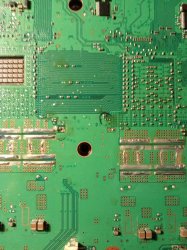
Today I was able to solder these 4 capacitors and 1 resistor which I broke off earlier. In addition, I soldered 16 new tantalum capacitors in place of four NEC TOKINs. I tried to solder them like damaged components with HOTAIR (thanks to which they would be soldered flat), but I gave up when at 380 degrees Celsius only a few soldered but I paid for it with flushing of the capacitor housing.
Of course, before I warmed up the plate (admittedly I used 200 degrees celcius but I was afraid to heat more)

- The console does not freeze on the PS Store
- It used to crash when loading Battlefield 1943, now it's okay
- The Last of Us: when I started the game just check if there are no glitchy as before, I left the game paused for 40 minutes -> the console turned off. Then I played over 2 hours non-stop -> everything OK.

Tomorrow fresh thermal paste, completely screwed housing and further tests. In general, thanks to this site, the console after 5 years in the closet will be useful for something :)
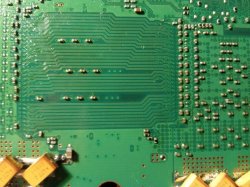
PS. The first picture is after soldering but before cleaning the motherboard from Flux. That is why there are such dark spots in 2 places.
 

Attachments

  • 89150836_491933785045386_2116278872348557312_n.jpg
    89150836_491933785045386_2116278872348557312_n.jpg
    97.3 KB · Views: 250
  • 89355337_515997739100191_7447157323404935168_n.jpg
    89355337_515997739100191_7447157323404935168_n.jpg
    577.2 KB · Views: 271
Last edited:
You very likely do not need a rebelling. This entire thread is basically a giant debunking of that being the main reason for the YLOD. Now, it does happen but it's been proven to *not* be the main fault causing it.
If you're heating up the NEC caps and the console works again for a bit, you very likely only need to replace those. It's likely that your chips and the solder balls beneath them are fine.


As for someone to do it for you, I'm not sure. I'd have to assume that any reputable electronics repairman/woman could do it given that it's not that hard of a job. I'm a novice at all of this and even I don't find it to be all that overwhelming. Now it's not easy for a beginner like myself but I knew pretty quickly that an experienced person could do it rather easily.

I say all that to say that you might want to consider trying it yourself if at all possible. If that's not an option, I'd have to assume most repairmen could and would do it if you explained the job.
Why? Well, as explained in the OP, the PS3 isn't the first device to need a replacement of those NEC Tokin capacitors. Toshiba laptops were renowned for this fault and the idea to do this to fix YLOD came from the laptop issue. So, it's a repair an experienced and/or busy repair service may have already done many times.

I'm not sure where you live but maybe call around and see what different businesses say. Yet, of you have tools it's a job you can do with some patience and a steady hand.

i don't want to do it coz i'm not a pro i will pay for who will fix it but i have another ps3 who works so good never have ylod should i remove its nec and replace them with tantalum
 
So after several hours of fixing and repairing I'm pretty close to being ready to attempt putting in the tantalum. Turned out my casaulty count of innocent caps was higher than I thought haha. Had to microsolder back in c2209,c2138,c2233 and c1486. One nice thing about everything being in short to ground when off is that it's pretty easy to test that the cap has a solid connection. Still need to finish off c2204 tonight/tomorrow. Then I'll be getting around to cleaning the main cap pads and putting in the Tantalum.

@ElGris
Thank you for your encouragement earlier on. Without your suggestion and encouragement I'm pretty sure I'd have junked this. The repairs won't win any beauty contests when I'm done. But I'm pretty proud of myself managing to get 4(of the 5 total innocents) hand soldered back in place with smd(harvested from a dead laptop). With any luck when all is said and done this cechA will come back to life.

In case anyone ends up making this same sort of flubs and then is trying to repair them make sure the pads are clean. Had a lot of difficulty getting c2209 soldered in place due to the tight confines. Keeping it clean made it a lot easier.
 
@Squiglemouse Nice! If you have problems with the soldering, you can you use your heatgun instead, with the small nozzle apply heat 400ºC and 30% of air flow. Sometimes the soldering iron is way too big for some components. Also you could use soldering paste, which is easier to use, but not that agile. Remember, always use flux.

When soldering the tantalums, keep in mind the common steps for the installation and you're ready to revive it! Also, don't know if you removed all the NECs, but if you didn't and you still get a YLOD, you're gonna need to remove all of them. If you have a multimeter with capacitance reader, check every tantalum before installation.
 
@ElGris unfortunately I don't have a capacitance reading multimeter(muh regret for cheaping out a year ago on my multimeter buy). I am tentatively going to remove all the Necs (will probably test with just all the back ones removed, but I sourced the caps from mouser so I'm not too worried).

But due to an abundance of concern I ended up sourcing some more smd 01005 caps(these things are so small and cheap that it costs more to ship than buy them!). The ceramic ones I had I didn't trust and I got cold feet in trusting anything from the dead laptop. So once more I delay myself by wanting to make sure I give it the perfect chance. Flux and a super fine tip iron are definitely mvp for this work.
 
@Squiglemouse Well, at least you can check if they aren't in short by using the continuity check. Some posts earlier I said one tantalum cap (those yellow ones that now I don't recommend because the the capacitance is less than it should) got damaged for no reason. The capacitance check will show OL, open circuit, and the cap wasn't in short either, but it was creating one. After I detected which one was the faulty, I replaced it and the console booted again.

Did you buy the same ceramic caps the mobo has? I was talking about these: https://storage.googleapis.com/stateless-www-faranux-com/2017/04/100nf-Ceramic-Capacitors.gif :D

It's the same and easier to find near your home for sure, and I believe you used the schematics of your old notebook to see the size of those caps, right? If that so, there's no problem, because I don't think those caps are bad.
 
@Squiglemouse Well, at least you can check if they aren't in short by using the continuity check. Some posts earlier I said one tantalum cap (those yellow ones that now I don't recommend because the the capacitance is less than it should) got damaged for no reason. The capacitance check will show OL, open circuit, and the cap wasn't in short either, but it was creating one. After I detected which one was the faulty, I replaced it and the console booted again.

Did you buy the same ceramic caps the mobo has? I was talking about these: https://storage.googleapis.com/stateless-www-faranux-com/2017/04/100nf-Ceramic-Capacitors.gif :D

It's the same and easier to find near your home for sure, and I believe you used the schematics of your old notebook to see the size of those caps, right? If that so, there's no problem, because I don't think those caps are bad.


Unfortunately I wasn't able to source the schematic of the laptop. Hence why my greater sense of caution won out. I did source ceramic disc caps but they just weren't thin enough that I felt safe trying to use them(with multiple of the spots being by the small feet that seat around the rsx/cell). So I ended up sourcing https://www.mouser.com/ProductDetail/81-GRM022R61A104ME1L . Again pretty cheap sourcing wise with the damn shipping being more than the caps. But as an upside it's perfectly in spec with the oem/schematic.

For the tantalum I'll definitely follow your suggestion to check they aren't in short. Not expecting to have issues given I didn't china special them(again sourced via mouser).

If I could find a schematic for the cech25xx I'd consider using my dead glod one to try and finish this repair. As it is I'll be waiting till monday most likely. But the priority is on repairing things correctly. The last thing I want is to repair it then short something and have the unit truly dead.

On a repair note this experience has cemented my views on the right to repair being more important with how corporations try and hide schematics so that consumers/repair folks can't do the labor.
 
Unfortunately I wasn't able to source the schematic of the laptop. Hence why my greater sense of caution won out. I did source ceramic disc caps but they just weren't thin enough that I felt safe trying to use them(with multiple of the spots being by the small feet that seat around the rsx/cell). So I ended up sourcing https://www.mouser.com/ProductDetail/81-GRM022R61A104ME1L . Again pretty cheap sourcing wise with the damn shipping being more than the caps. But as an upside it's perfectly in spec with the oem/schematic.

For the tantalum I'll definitely follow your suggestion to check they aren't in short. Not expecting to have issues given I didn't china special them(again sourced via mouser).

If I could find a schematic for the cech25xx I'd consider using my dead glod one to try and finish this repair. As it is I'll be waiting till monday most likely. But the priority is on repairing things correctly. The last thing I want is to repair it then short something and have the unit truly dead.

On a repair note this experience has cemented my views on the right to repair being more important with how corporations try and hide schematics so that consumers/repair folks can't do the labor.
Mouser.. that's not aliexpress, that's for sure. Good for you for picking up the right caps.

What happened to that cech25xx? If the CELL is damaged you can use some of the tantalums it has.

"On a repair note this experience has cemented my views on the right to repair being more important with how corporations try and hide schematics so that consumers/repair folks can't do the labor."

Indeed. On youtube you can find infinite videos about how cheap and crappy are these consoles every new generation. But I hope the best for the new PS5. Cross fingers people.
 
Mouser.. that's not aliexpress, that's for sure. Good for you for picking up the right caps.

What happened to that cech25xx? If the CELL is damaged you can use some of the tantalums it has.

"On a repair note this experience has cemented my views on the right to repair being more important with how corporations try and hide schematics so that consumers/repair folks can't do the labor."

Indeed. On youtube you can find infinite videos about how cheap and crappy are these consoles every new generation. But I hope the best for the new PS5. Cross fingers people.
The unit picked up glod after I was opening it to service it and in my impatience I think the rsx got enough stress placed on it to damage the bga(Seriously hate the sandwich style emi with the heat-sinks attached to them, combined with thermal paste acting semi glue like.). Honestly if I knew a good place that could give it a reflow I'd probably try that. If I could source a schematic for the slim I'd be more tempted to bum some of the ceramic smds from it.

Definitely like the metal build quality of the launch phat well above the largely plastic contstruction of the slim. It had some damage to screw holes I've had to repair with epoxy.

But yah schematics and right to repair. Super important and people should fight harder to make it a reality.
 
hello again, I thought and hoped that I am through with this topic, however, my ps3 simply turned off yesterday and wont turn on again.
I thought, because I only replaced 6 out of 8 NECs that I should now change the remaining 2 too.
So, I did, but nothing changed. I then added 2 more tantals to the RSX, resulting in 16 now on the RSX, but nothing changed.
The situation is not that I have 12 tantals on the CPU and 16 on the RSX. The space is very little, I dont know if I could add more to the CPU, but, if you think that it will help, I would try it.
My previous fix lasted about 2 Months and I was so happy :(
 
hello again, I thought and hoped that I am through with this topic, however, my ps3 simply turned off yesterday and wont turn on again.
I thought, because I only replaced 6 out of 8 NECs that I should now change the remaining 2 too.
So, I did, but nothing changed. I then added 2 more tantals to the RSX, resulting in 16 now on the RSX, but nothing changed.
The situation is not that I have 12 tantals on the CPU and 16 on the RSX. The space is very little, I dont know if I could add more to the CPU, but, if you think that it will help, I would try it.
My previous fix lasted about 2 Months and I was so happy :(
What kind of caps did you use? You are having an instant YLOD? If you have some more new tantalums, remove the ones you applied and use those. Maybe some are damaged. It's the only thing you can do about this tutorial, as the rest of the problems are related with bad bga contact, some fuse damaged or even the RSX in short/damaged.
 
Remove all of them
Clean the rails
Measure the tantalums so you have the right UF for every token replaced (-/+1200)
Try to put them back neatly placed and to avoid any bridging.
Change all tokens dont leave anyone behind.
Add the wires +/+ when you are done.
Close up and fire the ps3 up.

Στάλθηκε από το POCOPHONE F1 μου χρησιμοποιώντας Tapatalk
 
Ok, i removed them, I changed the new ones to the RSX and all the others are on CPU side. Now I have a fully 32 Tantals soldered in.
It seems to work, but it terribly smells like somethin is burning inside of the PS3. It comes from the ventilation holes. Looks like, I have to take it apart again :/

PS: I once tried it with 30 tantals installed, but forgot to connect + to + on one side of the CPU. It took the ps3 a little longer to YLOD, but it behave differently. Did I break something and thus the smell?
 
Ok, i removed them, I changed the new ones to the RSX and all the others are on CPU side. Now I have a fully 32 Tantals soldered in.
It seems to work, but it terribly smells like somethin is burning inside of the PS3. It comes from the ventilation holes. Looks like, I have to take it apart again :/

PS: I once tried it with 30 tantals installed, but forgot to connect + to + on one side of the CPU. It took the ps3 a little longer to YLOD, but it behave differently. Did I break something and thus the smell?

Sounds like maybe flux residue burning off? Maybe try cleaning both sides of the pcb using isopropyl and a soft bristle brush or microfiber cloth very gently?

Still if the unit is now functional that's great news!
 
Flux is conductive so if you didn't clean it after application you have most certainly burned a few circuits

Στάλθηκε από το POCOPHONE F1 μου χρησιμοποιώντας Tapatalk
 
Flux is only resine with some isopropyl alcohol. It isn't dangerous, bad soldering or bad components are, and since these chinese caps, the yellow ones, are bad quality, it wouldn't be a surprise if some of them would burn (again, for no reason).

If that's the case, it's a very dangerous situation. Better @hoyohoo check your tantalums before turning on the console.


On a PS3 you aren't applying voltage above the limit of the tantalum, so I don't think this could happen, since you have to apply the double of the limit, and sometimes a little more. But you never know..
 
I would suggest you stop playing a know it all role as sometimes this kind of attitude is catastrophic when trying to help people out.
"Conductivity - some fluxes remain conductive after soldering if not cleaned properly, leading to random malfunctions on circuits with high impedances. Different types of fluxes are differently prone to cause these issues."
Fact! See -> https://en.m.wikipedia.org/wiki/Flux_(metallurgy)

Στάλθηκε από το POCOPHONE F1 μου χρησιμοποιώντας Tapatalk
 
I would suggest you stop playing a know it all role as sometimes this kind of attitude is catastrophic when trying to help people out.
"Conductivity - some fluxes remain conductive after soldering if not cleaned properly, leading to random malfunctions on circuits with high impedances. Different types of fluxes are differently prone to cause these issues."
Fact! See -> https://en.m.wikipedia.org/wiki/Flux_(metallurgy)

Στάλθηκε από το POCOPHONE F1 μου χρησιμοποιώντας Tapatalk
I'm not playing any role, just pointing out what could be the problem. Seems you always want to be correct, and that's ok. I'm not here to say bullshit, only talking based on my experience, and I'm truly believe this isn't a "flux shorting the mobo" problem. Didn't you ask yourself why the majority of technicians that do a rework on a mobo, don't clean the residual flux in between the bga's? Ask Sony why they left residual flux in all their mobos too, maybe they can give you another opinion.
 
Back
Top