PS3 (Research/Experimental) - NEC/TOKIN Capacitors Replacement - YLOD

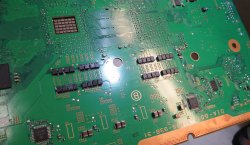
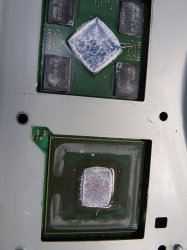
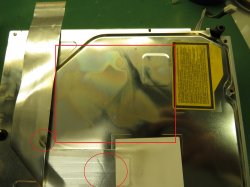
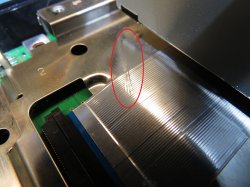
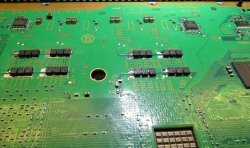
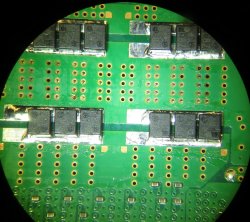
Finally got me caps in the mail. Had time to get started tonight with the CECHH machine from my prev. post. First experiment is to try strictly the tantalums to replace the four nec's i removed from it's backside. I started with 12 per chip, still had a fast YLOD and didn't boot. Tried adding four more just for the heck of it for 16 per chip. Still has YLOD, but I swear it remains green for at least a second longer than it did before. Might be wishful thinking, I hope not. The original nec's are still in place on the chip side of the board(if you haven't been following). Resistance measurements are still like they were in my prev. post, I still get one higher cap reading over the one group of the cell when measuring hot rail to hot rail. This one ~much~ higher reading might mean a problem with one of the caps underneath on the cell side?? I don't understand the electrical side much, more of a mechanical guy...Anyway, the surgery went alright I think. NOT an easy job, I really wish my caps had longer legs sticking out the sides like some do, but the cathode? one is nearly flush with the cap body, and makes visible confirmation of a good joint almost impossible. These appear to be meant for hot air install, but I'm hot air-phobic and used only my iron with large bevel tip at 700F. I had pre-tinned the contacts underneath and added some solder to my clean rails as well. Then soldered each side one at a time while pushing down on body of cap to finally sit flat on board. When reassembling for test, I noticed the underside of my BD drive shows signs of some heat discoloration, on the ribbon as well. I also noticed some possible damage to the ribbon cable in two spots I hadn't noticed before. Can someone tell me the bare minimum to reassemble for a test to see if YLOD went away? Does hdd have to be connected? Does BD drive have to be connected? I would think so if either of these being bad can be a cause of YLOD as previously mentioned? What about usb port board, or wireless thingy?
 

Attachments

  • Tried12Per.JPG
    Tried12Per.JPG
    570.9 KB · Views: 163
  • 12Close.JPG
    12Close.JPG
    391.9 KB · Views: 161
  • WentTo16Per.JPG
    WentTo16Per.JPG
    1 MB · Views: 165
  • ChipPaste.JPG
    ChipPaste.JPG
    513.7 KB · Views: 154
  • HotDriveAndRibbonDamage.JPG
    HotDriveAndRibbonDamage.JPG
    1.2 MB · Views: 157
  • BdRibbonDamage.JPG
    BdRibbonDamage.JPG
    962.8 KB · Views: 156
I don't know about the wireless daughter board, but neither HDD nor the BluRay drive need to be connected for the PS3 to boot. (It will simply show a message about missing system memory on the screen, but it won't YLOD)
 
Hello, I'm here seeking answers regarding the YLOD. I bought the 0E128 NEC Tokin caps brand new. Wondering is there evidence that suggests it's for sure the capacitors? Or could it be the design of the board that is draining the caps faster then expected?
I'm writing this because using tants isn't exact in any of the specs and if it's not for sure the tokens and is the design of the board. Is there something else that needs to be addressed to properly fix this issue.
I guess for me only time will tell. Hoping someone with the knowledge can clarify.
Thank you
 
@RIP-Felix Oh, those are the OG tantalums the newer PS3 use, nice. I didn't try yet filling a fattie or even a BC with those caps, I only tried a chinese ones (cancer) and a mix of those with some I got from a few SS boards I have here. It would be great to know how good the console can run with 4x470 per NEC, how much time of heavy use, and if this is the way to go. Instead of adding too MLC caps that we don't know if they are really necessary or not.

I didn't have time to read all the progress you guys made so far, it looks great though.

About the rework method you use, I recommend you to watch videos of how to set one of those rework stations, there're steps that you have to follow to preheat the zone and then apply heat from above. The important rule is not to lift if it's not loose, you can touch the processor to know if it's loose or not, otherwise you'll damage both things.
Finally got me caps in the mail. Had time to get started tonight with the CECHH machine from my prev. post. First experiment is to try strictly the tantalums to replace the four nec's i removed from it's backside. I started with 12 per chip, still had a fast YLOD and didn't boot. Tried adding four more just for the heck of it for 16 per chip. Still has YLOD, but I swear it remains green for at least a second longer than it did before. Might be wishful thinking, I hope not. The original nec's are still in place on the chip side of the board(if you haven't been following). Resistance measurements are still like they were in my prev. post, I still get one higher cap reading over the one group of the cell when measuring hot rail to hot rail. This one ~much~ higher reading might mean a problem with one of the caps underneath on the cell side?? I don't understand the electrical side much, more of a mechanical guy...Anyway, the surgery went alright I think. NOT an easy job, I really wish my caps had longer legs sticking out the sides like some do, but the cathode? one is nearly flush with the cap body, and makes visible confirmation of a good joint almost impossible. These appear to be meant for hot air install, but I'm hot air-phobic and used only my iron with large bevel tip at 700F. I had pre-tinned the contacts underneath and added some solder to my clean rails as well. Then soldered each side one at a time while pushing down on body of cap to finally sit flat on board. When reassembling for test, I noticed the underside of my BD drive shows signs of some heat discoloration, on the ribbon as well. I also noticed some possible damage to the ribbon cable in two spots I hadn't noticed before. Can someone tell me the bare minimum to reassemble for a test to see if YLOD went away? Does hdd have to be connected? Does BD drive have to be connected? I would think so if either of these being bad can be a cause of YLOD as previously mentioned? What about usb port board, or wireless thingy?

For testing any PS3's boot stage you don't need to attach the drive or hdd, or the BT pcb in your case. It's wierd, H's are very simple and easy to revive, I have at least 5 alive. But I remember I posted in this thread a case where I had to remove all the NECs on the RSX to actually make it boot, and said that that was the proof that NECs in bad shape can actually provoke a YLOD when they're installed. I removed the 2 left on the RSX side and the console booted. If you feel that the console has an extra moment of green light, then you're making progress. Other thing you can do is to use a heatgun and refresh ( :D ) the remaining NECs, that could be another way to find if the console is able to boot with the actual fix.

It's important to know if the console had dalayed YLOD and you went directly to the NECs, or it had instant YLOD. You could post a video (audio is important too) of how it's shutting off right now, 'cause I posted two videos comparing both situations some pages back.
 
Trying to catch up on the latest findings in the thread -- It sounds like we're trying to match the ESR of the added tantalums caps with what was provided by the original tokins. If that's correct, then the questions are:

* the per-cap ESR is provided in the datasheet of that particular cap. But how are we calculating the total ESR for the tantalums?
* Once we arrive at that total ESR, how do we translate total ESR into "I will need this many caps per tokin"?

I've seen mentions of an online ESR calculator, but I can't seem to find the link in the thread. Is that how we're calculating the values above?
 
@ElGris Yeah, I watched videoes for weeks before mustering the courage to try. I used a manual profile with timers and adjusting the height and temperature of the heat gun. It worked great for the RSX, but for some reason the CPU wouldn't let go even when the temp was WAY above the melting point. Something else was up, not sure what.

@Dylan w heat kill capacitors as well as all electronics. PS3 and XB360 ran far hotter than previous generations of consoles, thus they wear out faster. However, NEC/TOKIN proadilizers were known to go bad prematurely in many of the products (such as laptops) they were found in. That's what led to the idea that PS3 YLOD wasn't necessarily a ball grid array issue, which it still might be, but that's "apparently" less likely based on the finding in this tread. Overheating, due to bad thermal contact (aging thermal compound) causes more heat in the area adjacent to the CPU/RSX where the NEC/TOKINs are, and that will hasten their inevitable demise. Luckily, it "appears" this often happens before irreparable damage is caused to the BGA. So the theory goes.

So long as you replace the thermal paste (on both sides of the IHS), new NEC/TOKINs should work fine. However, the heat required to install them could easily damage the BGA under the CPU/RSX if you don't have the right equipment and know how.

@marciolsf the parallel resistance equation can be used for ESR of identical capacitors (ESR/# used), but not for caps of different sizes.
Working with an IR preheater or hot air to preheat the area will limit bad welds.

To answer your question, the smaller the capacitance the easier it is to find sufficiently low ESR caps. Low ESR is important for better efficiency and heat performance. 3.5mm caps don't require removing solder mask or soldering at an angle, but you can't find them above 330uF or perhaps 470uF. Also, ESR follows the Parallel Resistance Equation only for capacitors of equal value.

NEC/TOIKINs for example:
= 1 / [(1/R)+(1/R)...]
= 1 / [(1/1.5mΩ)+(1/1.5mΩ)...]
= 1/(4/1.5mΩ)
= 4800uF 0.375mΩ

So for example an equivalent ESR using 270uF 6mΩ ESR would be:
= 1/(18/6mΩ)
= 4860uF 0.333mΩ

You can't use the Parallel Resistance Equation like this unless you use identical caps. ESR can be calculated for dissimilar caps, but it gets more complicated. It's not just easier to use the same capacitors, but they will perform the same and last the same amount of time (on average).

@chugAlugDonnaWould you please post your resistance readings on the RSX/CPU between +/GND for posterity?

I can see some coiling in your solder. Looks like a roll of coins fell over. That means that just as you moved the iron the solder solidified before you took the iron off the pad. It can also mean that the solder underneath the pad did not make proper contact with the pad - potentially a cold solder joint. Although your work looks 90% better than most of the pictures I've seen here. So good job! Also, you did a pro job with the delid and cleanup of the thermal adhesive. Like a BOSS! This is what hot air is for. You want to sweep the iron across all the pads and have a wet, water-like puddle that solidifies all at once when you remove the heat. You can do it by increasing the heat on your iron or using hot air. Hot air is the lesser evil IMO, but others swear by the high iron temp method. YMMV.

As for your result, that's disheartening! For all the research I've done and picking (theoretically) the right caps, both of us are having problems. I hate to think I led you astray! This is good caution for anyone following this thread. THIS "FIX" IS STILL EXPERIMENTAL. I wish an engineer with and Oscilloscope would chime in....anyone...ANYONE? Well, until then I guess it's up to us.

Your 16x 270uF caps should be 0.375mOhms ESR and 4320uF. The remaining 2x NEC/TOKINs should be contributing some capacitance to make up the difference, but you're not booting. Hmm...

Hypothesis #1:
  • When I soldered in my caps I used Hot air. We (know?) that hot air can temporarily restore function to the NEC/TOKIN proadilizers. It's possible that the positive result I got was simply due to this phenomenon and not a true "fix." You didn't use hot air and removed both proadilizers on the backside of the board. So most likely the NEC/TOKIN prodilizers on the topside were sheltered from the heat and remain are in their original state. IF that state is failed and 16x 270uF TaPol ow ESR caps are not sufficient to prevent a YLOD, then this would explain both of our YLODs.
Experiment to confirm:
  • This weekend I will try removing the other NEC/TOKINs on the back side of my board and soldering in 18x 270uF TaPol caps. I should get the same result as you if this hypothesis is correct.
  • You could take some hot air to the NEC/TOKINs on your board to see if the console will Boot. I understand if you choose not to do this, but it would confirm that a YLOD can be fixed by nothing more than some hot air to the NEC/TOKINs. It would explain my initial success and show 4320uF worth of Low ESR TaPol are not sufficient.
Hypothesis #2:
  • It's possible the NEC proadilizers are interfering with the tantalum caps. Maybe they are creating an antiresonance peak that's counterproductive.
Experiment to confirm:
  • An oscilloscope would really help us see what's happening, but failing that we have to replace all the NEC/TOKINs and use bridge wires. If 18x 270uF (4860uF total) works without the NEC/TOKINs when it didn't with them, then the proadilizers were interfering.
  • If it still doesn't boot, this will answer definitively that 4860uF worth of TaPol is insufficient and we need to rethink the whole "Trust SONYs engineers and stick with 4800uF" thing. We are back to increasing the capacitance.
Hypothesis #3:
  • I already confirmed that 24x 330uF 9mOhm ESR TaPol (7920uF, 0.375 ESR combined) worked on PS3#1. It had artifacting that caused the console to freeze. I "assumed" this was due to an RSX issue that required a reball to fix. That's why I tried and failed. However, if the TaPol caps were not providing enough decoupling to prevent artifacting, but just enough to prevent the YLOD it's possible all that was at faults was that I needed to add more capacitance. I could have fit up to 32x or 10,560uF.
Experiment to confirm:
  • I do have more 330uF 9mOhm ESR caps that I can try. To achieve the same ESR I need to use 24x of them for a total of 7920uF.
  • Or you can just go for the 470uF caps that everyone else is reporting success with.
To those of you who have had success:
I would like to hear if any of those people had a recurring YLOD or not. How long has it lasted and how many hours of on time has it had since the fix. Have you tested PS1, PS2 and PS3 games extensively to thoroughly tax the system over multiple boot cycles and months of time. Most of the posts I've read say "it works, thanks." then they never post again with an update. It'd be nice if they'd check in and say, "been going strong for a year now with constant daily use" or "worked for a few weeks then it died again" or "been sitting on my shelf since I fixed it. I lost interest and have been playing PS4 ever since" or "fixed it to sell on e-bay, haven't had a complaint yet".

There's no shame in reporting the fix didn't last.
 
Last edited:
Thanks! It was easier than I realize. Based on the examples, for the 370ohm & 0.009ohm ESR caps I purchased, I should be aiming for 26 caps per tokin -- that would give me 0.34 ESR and a whopping 8580uF per tokin. Does that sound correct, or did i mess up the formula?

I think I only installed 8 caps per tokin... Again, if the formula is right, that's 1.125ohms, or a whole lot more than the 0.3 the tokins required.

@ElGris Yeah, I watched videoes for weeks before mustering the courage to try. I used a manual profile with timers and adjusting the height and temperature of the heat gun. It worked great for the RSX, but for some reason the CPU wouldn't let go even when the temp was WAY above the melting point. Something else was up, not sure what.

@Dylan w heat kill capacitors as well as all electronics. PS3 and XB360 ran far hotter than previous generations of consoles, thus they wear out faster. However, NEC/TOKIN proadilizers were known to go bad prematurely in many of the products (such as laptops) they were found in. That's what led to the idea that PS3 YLOD wasn't necessarily a ball grid array issue, which it still might be, but that's "apparently" less likely based on the finding in this tread. Overheating, due to bad thermal contact (aging thermal compound) causes more heat in the area adjacent to the CPU/RSX where the NEC/TOKINs are, and that will hasten their inevitable demise. Luckily, it "appears" this often happens before irreparable damage is caused to the BGA. So the theory goes.

So long as you replace the thermal paste (on both sides of the IHS), new NEC/TOKINs should work fine. However, the heat required to install them could easily damage the BGA under the CPU/RSX if you don't have the right equipment and know how.

@marciolsf the parallel resistance equation can be used for ESR of identical capacitors (ESR/# used), but not for caps of different sizes.


@chugAlugDonnaWould you please post your resistance readings on the RSX/CPU between +/GND for posterity?

I can see some coiling in your solder. Looks like a roll of coins fell over. That means that just as you moved the iron the solder solidified before you took the iron off the pad. It can also mean that the solder underneath the pad did not make proper contact with the pad - potentially a cold solder joint. Although your work looks 90% better than most of the pictures I've seen here. So good job! This is what hot air is for. You want to sweep the iron across all the pads and have a wet, water-like puddle that solidifies all at once when you remove the heat. You can do it by increasing the heat on your iron or using hot air. Hot air is the lesser evil IMO, but others swear by the high iron temp method. YMMV.

As for your result, that's disheartening! For all the research I've done and picking (theoretically) the right caps, both of us are having problems. I hate to think I led you astray! This is good caution for anyone following this thread. THIS "FIX" IS STILL EXPERIMENTAL. I wish an engineer with and Oscilloscope would chime in....anyone...ANYONE? Well, until then I guess it's up to us.

Your 16x 270uF caps should be 0.375mOhms ESR and 4320uF. The remaining 2x NEC/TOKINs should be contributing some capacitance to make up the difference, but you're not booting. Hmm...

Hypothesis #1:
  • When I soldered in my caps I used Hot air. We (know?) that hot air can temporarily restore function to the NEC/TOKIN proadilizers. It's possible that the positive result I got was simply due to this phenomenon and not a true "fix." You didn't use hot air and removed both proadilizers on the backside of the board. So most likely the NEC/TOKIN prodilizers on the topside were sheltered from the heat and remain are in their original state. IF that state is failed and 16x 270uF TaPol ow ESR caps are not sufficient to prevent a YLOD, then this would explain both of our YLODs.
Experiment to confirm:
  • This weekend I will try removing the other NEC/TOKINs on the back side of my board and soldering in 18x 270uF TaPol caps. I should get the same result as you if this hypothesis is correct.
  • You could take some hot air to the NEC/TOKINs on your board to see if the console will Boot. I understand if you choose not to do this, but it would confirm that a YLOD can be fixed by nothing more than some hot air to the NEC/TOKINs. It would explain my initial success and show 4320uF worth of Low ESR TaPol are not sufficient.
Hypothesis #2:
  • It's possible the NEC proadilizers are interfering with the tantalum caps. Maybe they are creating an antiresonance peak that's counterproductive.
Experiment to confirm:
  • An oscilloscope would really help us see what's happening, but failing that we have to replace all the NEC/TOKINs and use bridge wires. If 18x 270uF (4860uF total) works without the NEC/TOKINs when it didn't with them, then the proadilizers were interfering.
  • If it still doesn't boot, this will answer definitively that 4860uF worth of TaPol is insufficient and we need to rethink the whole "Trust SONYs engineers and stick with 4800uF" thing. We are back to increasing the capacitance.
Hypothesis #3:
  • I already confirmed that 24x 330uF 9mOhm ESR TaPol (7920uF, 0.375 ESR combined) worked on PS3#1. It had artifacting that caused the console to freeze. I "assumed" this was due to an RSX issue that required a reball to fix. That's why I tried and failed. However, if the TaPol caps were not providing enough decoupling to prevent artifacting, but just enough to prevent the YLOD it's possible all that was at faults was that I needed to add more capacitance. I could have fit up to 32x or 10,560uF.
Experiment to confirm:
  • I do have more 330uF 9mOhm ESR caps that I can try. To achieve the same ESR I need to use 24x of them for a total of 7920uF.
  • Or you can just go for the 470uF caps that everyone else is reporting success with.
To those of you who have had success:
I would like to hear if any of those people had a recurring YLOD or not. How long has it lasted and how many hours of on time has it had since the fix. Have you tested PS1, PS2 and PS3 games extensively to thoroughly tax the system over multiple boot cycles and months of time. Most of the posts I've read say "it works, thanks." then they never post again with an update. It'd be nice if they'd check in and say, "been going strong for a year now with constant daily use" or "worked for a few weeks then it died again" or "been sitting on my shelf since I fixed it. I lost interest and have been playing PS4 ever since" or "fixed it to sell on e-bay, haven't had a complaint yet".

There's no shame in reporting the fix didn't last.
 
Thanks! It was easier than I realize. Based on the examples, for the 370ohm & 0.009ohm ESR caps I purchased, I should be aiming for 26 caps per tokin -- that would give me 0.34 ESR and a whopping 8580uF per tokin. Does that sound correct, or did i mess up the formula?

I think I only installed 8 caps per tokin... Again, if the formula is right, that's 1.125ohms, or a whole lot more than the 0.3 the tokins required.
No, the OG NEC/TOKINs had at best 1.5mOhms ESR. 1.5 / 4 = 0.375mOhms. So 9mOhms ESR caps would require 24 caps to equal 0.375mOhms. 24 X 370uF = 8880uF total. Make sense?

EDIT: just noticed you probably meant 330mOhm caps instead of 370uF. So 24 x 330uF = 7920uF. I tried that, and it did work, but I got artifacting. Still unsure if that was due to chip needing a reball or if the capacitance was insufficient.
 
It does now, thank you! Ultimately, the combined ESR going into the RSX needs to be less than 0.375ohms, however many caps that takes.
It's like the 88mph for the ps3 :)

So really, worst case scenario, I just need to replace all 4 tokins with 24 tantalums, as long as I can get sufficient capacitance (at least 4800uf) AND .375ohm ESR (or less).

And yes, good catch, I did mean 330uF! It's interesting that you were getting artifacting at 7920uf. You'd think that's a power issue, but that's almost twice the amount of capacitance of the original tokins... Did you ever solve that particular issue?

EDIT: just reread your post and noticed that you weren't able to solve it. Too bad! Looks like I'm in the same situation as your ps3 #1, I'm going to get more 330uf caps and see where that goes.

No, the OG NEC/TOKINs had at best 1.5mOhms ESR. 1.5 / 4 = 0.375mOhms. So 9mOhms ESR caps would require 24 caps to equal 0.375mOhms. 24 X 370uF = 8880uF total. Make sense?

EDIT: just noticed you probably meant 330mOhm caps instead of 370uF. So 24 x 330uF = 7920uF. I tried that, and it did work, but I got artifacting. Still unsure if that was due to chip needing a reball or if the capacitance was insufficient.
 
Did you ever solve that particular issue?

EDIT: just reread your post and noticed that you weren't able to solve it. Too bad! Looks like I'm in the same situation as your ps3 #1, I'm going to get more 330uf caps and see where that goes.
Yeah, I solved it in the same way a these guys did...
 
OH, I just had a realization! @chugAlugDonna The NEC/TOKINs you and I removed are not contributing to the ESR anymore. This means the remaining NEC/TOKINs have a combined ESR that's higher than the specification! In my case I only removed 1 per chip and the system worked for awhile. 1.5mOhms/3 = 0.5mOhms ESR. You removed 2, so 1.5mOhms / 2 = 0.75mOhms. That resulted in a YLOD with even more of the same capacitors I used. The more NEC/TOKINs we remove the higher the ESR gets, no matter what we add. All the NEC/TOKINs have to go or the ESR will be higher than it's designed to be!

I can't believe I didn't think of that before.
 
Checking in for my quarterly review. I see a had a bunch of notifications, but I can't see the actual things they are about since they were too old, I just saw that I got them. If anyone still needed anything, send a PM.

There's just too many new posts for me to cover everything and hit all your usernames with the pertinent info, so I'm just gonna do a quick rundown and hope the right people see it. It appears this thread has gotten way too big, because I've seen a lot of questions asked that have been answered a hundred times, and the same misinformation is still being repeated. I may just copy and paste this every few months for visibility...

Someone said they wanted 'scope images, they're still on my signature.

The failed capacitors can only be identified by oscilloscope under load. All the ones I found read perfectly within specs for capacitance and ESR when out of circuit.

Heating the caps to get your system to work doesn't prove anything. Not only is there ZERO documentation or evidence anywhere that heating a POLYMER cap causes it to regain capacitance, missing capacitance isn't the problem in the first place. You're also flexing the board by microscopic amounts no matter how isolated you think you made the area you heated. It will just as easily give you a false positive from a mechanical re-connection of a cracked joint. I even heated one of the failed sets myself WHILE CONNECTED TO AN OSCILLOSCOPE and observed no change whatsoever in the signal. Please stop spreading misinformation that this test yields any meaningful results.

If you're bothering to do the repair, please replace all of the TOKINs at once. Do it right the first time. While the exact mechanism of failure still isn't clear to me, the failed capacitors need to be removed. I even verified this by moving a bad cap to a console that was running fine with a missing cap, and this caused it to YLOD. Missing capacitance isn't the problem - remember my videos of running just fine with half of the caps removed? There is some kind of short or something when under load, so the bad cap has to go, not just have more capacitance thrown at it.

I am still not convinced that electrolytics are actually "in" the circuit due to frequency/ESR/long wires. I again ask that any of you that ran wires and put some fat juicy 'lytics outside of the shielding do a small test for me. If your console is currently working, disconnect the electrolytics and try again. Let me know whether the console still worked. Same for when you reconnect it.

The burn marks once you pop the tops off the caps do not indicate that the cap is bad, no matter how burned they are. One of the bad sets I found looked brand new.

I can't stress this one enough - DO NOT USE PS3SPECIALIST EVER. I've been around the whole time this dude has been in business, and I've heard nothing except horror stories about him scamming people and stealing their consoles. I do NOT offer repair services on PS3 consoles directly, I buy them broken and sell them fixed. My business is not at all affected by him, so I'm not just trying to undermine my competition. There are literally hundreds of people that will back up any horror stories you've heard about him.

If you scratched your CPU and tore any traces while delidding, send me a PM if you are in the USA. If it's only one layer deep, I can take care of it. I only offer this to keep them out of the trash. I will not perform any other work for any reason, and there is no warranty or guarantee included with the repair.

If you want a reballed console (with photo evidence), I'll take yours in as trade, but I WILL NOT reball yours.

I have no idea what page it's on, but I've shown, with 'scope images, that you should be going as close to the original specs as possible. Obviously, less capacitance made the noise worse, but adding more than the original amount also made it worse.

Finally, I'm still sitting at something like 3 bad sets of TOKIN confirmed in about 100 dead consoles. Sorry, it's all BGA defects here. I haven't found another bad set of caps in 6 months or more, but I did slow down quite a bit over the summer to do some home remodeling and other projects. I'm just starting to get back up to speed, so hopefully I can find another one soon and confirm some data for you SYSCON folks.

PM me if you need anything, it goes to my e-mail. Otherwise, after a few days of replying to anything, I probably won't check in to copy and paste all of this again for another 6 months.
 
WOAH!,sqeept's back!

ElGris!- Alright, so for quick testing of if ylod is gone or not I can have just the fan in the bottom of the case, mobo sitting atop it, and psu plugged in? I wouldn't have to have the top metal sheild with the two CLAMPS over rsx and cell installed, correct? what about GND screw for the power switch wire? I swore I saw mentioned earlier that a bad hdd would give ylod, and am absolutely sure I saw that a bad BD drive will as well, that's why I thought these would have to be connected. Before just ripping off all the caps, I followed the suggestions I found here on earlier pgs. to try to rule out cracked bga, bad paste, and dead chips. I tried booting while pressing HARD over each and both chips, always still had ylod. I know paste isn't an issue, and I did resistance checks as suggested also. But I DIDN'T try a boot when all nec's from bottom were removed, guess I should've. Before removing any caps, it was hard to time one second before ylod, now it's at least 2, maybe 3. Does the heat damage to the underside of my drive look normal, or evidence of really bad heat seen?

pg124 tok replace psxplace01.jpg

pg124 tok replace psxplace02.jpg


RIP-Felix!-those weld-like beads on the sides of my caps are from a quick, "drag along" cleanup of those edges, just to beautify and spread out the excess solder without trying to braid it off after all caps were installed. I had the underside of the caps tinned, and the rails tinned, and made sure each cap eventually sat down flat on the rails. I did my best to ensure they actually soldered, but without leads protruding from the sides, it's really hard to tell! I am not disheartened, and do not feel led astray by anyone! I did my homework before buying or doing anything as you know. Also, this machine I would love to get going again because all the modded games and saves on it I no longer have access to, but I'm experimenting with it first, before doing anything to my[more important] dead launch machine. ALso, I'd planned all along to replace all nec's anyway, and if you remember WORKS 777 trials, he always had ylod until eventually having no mix of og nec's/tantalum replacements, either all new nec's or all replaced with tantalums, I don't think he had any success with any mixture IIRC. I did try hot air once, but only on the nec's I ended up removing, not on the ones chip side. I fear I'm too impatient for the proper ramp up and ramp down to try hot air, and am too fearfull of melting things, having things fall off...PLUS, they're all coming off eventually anyway, and didn't want to complicate any results from the use of heat for this cap replacement experiment.
I have access to big O-scope if someone can tell me what settings to use, and where to connect leads. BUT, without a boot at all, would it tell us anything?
I now have to think about my next steps with this machine, will have to decide on a bridging method now when I remove the nec's from the other side. COnsidering how many caps I currently have on this side of the board, how many more do you recomend I try on the other side when I get to it(still all nothing but the tantalums for this experiment)? When I get it back apart, I'll recheck resistance measurements, but they were just like (maybe a little lower) than my measurements I took after removing the four nec's, see below.
resistance is useless.jpg


Yeah, I've been thinking og nec's and tantalum mix don't play nice, also there is no way to know if one is truly bad on my other side mucking things up. I was also wondering about overall esr since there is now a mix, and since I've removed so many that keeps raising esr, but as I said I don't understand the electrical side very well. BUT, this is all an experiment after all, I could easily be overlooking something else, and as I said before, I did drop this machine onto a hard wood floor once, right on it's corner.
Oh BTW, I did check every fuse and themal link I could find, all checked out.
 
Checking in for my quarterly review. I see a had a bunch of notifications, but I can't see the actual things they are about since they were too old, I just saw that I got them. If anyone still needed anything, send a PM.

There's just too many new posts for me to cover everything and hit all your usernames with the pertinent info, so I'm just gonna do a quick rundown and hope the right people see it. It appears this thread has gotten way too big, because I've seen a lot of questions asked that have been answered a hundred times, and the same misinformation is still being repeated. I may just copy and paste this every few months for visibility...

Someone said they wanted 'scope images, they're still on my signature.

The failed capacitors can only be identified by oscilloscope under load. All the ones I found read perfectly within specs for capacitance and ESR when out of circuit.

Heating the caps to get your system to work doesn't prove anything. Not only is there ZERO documentation or evidence anywhere that heating a POLYMER cap causes it to regain capacitance, missing capacitance isn't the problem in the first place. You're also flexing the board by microscopic amounts no matter how isolated you think you made the area you heated. It will just as easily give you a false positive from a mechanical re-connection of a cracked joint. I even heated one of the failed sets myself WHILE CONNECTED TO AN OSCILLOSCOPE and observed no change whatsoever in the signal. Please stop spreading misinformation that this test yields any meaningful results.

If you're bothering to do the repair, please replace all of the TOKINs at once. Do it right the first time. While the exact mechanism of failure still isn't clear to me, the failed capacitors need to be removed. I even verified this by moving a bad cap to a console that was running fine with a missing cap, and this caused it to YLOD. Missing capacitance isn't the problem - remember my videos of running just fine with half of the caps removed? There is some kind of short or something when under load, so the bad cap has to go, not just have more capacitance thrown at it.

I am still not convinced that electrolytics are actually "in" the circuit due to frequency/ESR/long wires. I again ask that any of you that ran wires and put some fat juicy 'lytics outside of the shielding do a small test for me. If your console is currently working, disconnect the electrolytics and try again. Let me know whether the console still worked. Same for when you reconnect it.

The burn marks once you pop the tops off the caps do not indicate that the cap is bad, no matter how burned they are. One of the bad sets I found looked brand new.

I can't stress this one enough - DO NOT USE PS3SPECIALIST EVER. I've been around the whole time this dude has been in business, and I've heard nothing except horror stories about him scamming people and stealing their consoles. I do NOT offer repair services on PS3 consoles directly, I buy them broken and sell them fixed. My business is not at all affected by him, so I'm not just trying to undermine my competition. There are literally hundreds of people that will back up any horror stories you've heard about him.

If you scratched your CPU and tore any traces while delidding, send me a PM if you are in the USA. If it's only one layer deep, I can take care of it. I only offer this to keep them out of the trash. I will not perform any other work for any reason, and there is no warranty or guarantee included with the repair.

If you want a reballed console (with photo evidence), I'll take yours in as trade, but I WILL NOT reball yours.

I have no idea what page it's on, but I've shown, with 'scope images, that you should be going as close to the original specs as possible. Obviously, less capacitance made the noise worse, but adding more than the original amount also made it worse.

Finally, I'm still sitting at something like 3 bad sets of TOKIN confirmed in about 100 dead consoles. Sorry, it's all BGA defects here. I haven't found another bad set of caps in 6 months or more, but I did slow down quite a bit over the summer to do some home remodeling and other projects. I'm just starting to get back up to speed, so hopefully I can find another one soon and confirm some data for you SYSCON folks.

PM me if you need anything, it goes to my e-mail. Otherwise, after a few days of replying to anything, I probably won't check in to copy and paste all of this again for another 6 months.
See here folks, that's constructive criticism. I was just reading this, which explains this all quite nicely. Together with the oscilloscope images you linked these are the holy grail I was looking for! From the example PowerPC processors they provide, the one with the closest frequency in the GHz range to the PS3's Cell BE has a Z_Target of 2.2mOhms. That's a big piece of the puzzle. This is the highest ESR permissible for an array of bypass (decoupling) capacitors. Also, their example oscilloscope measurements for di/dt show the transient ripple in the 150mV range, which is about the range of the power spikes in your measurements for known good caps. So that checks out! Thanks for those BTW!

I suspected that the ripple and noise performance would get worse if one uses less or more capacitance, because of the RLC second stage filter SONY used. But without actually testing it with an O-scope I couldn't be sure. You say you measured it, and it indeed does? So that confirms the RLC Band is tuned with 4800uF in mind. It further reduces noise, but limit's our choice in caps. That's another big piec of the puzzle. @squeept is full of insight today!

Fascinating read. Thank you for the at nauseam regurgitation of old news for us illiterate newcomers, even though if felt more like a brawl beating than a gentile reminder...lol! Perhaps it would be advisable to link to the pertinent posts and resources in your regular monthly beat downs. If you take the time to mingle with mere mortals, you may as well dazzle us with ancient wisdom.

Lastly, if disinformation is really that big of a problem, then perhaps the initial post should be updated with links to the pertinent posts in the forum, so people can find the answers to common questions they are looking for (a FAQ) instead of sifting through it one page at a time for the literal weeks it takes to read it all. The first post mentions nothing of the work I've done in the last year and had to discover on my own. The available information is difficult to piece together to say the least. So I feel for anyone who gets lost and posts a question asked many times before. I've said my peace.
 
Last edited:
Sorry, I try to watch my tone here considering my history of being..... argumentative. I was just being "matter of fact" since there was a lot to cover.

You say you measured it, and it indeed does?

Found it, the images start on page 82. Someone posted the "make your own TOKIN" info somewhere between then and now. It seemed the smaller nm chips had a much tougher time with noise and you needed to toss some ceramic caps in the mix to clean it up more. I haven't tested that yet since I only buy backwards compatible models and they work fine with just the tantalums.


I have access to big O-scope if someone can tell me what settings to use, and where to connect leads. BUT, without a boot at all, would it tell us anything?

1us/div, 50mV/div, and the signal will be right around 1.2V good or bad. If you have a full on YLOD, you'll need to be familiar with the memory function of your 'scope so you can catch the couple of seconds before it turns back off.
 
WOAH!,sqeept's back!

ElGris!- Alright, so for quick testing of if ylod is gone or not I can have just the fan in the bottom of the case, mobo sitting atop it, and psu plugged in? I wouldn't have to have the top metal sheild with the two CLAMPS over rsx and cell installed, correct? what about GND screw for the power switch wire? I swore I saw mentioned earlier that a bad hdd would give ylod, and am absolutely sure I saw that a bad BD drive will as well, that's why I thought these would have to be connected. Before just ripping off all the caps, I followed the suggestions I found here on earlier pgs. to try to rule out cracked bga, bad paste, and dead chips. I tried booting while pressing HARD over each and both chips, always still had ylod. I know paste isn't an issue, and I did resistance checks as suggested also. But I DIDN'T try a boot when all nec's from bottom were removed, guess I should've. Before removing any caps, it was hard to time one second before ylod, now it's at least 2, maybe 3. Does the heat damage to the underside of my drive look normal, or evidence of really bad heat seen?

View attachment 28332
View attachment 28333

RIP-Felix!-those weld-like beads on the sides of my caps are from a quick, "drag along" cleanup of those edges, just to beautify and spread out the excess solder without trying to braid it off after all caps were installed. I had the underside of the caps tinned, and the rails tinned, and made sure each cap eventually sat down flat on the rails. I did my best to ensure they actually soldered, but without leads protruding from the sides, it's really hard to tell! I am not disheartened, and do not feel led astray by anyone! I did my homework before buying or doing anything as you know. Also, this machine I would love to get going again because all the modded games and saves on it I no longer have access to, but I'm experimenting with it first, before doing anything to my[more important] dead launch machine. ALso, I'd planned all along to replace all nec's anyway, and if you remember WORKS 777 trials, he always had ylod until eventually having no mix of og nec's/tantalum replacements, either all new nec's or all replaced with tantalums, I don't think he had any success with any mixture IIRC. I did try hot air once, but only on the nec's I ended up removing, not on the ones chip side. I fear I'm too impatient for the proper ramp up and ramp down to try hot air, and am too fearfull of melting things, having things fall off...PLUS, they're all coming off eventually anyway, and didn't want to complicate any results from the use of heat for this cap replacement experiment.
I have access to big O-scope if someone can tell me what settings to use, and where to connect leads. BUT, without a boot at all, would it tell us anything?
I now have to think about my next steps with this machine, will have to decide on a bridging method now when I remove the nec's from the other side. COnsidering how many caps I currently have on this side of the board, how many more do you recomend I try on the other side when I get to it(still all nothing but the tantalums for this experiment)? When I get it back apart, I'll recheck resistance measurements, but they were just like (maybe a little lower) than my measurements I took after removing the four nec's, see below.
View attachment 28334

Yeah, I've been thinking og nec's and tantalum mix don't play nice, also there is no way to know if one is truly bad on my other side mucking things up. I was also wondering about overall esr since there is now a mix, and since I've removed so many that keeps raising esr, but as I said I don't understand the electrical side very well. BUT, this is all an experiment after all, I could easily be overlooking something else, and as I said before, I did drop this machine onto a hard wood floor once, right on it's corner.
Oh BTW, I did check every fuse and themal link I could find, all checked out.
Well the ideal 4860uF 0.333mOhms ESR total be 18x 270uF caps. Since you already have 16 on the back side you only need 2 on the top side, which is kind of a problem. Ideally 2 tokins would be replaced with 4 TaPol, and the other 2 with 6, to evenly distribute them. Desoldering these once they are on is harder than getting them on, but once they are off there will be plenty of room for bridge wires.

Along with @squeept settings (I was about to post those and he beat me to it..lol), this document is a recommended read if you plan on scoping this circuit. They reccomend soldering a 50 Ohm wire soldered directly to a pair of BGA VIAs under the processor itself (to get the cleanest signal), but those are EXTREEMLY minuscule. However, once in place you do have a nice diagnostic cable coming off the PS3 for testing. I was thinking that soldering to the capacitor rails themselves would be easier, if a bit noisier. @squeept where did you probe?
 
Lastly, if disinformation is really that big of a problem, then perhaps the initial post should be updated with links to the pertinent posts in the forum, so people can find the answers to common questions they are looking for (a FAQ) instead of sifting through it one page at a time for the literal weeks it takes to read it all. The first post mentions nothing of the work I've done in the last year and had to discover on my own. The available information is difficult to piece together to say the least. So I feel for anyone who gets lost and posts a question asked many times before. I've said my peace.

I really wish we did -- there's so much we've learned since then, and at 141 pages, very few are likely to read through it all. It cracks me up how every now and then old arguments will resurface and I'll think "but didn't we settle this point already???"
 
Sorry, I try to watch my tone here considering my history of being..... argumentative. I was just being "matter of fact" since there was a lot to cover.


Found it, the images start on page 82. Someone posted the "make your own TOKIN" info somewhere between then and now. It seemed the smaller nm chips had a much tougher time with noise and you needed to toss some ceramic caps in the mix to clean it up more. I haven't tested that yet since I only buy backwards compatible models and they work fine with just the tantalums.


1us/div, 50mV/div, and the signal will be right around 1.2V good or bad. If you have a full on YLOD, you'll need to be familiar with the memory function of your 'scope so you can catch the couple of seconds before it turns back off.
Are you referring to this for the make your own?
pg128 tok replace psxplace tantalum+MLCCs 04.jpg
 
Well the ideal 4860uF 0.333mOhms ESR total be 18x 270uF caps. Since you already have 16 on the back side you only need 2 on the top side, which is kind of a problem. Ideally 2 tokins would be replaced with 4 TaPol, and the other 2 with 6, to evenly distribute them. Desoldering these once they are on is harder than getting them on, but once they are off there will be plenty of room for bridge wires.

Along with @squeept settings (I was about to post those and he beat me to it..lol), this document is a recommended read if you plan on scoping this circuit. They reccomend soldering a 50 Ohm wire soldered directly to a pair of BGA VIAs under the processor itself (to get the cleanest signal), but those are EXTREEMLY minuscule. However, once in place you do have a nice diagnostic cable coming off the PS3 for testing. I was thinking that soldering to the capacitor rails themselves would be easier, if a bit noisier. @squeept where did you probe?


Does this https://www.ti.com/lit/an/slva214a/slva214a.pdf have any relevance for us? Sorry if dumb question...I don't think I'll have any problem removing any of the caps I already installed, I also have a haako iron that's like a huge pair of hot tweezers for removal...If you can give me a picture of where to solder to what via's, I'm fine with trying...No stranger to soldering the very small. What would make a 50ohm wire, just a resistor on said wire?
 
I don't think that paper will help us. The wire would need to essentially be an oscilloscope probe. So a full shielded/insulated 2 pin wire with BNC on one end. I'm guessing a 50Ohm resistor is under the heat shrink in the photo on figure 4 of the link in my previous post. As for the vias, you'll have to reference the PS3 Schematic for a Vdd / GND. Choose one as close together as possible. But this is for super accurate results, and it may be fine to just connect to the rails.

Okay here are some parameters I think I have in the ballpark. These factor into the "bulk capacitor" choice (the NEC/TOKINS and/or tantalums to replace them):
  • dV, Maximum allowable change in voltage = 0.05V (general value)
  • I, Maximum Current Draw = 16A (if it draws more than this it'll pop your circuit breaker. Although it may be possible for the processor to transiently draw more than this, I'm not sure. I chose this number more or less arbitrarily, but could be wrong here.)
  • dt, Response time of the VRM = 14.2uS (tVmax on @squeept's o-scope measurement for the CPU)
  • C, capacitance = 4800uF
  • Z_target, maximum allowable ESR = 2.2mOhms (based on MPC7447A @ 1420 MHz, a similar PowerPC processor)
C = I X dt / dV = 16A (14.2uS / 0.05V) = 4544uF

Based on the above calculation, the choice of capacitors should be at least 4544uF and have a combined ESR lower than 2.2mOhms (as low as possible) to meet design goals. This information is based off section 3.3.1 in this document, pieced together with @squeept's measurments, an example PowerPC processors similar to the CELL BE in the PS3, and some of it is arbitrarily chosen as a best guess. The numbers are not set in stone, just ballpark. They are based on real world measurements and engineering (not hearsay), so it's more reliable than "I tried these and it worked."
 
Last edited:
Back
Top