think 18-20 is fine?14 to 16 gauge solid

You are using an out of date browser. It may not display this or other websites correctly.
You should upgrade or use an alternative browser.
You should upgrade or use an alternative browser.
PS3 (Research/Experimental) - NEC/TOKIN Capacitors Replacement - YLOD
- Thread starter Naked_Snake1995
- Start date
Lansingone
Forum Noob
I just finished this fix on a CECHA01 that a family member still had lying around. Fixed the ylod that it had. But, I've run into an old issue that I've only seen once before and I'm curious if anyone here has seen it. PS2 compatibility is broken. PS1, PS3, blu-ray, and DVD playback all work normally, but when you put in a PS2 disc and you see the ps2 disc appear on the xmb, if you try to boot it, you get a black screen that flickers between lighter and darker 5 times and settles on the slightly lighter black. No ps2 logo, but the PS button functions normally and you can change settings, reset game, or quit to xmb. Quitting to Xmb functions normally.
theres 8 nec tokins any one of them can fail its best to do them all. mine ylod a couple times because I just did the ones on the back. turns out it is the one on the frontRemoved 3 caps and replace with 470uf 16v capacitors 12 pieces
The YLOD is still same.
You mean , shall I flip the board and change the caps there too ?theres 8 nec tokins any one of them can fail its best to do them all. mine ylod a couple times because I just did the ones on the back. turns out it is the one on the front

Pacorretaco
Member
Hello all!
Im so happy to be part of a thread that is 150 pages long. Surely is because people keep coming to say thanks for the ultimate "fix".
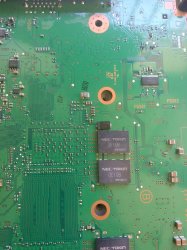
Well, thank you. I fixed an L model with a delayed (about 5 sec long) YLoD which had indeed a simple capcitor issue and now is working well.
Im so happy to be part of a thread that is 150 pages long. Surely is because people keep coming to say thanks for the ultimate "fix".
Well, thank you. I fixed an L model with a delayed (about 5 sec long) YLoD which had indeed a simple capcitor issue and now is working well.
Attachments
Pacorretaco
Member
I was mostly kidding of course.
If I am to thank @Naked_Snake1995 is because of managing to bring back hope and interest in giving these old machines yet another chance. And he did.
But the sad truth is, the original post is full of bullshit. And should be edited sooner or later.
90% of YLOD is no way due to capacitors sorry. Especially in the early 90nm models. I'd bet it's not even the opposite. Probably less than 10% is due to capacitors.
Just another beautiful lie good enough to get people excited. Which is also good, don't get me wrong.
Im no supertechnician at all but out of 6 C model ps3s... 0 are having capacitor issues. I can and will hopefully tell more details about each one.
But just the fact that this is at page #152 tells me I'm more right than wrong.
Cheers
If I am to thank @Naked_Snake1995 is because of managing to bring back hope and interest in giving these old machines yet another chance. And he did.
But the sad truth is, the original post is full of bullshit. And should be edited sooner or later.
90% of YLOD is no way due to capacitors sorry. Especially in the early 90nm models. I'd bet it's not even the opposite. Probably less than 10% is due to capacitors.
Just another beautiful lie good enough to get people excited. Which is also good, don't get me wrong.
Im no supertechnician at all but out of 6 C model ps3s... 0 are having capacitor issues. I can and will hopefully tell more details about each one.
But just the fact that this is at page #152 tells me I'm more right than wrong.
Cheers
IndeedYou mean , shall I flip the board and change the caps there too ?

Yugonibblit
PSX-Place Supporter
No,to smallthink 18-20 is fine?
how many amps go through each nec token. I have trouble believing its close to 10 amps each. 20 might be a bit too small your right. but 18 has a rating of 10 amps and 16 is 13 amps. If all the power in the psu went to the necs that'd be about 8 amps per wire since there would be 4 wires. So theres still a 20% seems within spec for 18awgNo,to small
Yugonibblit
PSX-Place Supporter
Do what you want then, you asked me?, people in earlier posts had problems with 18 gauge and lower do to the wire overheating and melting. It's up to u I always use solid house wire. Romex 3 conductor continuity is better with thicker wire and has a cleaner current flow. At least for this application my first experiment with wire was an old extension cord 2 conductor 14 awg. And I had no problems.how many amps go through each nec token. I have trouble believing its close to 10 amps each. 20 might be a bit too small your right. but 18 has a rating of 10 amps and 16 is 13 amps. If all the power in the psu went to the necs that'd be about 8 amps per wire since there would be 4 wires. So theres still a 20% seems within spec for 18awg

I just had some patio beers with my EE buddy... tossed him a scrap board, explained the basic issue, and sent him some 'scope images to look at. He basically said "I have no fuckin' idea but save the next bad one you get and we can do some experiments after covid." His guess was either that it's failing to filter some low frequency component that's messing with the feedback to the controller chips, or that there is some component like a diode built in to the cap that's failing that we just can't visually identify, which is pretty much in line with everything we've put together so far. But, he has access to a real spectrum analyzer, so next time I find a bad one to set aside post-covid, I think we might get an answer on HOW they fail, and that will help us build a solution for the non-BC consoles that are so temperamental.
But, since they're some kind of weird hybrid proprietary polymer caps, he still won't be able to explain to us WHY they fail. I guess that will be left to a physicist, a chemist, or someone that has access to NEC employees.
But, since they're some kind of weird hybrid proprietary polymer caps, he still won't be able to explain to us WHY they fail. I guess that will be left to a physicist, a chemist, or someone that has access to NEC employees.
Last edited:
I was mostly kidding of course.
There's only room for one doubting asshole in this thread. I choose me!

RIP-Felix
Senior Member
I think I know what he might have been referring to. When designing second stage filters, you have to be careful that your LC filters are past the remote sense lines on the DC-DC converter, or it can interfere with the internal control loop of the VRM....His guess was either that it's failing to filter some low frequency component that's messing with the feedback to the controller chips...
thank you that is the explanation I was looking forDo what you want then, you asked me?, people in earlier posts had problems with 18 gauge and lower do to the wire overheating and melting. It's up to u I always use solid house wire. Romex 3 conductor continuity is better with thicker wire and has a cleaner current flow. At least for this application my first experiment with wire was an old extension cord 2 conductor 14 awg. And I had no problems.
im excited to see what he comes up withI just had some patio beers with my EE buddy... tossed him a scrap board, explained the basic issue, and sent him some 'scope images to look at. He basically said "I have no fuckin' idea but save the next bad one you get and we can do some experiments after covid." His guess was either that it's failing to filter some low frequency component that's messing with the feedback to the controller chips, or that there is some component like a diode built in to the cap that's failing that we just can't visually identify, which is pretty much in line with everything we've put together so far. But, he has access to a real spectrum analyzer, so next time I find a bad one to set aside post-covid, I think we might get an answer on HOW they fail, and that will help us build a solution for the non-BC consoles that are so temperamental.
But, since they're some kind of weird hybrid proprietary polymer caps, he still won't be able to explain to us WHY they fail. I guess that will be left to a physicist, a chemist, or someone that has access to NEC employees.
Pacorretaco
Member
There's only room for one doubting asshole in this thread. I choose me!
Wise choice. And here I was thinking this thread was anything but small! Nice to meet you anyhow hehehe.
To be fair, there's no standard way of measuring assholes. After all, you seem to be the one bringing hope. With reballing yes?
As I said I'm just amateur.. stuck with a bunch of funny consoles.
But the thing I never understood is; if BGA defects are it, then why are they always under the RSX?
There's the same solder under the CELL BE, which also tends to run even hotter in these machines, yet very rarely it is causing any problems. Common sense would expect something more balanced.
Honestly I'd still love to have a chance at a reliable console again, as the original post cheekily implied. But after capacitors not being the answer... I can only hope one day we can "update" the SYSCON to accept newer RSX in earlier boards. More or less what Sony would do. Because the way I see it, no matter how well you bake the pizza, It will still be a choking hazard as long as the 90nm RSX is the main ingredient.
Cheers
But the thing I never understood is; if BGA defects are it, then why are they always under the RSX?
I can only hope one day we can "update" the SYSCON to accept newer RSX.
Maximum heat doesn't matter as much as the heat cycles. My pet theory on why the GPUs of various consoles tend to have more BGA defects is that they experience "mini heat cycles". The temperature seems to fluctuate during use more than the CPU, so they can go through tons of smaller heat cycles per session. Just a guess.
Once I get the next bad TOKIN so I can do some more testing, I intend to learn all of that syscon junk to verify a bunch of stuff from the syscon thread. With the help of the people from the "Frankenstein" thread where the guy had a real Sony made CECHA01 with a newer GPU, hopefully we can get it working. Seems pretty straightforward.
Similar threads
-
 PS3 Interesting PS3 Errors (1802, 1701, 1601) and Capacitor Replacement
- Started by Cheshire UK
- Replies: 2
-
PS3 CECHA00 with several SYSCON errors (3004, 1001,1002, 2120,3011)
- Started by LSL
- Replies: 7
-
PS3 A0801002 after 4 nec/tokin replacement (maybe Felix or anyone help me)
- Started by Swhalegod
- Replies: 3
-
Hello newcomer to the ps3 modding scene, needing help with syscon diagnostic
- Started by ascendantprime
- Replies: 1