PS3 (Research/Experimental) - NEC/TOKIN Capacitors Replacement - YLOD

So you've never have reballed console fail. That's what you're saying?

After they pass stress testing, it's very rare. The few returns I've mentioned / had pop up in this thread have been reballed consoles that lasted like 3 or more years and then had TOKIN failures.
 
After they pass stress testing, it's very rare. The few returns I've mentioned / had pop up in this thread have been reballed consoles that lasted like 3 or more years and then had TOKIN failures.
The stress of going through a proper reball probably greatly shortens the tokins lifespan (given their proximity to the heat). Perhaps you could start offering Tantalizers at a premium, once I finalize the design. That should pretty much take care of issues untill the bumps go bad.
 
The stress of going through a proper reball probably greatly shortens the tokins lifespan (given their proximity to the heat). Perhaps you could start offering Tantalizers at a premium, once I finalize the design. That should pretty much take care of issues untill the bumps go bad.
I've been wondering about that... what do you think about going the other way around? In my case, I botched my tokins early on, and now I know for sure I need a reball. I've been thinking of doing the tantalizers first just to clear the mess I made, and then eventually reball if I can ever find someone that does it, but my chances are higher if I can have a nicer solution in place, like the tantalizer :)

I'm rambling, though, so my question really is -- how well do you think the tantalizers would deal with a reball?
 
And after a few more messages, it appears the customer swapped a bad hard drive in. He's putting the original back in and then he'll get back to me. Appears that I may have dodged a bullet.

Yeah, I've assumed that it would do at least a little damage, but all the new diagnosis and the spreadsheet results will answer whether I should be swapping them out in the long run.
 
... how well do you think the tantalizers would deal with a reball?
The tantalizers would be installed with 60/40 or similar leaded solder. So they would flow during a reball where the temps needed to melt lead-free are used. Unless taped on, they might fall off! I imagine the solder would become oxidized and lead to a cold solder joint. They are designed to be easy to install using minimal heat, so as not to stress the area. I would install after a reball, not before.
 
Well thank god I read past the first few pages, was about to pull the trigger on like $80 worth of caps. Thankyou everyone.

I have a CECH-C02 that has decided to start freezing in games only. It'll run for hours with any other task, but boot into GTA or something and the video will freeze (usually the audio will continue, sometimes I can quit out of the game with the ps button, sometimes not). No ylod.

I know it's not the blu ray drive because it happens with digital games also, I know it's not the hdd because I've swapped that out for a known good drive.

Based on the old hdds smart data, this unit has only been powered on for about 900 hours in it's life. Seems a shame to give up on it.
 
...freezing in games only. It'll run for hours with any other task, but boot into GTA or something and the video will freeze (usually the audio will continue, sometimes I can quit out of the game with the ps button, sometimes not). No ylod...
Glad to help.

If I were you I'd get a TTL Serial to USB adapter and perform the SYSCON mod to get the Error codes off the PS3. Freezing and graphical artifacts are possible signs of an RSX issue. The SYSCON may be recording error codes even if the console isn't experiencing a YLOD. However, you will have to decide which camp your in before investing deeper.
...There are 2 camps of people:
  1. You were hoping to fix it yourself to save some money.
  2. You were hoping to fix it yourself for the fun of it.
Sell your broke console for parts and buy a working console. It'll save you time and money. Most of the YLOD are due to BGA problems that you can't easily fix and requires equipment that costs more than a new console anyway. Not worth the trouble.

..."But my saves!", you say? Well...yeah! That's a fair counterpoint!
  1. Perform the Pressure test to see if applying pressure to the RSX will allow your console to boot. This confirms a BGA defect and possibly allows you enough time to backup your saves.
  2. If the pressure test doesn't work, consider the SYSCON error codes. It only costs $5 for the USB-Serial adapter and is easy to perform. IMO, the reason is to see if you have a 3034 (requires reball). If you don't, then it could be an easier DIY fix. But a 3034 is a death sentence for camp 1 people...
  3. You can try using hot air over the RSX area. You're not reflowing it, just trying to warp the board a little. This is why many people initially thought the NEC/TOKIN fix worked, because the heat needed to remove/install tantalum caps mechanically reconnects the solder balls so the console will boot until the stress relaxes. The YLOD returns in days to weeks, long enough to get your saves backed up. But you don't have to remove the NEC/TOKINs and replace them with tantalum, that was a red herring! It was the heat that warped the board that actually made the YLOD go away (temporarily). The real fix in about 90% of cases a reball. 5-9% of the time it's a blown fuse, shorting cap, MOSFET, IC, or PSU. Maybe 1-5% of the time it's faulty tokins (by far the least likely thing).
Anyone looking to just fix their PS3 is stymied by SONY's anti right-to-repair practices. Without previous experience, proper tools, PS3 repair knowledge, schematics, project boards, donor boards, and working boards for reference, it's not likely a novice can easily fix their console.And if you're hoping to save money, forget it. Just buy another console, it'll save you time/money in the end.
Understand first that this can get expensive. Fixing PS3's involves learning to reflow/reball them. Doing this without destroying it is very tricky. You will likely destroy your first few boards before getting it right. Also, the equipment costs many hundreds of dollars. So you need to decide if that's what you singed up for or not.

I've only worked on A models (COK-001), but doing so familiarized me with the general hardware and engineering that went into the PS3. So now when I look at any model of PS3 I have a general idea of what I'm looking at and what it probably does. I have worked on other consoles too and am not shy about googling for many hours reading up on obscure electrical engineering papers and watching dry EE videos. If you want to learn how to fix your own console and enjoy this kind of thing, then by all means pickup a YLOD model we have schematics for. Troubleshoot it and learn about it. Then, once you're familiar with it and the purpose of many of the components, you can pretty much apply that knowledge to the consoles we don't have schematics for. For them, it's best to have a working board to use as reference for what normal voltages/resistances should be. Then you are in the dark. So probe and experiment.
I don't mean to make it sound like the YLOD is all RSX issues. It could be a fuse, or capacitor, or tokin. That's what the SYSCON codes are useful in helping to dianose. But before jumping to any one fix, you need to do some troubleshooting first.

It's up to you what you want to do. You'll have to decide if it's worth the time & money to fix, whether or not to learn how, or if it'd be better to pass it on to someone who does.
 
Last edited:
Glad to help.

If I were you I'd get a TTL Serial to USB adapter and perform the SYSCON mod to get the Error codes off the PS3. Freezing and graphical artifacts are possible signs of an RSX issue. The SYSCON may be recording error codes even if the console isn't experiencing a YLOD. However, you will have to decide which camp your in before investing deeper.

I don't mean to make it sound like the YLOD is all RSX issues. It could be a fuse, or capacitor, or tokin. That's what the SYSCON codes are useful in helping to dianose. But before jumping to any one fix, you need to do some troubleshooting first.

It's up to you what you want to do. You'll have to decide if it's worth the time & money to fix, whether or not to learn how, or if it'd be better to pass it on to someone who does.

Cool, I'm definitely doing it for the fun of it. I got this thing for $20 Australian. I'll get the cable as a starting point, that's great.

Thanks.
 
Just got another bad set, so I'm up to 6 in 150ish on the unofficial count. I need to update the spreadsheet a bit, it won't be in there yet.

@RIP-Felix Your board reballed to GLOD with A0801001. All other checks normal, and I replaced the caps just in case since it was otherwise such a perfect candidate. So I think that means bad GPU, which then means your board will have the distinction of being the first 65nm swap (edit: with that modchip) I try out.
 
Last edited:
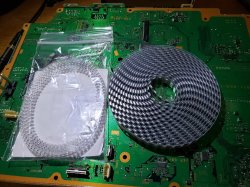
Is this enough capacitors? /s
 

Attachments

  • 20210409_173922.jpg
    20210409_173922.jpg
    2.8 MB · Views: 423
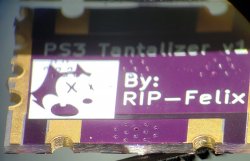
PS3 Tantalizer - Beta Release (v0.2b)
(Order or Download from OSH Park HERE)

EDIT: I removed v0.2b when releasing v0.3b
Notes:
  • If you choose to use this PCB, you are doing so at your own risk! I cannot be held responsible for any damages or loss of life resulting from use of this product!
  • This PCB is designed to make it easier and safer to attach tantalum/MLCC capacitors to your PS3. Removing the NEC/TOKINs and replacing with Tantalum/MLCC capacitors is an experimental mod not guaranteed to fix the problems you are experiencing. You must properly troubleshoot your console to decide if this mod is right for you.
  • You must order a minimum of 3 boards. I recommend ordering 3x (currently 3x costs $4.20 - No I didn't plan that). That will get you get 9 total. That will be enough to replace all the NEC/TOKINs on a PS3 and give you a spare in case there is a defect in the other 8.
  • MLCC pads are meant for 0805 case size.
  • Tantalum pads are a standard 7.3x4.3x1.9mm (LxWxH). You can use other types of capacitors that fit this footprint, such as aluminum polymer, tantalum polymer, etc.
  • You must choose 0.8mm board thickness in the options during checkout. This ensures it'll fit underneath the RF shield when you reassemble the console.
  • You must buy 1.9mm height capacitors. This ensures it'll fit underneath the RF shield when you reassemble the console.
  • You can download the Gerber files from OSH Park if you perfer to have another board house manufacture your Tantalizers. Just be sure they know the edges are castellated and that you need 0.8mm board thickness.
Pictures:

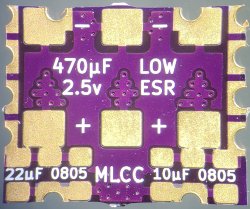
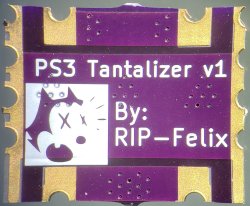
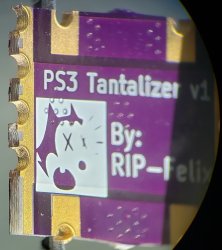
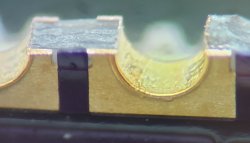
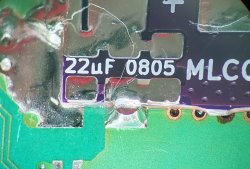
Top (clipped).jpg BTM (clipped).jpg BTM (Plated edge + Rail).jpg BTM (Perfectly alingned plated GND Pads).jpgCastellated Edges.jpgTantalizer Soldered (easy to install).jpg Tantalizer (Good wicking).jpg

Discussion:

I recieved the latest alpha revision and it looks good. I got the castellated edges right this time and they wick the solder really easily. This was much easier to install without adding too much heat. I think they might be easiest to install with a chisel tip or perhaps a knife edge. I used a T12-C4 for the thermal mass. This worked well to drive the heat down to the rails, but did make it hard to control. So some of the Thermal VIAs got filled with solder, not a big deal. With flux they wicked well, and produced the easiest install I've had yet! So mission accomplished!

I have not attempted to use them yet, so they are untested on console. The one pictured above was installed on a dead board just to test how easy it is to install. I did confirm with a multimeter that the rails are not shorting or anything. They are electrically sound. The next step is to populate and test. I have opened the beta, so anyone can DL or order them from OSH Park.

Just be warned that they need a little trimming. They come from the factory with some burrs that need removed. Takes a few minutes, but it's not hard.
Top (factory).jpg
BTM (factory).jpg


It's fine if you don't want to participate in the beta, potentially burning down your house or damaging your PS3. Once others and I have installed it and confirmed they work, I'll update the listing on OSH park with the v1.0, indicating a fully tested/working PCB.
 
Last edited:
PS3 Tantalizer - Beta Release (v0.2b)
(Order or Download from OSH Park HERE)
Notes:
  • If you choose to use this PCB, you are doing so at your own risk! I cannot be held responsible for any damages or loss of life resulting from use of this product!
  • This PCB is designed to make it easier and safer to attach tantalum/MLCC capacitors to your PS3. Removing the NEC/TOKINs and replacing with Tantalum/MLCC capacitors is an experimental mod not guaranteed to fix the problems you are experiencing. You must properly troubleshoot your console to decide if this mod is right for you.
  • You must order a minimum of 3 boards. I recommend ordering 3x (currently 3x costs $4.20 - No I didn't plan that). That will get you get 9 total. That will be enough to replace all the NEC/TOKINs on a PS3 and give you a spare in case there is a defect in the other 8.
  • MLCC pads are meant for 0805 case size.
  • Tantalum pads are a standard 7.3x4.3x1.9mm (LxWxH). You can use other types of capacitors that fit this footprint, such as aluminum polymer, tantalum polymer, etc.
  • You must choose 0.8mm board thickness in the options during checkout. This ensures it'll fit underneath the RF shield when you reassemble the console.
  • You must buy 1.9mm height capacitors. This ensures it'll fit underneath the RF shield when you reassemble the console.
  • You can download the Gerber files from OSH Park if you perfer to have another board house manufacture your Tantalizers. Just be sure they know the edges are castellated and that you need 0.8mm board thickness.
Pictures:

View attachment 32937 View attachment 32930 View attachment 32942 View attachment 32941View attachment 32939View attachment 32936 View attachment 32940

Discussion:

I recieved the latest alpha revision and it looks good. I got the castellated edges right this time and they wick the solder really easily. This was much easier to install without adding too much heat. I think they might be easiest to install with a chisel tip or perhaps a knife edge. I used a T12-C4 for the thermal mass. This worked well to drive the heat down to the rails, but did make it hard to control. So some of the Thermal VIAs got filled with solder, not a big deal. With flux they wicked well, and produced the easiest install I've had yet! So mission accomplished!

I have not attempted to use them yet, so they are untested on console. The one pictured above was installed on a dead board just to test how easy it is to install. I did confirm with a multimeter that the rails are not shorting or anything. They are electrically sound. The next step is to populate and test. I have opened the beta, so anyone can DL or order them from OSH Park.

Just be warned that they need a little trimming. They come from the factory with some burrs that need removed. Takes a few minutes, but it's not hard.
View attachment 32938 View attachment 32931

It's fine if you don't want to participate in the beta, potentially burning down your house or damaging your PS3. Once others and I have installed it and confirmed they work, I'll update the listing on OSH park with the v1.0, indicating a fully tested/working PCB.

Beautiful work, i might get me some later just for fun. Also, i know this is serious but i can't help but laugh at how bad your soldering must be if you end up actually dying replacing the NEC Tokins. Though i guess nothing is impossible, so that heads up is warranted.
 
Last edited:
It's fine if you don't want to participate in the beta, potentially burning down your house or damaging your PS3. Once others and I have installed it and confirmed they work, I'll update the listing on OSH park with the v1.0, indicating a fully tested/working PCB.

This is awesome! I have been waiting for this for a while since I have been reading this post. I do already have my cart filled as a compulsive buyer lol. I do have quite a few questions though.

1.) Who would want to try this? Right now I have 3 Phat PS3s working with no issues. Is this something people should invest in proactively on a working system? Is this only meant for trouble fixing YLOD after the diagnosis? I'm still not sure what the conclusion is on YLOD. At the beginning of the thread, people claim re-balling is not the solution (tokins are the problem), while at the end it seems re-balling is the solution (tokins are not the problem). I think many people who are into mods and preservation like myself are worried about longevity, maintenance, and prevention. So, it would be nice to know your input on this mod and its ability to prevent YLOD from ever occurring.

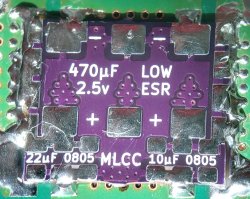
2.) What caps are recommended? and how many are recommended? I see there are several options for the board and require low ESR?:

470 uf
22 uf
10 uf

are these all required to populate the board? Or are these different options? I have mainly seen people only using:

4 caps per tokin 470 uf 6.3v:
https://www.mouser.com/ProductDetai...Z1n0r9vR22eJ9zXpiVR18leGqjnP/5FKXehTnVWHyfQ==

4 caps per tokin 330 uf 2.5v:
https://www.mouser.com/ProductDetail/581-TCJB337M002R0070/

3.) will it be possible in the future to buy these boards pre-populated?

I think it would be cool if you made a new post with your contribution. Maybe summarizing and clarifying this entire post into the main thread of a new post would be extremely helpful for those interested. It would also be useful to keep track of board revisions and successful installations of your board. It's just a thought.

Anyway thanks for your contribution! It looks like a well-thought-out solution! :chuncky:
 
This is awesome! I have been waiting for this for a while since I have been reading this post. I do already have my cart filled as a compulsive buyer lol. I do have quite a few questions though.

1.) Who would want to try this? Right now I have 3 Phat PS3s working with no issues. Is this something people should invest in proactively on a working system? Is this only meant for trouble fixing YLOD after the diagnosis? I'm still not sure what the conclusion is on YLOD. At the beginning of the thread, people claim re-balling is not the solution (tokins are the problem), while at the end it seems re-balling is the solution (tokins are not the problem). I think many people who are into mods and preservation like myself are worried about longevity, maintenance, and prevention. So, it would be nice to know your input on this mod and its ability to prevent YLOD from ever occurring.

2.) What caps are recommended? and how many are recommended? I see there are several options for the board and require low ESR?:

470 uf
22 uf
10 uf

are these all required to populate the board? Or are these different options? I have mainly seen people only using:

4 caps per tokin 470 uf 6.3v:
https://www.mouser.com/ProductDetail/AVX/TCJX477M006R0050E?qs=sGAEpiMZZMtZ1n0r9vR22eJ9zXpiVR18leGqjnP/5FKXehTnVWHyfQ==

4 caps per tokin 330 uf 2.5v:
https://www.mouser.com/ProductDetail/581-TCJB337M002R0070/

3.) will it be possible in the future to buy these boards pre-populated?

I think it would be cool if you made a new post with your contribution. Maybe summarizing and clarifying this entire post into the main thread of a new post would be extremely helpful for those interested. It would also be useful to keep track of board revisions and successful installations of your board. It's just a thought.

Anyway thanks for your contribution! It looks like a well-thought-out solution! :chuncky:

Yes, you are asking the right questions indeed.

Felix will probably explain it better, but what I understand is,
The PCB is designed to make the tokin replacement job easier. (Remember the replacement is only half of the job. The removal is just as important and delicate for good results)

However, this doesn't mean it's something you should be doing at all.
Because it doesn't change the fact that the tokin fault is very rarely the problem in the old but beloved backwards compatible systems. Despite the claims of the Original Post, which should be edited sooner or later.

Very rarely means that the average person will probably never find one causing a YLOD. This is why it's not a good idea to remove Nec Tokins without being really sure.
Thankfully an Oscilloscope is not the only way to check now.

Connecting to the SYSCON is accessible for everyone and can help you isolate a tokin problem if there actually is one.
So even for preservation it's probably a better idea to get ready to diagnose instead of messing with the tokins which will probably be fine.

Cheers
 
https://es.aliexpress.com/item/32832548758.html?spm=a2g0o.placeorder.0.0.6fbb7851dmNWC2&mp=1

hi everyone! do you guys recommend these? i have no idea if they are low ESR though...but if someone else worked with them could give me advice, that would be great. They are so cheap that i am really tempted
@RIP-Felix

which capacitors from aliexpress do you recommend? found those but not sure..
https://es.aliexpress.com/item/32832548758.html?spm=a2g0o.placeorder.0.0.6fbb7851dmNWC2&mp=1
 
@RIP-Felixwhich capacitors from aliexpress do you recommend? found those but not sure..
https://es.aliexpress.com/item/32832548758.html?spm=a2g0o.placeorder.0.0.6fbb7851dmNWC2&mp=1
  1. This if for the intermediate moder (not beginner) that needs a NEC/TOKIN replacement. 80 1002 SYSCON code is the one that seems to indicate a bad tokin, but I wouldn't say it's 100%. If there is a 3034 I would't bother with the tokins until you are sure the RSX is good. An oscilloscope can be used to verify bad tokins, but most people don't want to spend the money on one. The tokins are not the most common cause of the YLOD, still pretty rare on BC models ATM. Perhaps they are more common on later models where the RSX is more relable. However as time goes on the capacitors will age and die. So they could become a bigger issue. Considering how difficult the tokins are to remove and the heat needed to install a replacement, I wouldn't recommend you replace them unless you're sure you need to. The heat can cause a BGA defect that requires a reball to repair. So this is really for the enthusiast that enjoys tinkering with the PS3 and wants to help us develop a NEC/TOKIN replacment. The NEC/TOKIN is not in production anymore and new/old stock do not perform like new. Eventually they will all be gone or bad. No capacitor last's forever.
  2. Depends on model. BC models need 4800uF total for each the CPU and RSX. So 12x 470uF is adequate. It's not ideal going that high above 4800uF, but it seems to be fine. Later models switched to the 1000uF tokins before moving to AlPol. So for them 12x 330uF is very close to spec. What we really want is to get the ESR to 4.5mOhms to equal the NEC/TOKIN array. I haven't been able to find any TaPol caps that have an SER that low yet, only AlPol. While AlPol do work, they might require some additional help from MLCC. That's why there are 6x pads on the Tantalizer. My recommendation for 22uF and 10uF is based on the slim models. SONY's engineers replaced the NEC/TOKINs with a combination of AlPol + 22uF + 10uF MLCCs. However, you can put any combination of values on there for experimentation. You could use 1uF + 2.2uF + 4.7uF + 10uF + 22uF + 47uF. That might smooth out the frequency response curve better that 3x 10uF + 3x 22uF. Like I said, we're still experimenting. The silk screening is based on what Sony did (to be safe), but it's just a suggestion.
    • About the caps you linked, no they are trash! Stick to panasonic! Also they are too tall. The need to be 2mm or less. 4.3mm tall caps won't fit under the RF shield. The ones the user who posted before you are good, but I can't vouch for them. Manufacturers bin their caps in quality assurance. Caps that test within 10% of the rated specification get binned for sale at a premium, 20% is the standard, and any that fall outside that (say 30%) cannot be sold on reputable distributor sites like Digikey, Mouser, Arrow, & etc. They tend to be what you see sold on e-bay and aliexpress. They might be old, way out of spec, defective...there's no way to know for sure if you'll get good caps or not. That doesn't mean they're always bad caps. They just aren't guaranteed to perform to industry standards - Standards engineers use to make circuit diagrams and arrive at the correct capacitance needed. So you are taking a chance.
    • However, those "should" be fine. You may just have to verify the caps are good with a multimeter first. The "M9" means 9mOhms ESR. 9/12 = 0.75. The tokin array was 0.375mOhms combined ESR. So your array would be ~3x higher. Panasonic makes an "M7" version that I used successfully (So far) a number of pages back. Lower ESR is better, but it's not necessarily a requirement. If you can find lower, they would be better. I "recommend" getting caps as close to 4.5mOhms as possible. And I "recommend" getting them from a reputable distributor, not ebay or aliexpress (even though they may work fine). Feel free to disregard my recommendations at your own risk.
  3. I'm looking into that ATM. JLCPCB offers a manufacturing and populating service. There have some specific requirements I have to consider before I can have them MNF the board. I used OSHparks specification while designing the board (minimum drill hole size, trace witdths, etc), so I have some work to do to be sure they turn out okay. So far I suspect the cost would be a significant barrier. They do have the TaPol caps, but they come with an extra warehouse fee (not a basic part they place all the time, so they charge a fee to go grab it out of the warehouse and load it into the pick&place machine). This is mainly for my own curiosity, I'm not sure if I am going to actually go through with it or not. Been pretty busy with work, which eats my time and energy to work on the hobby.
 
Last edited:
  1. This if for the intermediate moder (not beginner) that needs a NEC/TOKIN replacement. 80 1002 SYSCON code is the one that seems to indicate a bad tokin, but I wouldn't say it's 100%. If there is a 3034 I would't bother with the tokins until you are sure the RSX is good. An oscilloscope can be used to verify bad tokins, but most people don't want to spend the money on one. The tokins are not the most common cause of the YLOD, still pretty rare on BC models ATM. Perhaps they are more common on later models where the RSX is more relable. However as time goes on the capacitors will age and die. So they could become a bigger issue. Considering how difficult the tokins are to remove and the heat needed to install a replacement, I wouldn't recommend you replace them unless you're sure you need to. The heat can cause a BGA defect that requires a reball to repair. So this is really for the enthusiast that enjoys tinkering with the PS3 and wants to help us develop a NEC/TOKIN replacment. The NEC/TOKIN is not in production anymore and new/old stock do not perform like new. Eventually they will all be gone or bad. No capacitor last's forever.
  2. Depends on model. BC models need 4800uF total for each the CPU and RSX. So 12x 470uF is adequate. It's not ideal going that high above 4800uF, but it seems to be fine. Later models switched to the 1000uF tokins before moving to AlPol. So for them 12x 330uF is very close to spec. What we really want is to get the ESR to 4.5mOhms to equal the NEC/TOKIN array. I haven't been able to find any TaPol caps that have an SER that low yet, only AlPol. While AlPol do work, they might require some additional help from MLCC. That's why there are 6x pads on the Tantalizer. My recommendation for 22uF and 10uF is based on the slim models. SONY's engineers replaced the NEC/TOKINs with a combination of AlPol + 22uF + 10uF MLCCs. However, you can put any combination of values on there for experimentation. You could use 1uF + 2.2uF + 4.7uF + 10uF + 22uF + 47uF. That might smooth out the frequency response curve better that 3x 10uF + 3x 22uF. Like I said, we're still experimenting. The silk screening is based on what Sony did (to be safe), but it's just a suggestion.
    • About the caps you linked, no they are trash! Stick to panasonic! Also they are too tall. The need to be 2mm or less. 4.3mm tall caps won't fit under the RF shield. The ones the user who posted before you are good, but I can't vouch for them. Manufacturers bin their caps in quality assurance. Caps that test within 10% of the rated specification get binned for sale at a premium, 20% is the standard, and any that fall outside that (say 30%) cannot be sold on reputable distributor sites like Digikey, Mouser, Arrow, & etc. They tend to be what you see sold on e-bay and aliexpress. They might be old, way out of spec, defective...there's no way to know for sure if you'll get good caps or not. That doesn't mean they're always bad caps. They just aren't guaranteed to perform to industry standards - Standards engineers use to make circuit diagrams and arrive at the correct capacitance needed. So you are taking a chance.
    • However, those "should" be fine. You may just have to verify the caps are good with a multimeter first. The "M9" means 9mOhms ESR. 9/12 = 0.75. The tokin array was 0.375mOhms combined ESR. So your array would be ~3x higher. Panasonic makes an "M7" version that I used successfully (So far) a number of pages back. Lower ESR is better, but it's not necessarily a requirement. If you can find lower, they would be better. I "recommend" getting caps as close to 4.5mOhms as possible. And I "recommend" getting them from a reputable distributor, not ebay or aliexpress (even though they may work fine). Feel free to disregard my recommendations at your own risk.
  3. I'm looking into that ATM. JLCPCB offers a manufacturing and populating service. There have some specific requirements I have to consider before I can have them MNF the board. I used OSHparks specification while designing the board (minimum drill hole size, trace witdths, etc), so I have some work to do to be sure they turn out okay. So far I suspect the cost would be a significant barrier. They do have the TaPol caps, but they come with an extra warehouse fee (not a basic part they place all the time, so they charge a fee to go grab it out of the warehouse and load it into the pick&place machine). This is mainly for my own curiosity, I'm not sure if I am going to actually go through with it or not. Been pretty busy with work, which eats my time and energy to work on the hobby.

You are awesome. I will search for those M7 Panasonic you mentioned then. thanks!
 
by the way, is it really that neccesary to use 470uf for ps3 phat? i mean, 330uf x 4= 1320uf. I know that another user said this was okay, but i keep wondering if it really is. @RIP-Felix
 
Back
Top