PS3 (Research/Experimental) - NEC/TOKIN Capacitors Replacement - YLOD

Perhaps the other 2 Tokins are bad. I can try replacing them with tantalizers and see if that helps. But first I want to try another HS to see if perhaps this one's heatpipes have crapped out or something. Still a mystery why this cell is so hot. It could be the cell, so if another HS doesn't change anything I'll know the cell is causing it. Then I'll try the remaining tokins to see if they are doing it. If not, I'll just have to accept this one runs hotter.

Not sure what to make of that yet.
The other day i was talking about this with @ElGris and i forgot to mention the copper pipes, but yeah... the pipes are "glued" to the other metal parts, and that glue is critical, sometimes it could "crack" so the pipe is unglued... there is also room for improvement in how is applyed because lot of times the glue is not filling the gaps completly

Another problem of the PS3 heatsinks is sometimes the interference shields are "pushing" it either outside (so the pressure is reduced in a non-uniform way), or are pushing it laterally causing a small rotation.. in both cases the result is the heatsink surface is not completly paralell to the IHS surface

So yeah... if you have some replacement heatsink at hand try to replace it
And btw... if you are going into this details, the first thing i would do is a lapping of the IHS, sometimes the surface have a bending from factory, the lapping is going to solve it and is easy to do

Yeah if you're a average person is not recommended, what gain do you get overall by just putting thermal paste over the ihs? down 2 degrees or soo?

although most people make the mistake of putting too little thermal paste on the RSX and CPU that has to cover the chips, not just the core

I say this from experience, before I had 60 60 adding "enough" and now I have 51 57 just because I put more thermal paste than before
In PC i use to apply a layer of thermal paste the most thin as posible because i know the surfaces are very flat and there is nothing that could affect how the two surfaces stays paralell to eah other, but in the PS3 is better to apply a little excess to fill the gaps caused by the problems i mentioned above, i do it too :)
But it needs to be made with a "non-electrical conductive" thermal paste because a bit of the excess of thermal paste is going to be "squeezed" outside... we need to count with it
 
Sandungas pipes are soldered. Flame gas brenner will desolder but we have to cut each pipe otherwise will explode if someone heat them closed! They need one end cut to leave pressure out. Is bit dangerous to play around there. I will say modify pipes and drive them out can give us chances to inject in same time coolant, double force of cooling in theory should be better, now practice will kill our time.
327c77fcf1313dbe6c50fd385b4f12fb.jpg
677a4309fa256b28997da22871a377d5.jpg
c87b0e1bb18e9b421412afebdacc7853.jpg
 
Sandungas pipes are soldered. Flame gas brenner will desolder but we have to cut each pipe otherwise will explode if someone heat them closed! They need one end cut to leave pressure out. Is bit dangerous to play around there. I will say modify pipes and drive them out can give us chances to inject in same time coolant, double force of cooling in theory should be better, now practice will kill our time.
327c77fcf1313dbe6c50fd385b4f12fb.jpg
677a4309fa256b28997da22871a377d5.jpg
c87b0e1bb18e9b421412afebdacc7853.jpg
I cant identify the heatsink model, but as far i remember i had one from a CECHJ or so (without PS2 BC) with the pipes glued with something that was looking like melted sugar, and actually it was "cracked" like a candy in several places

In the one in your photos is really solder all along, or they used both, soldered in some points but glued in other points ?
 
That "glue" is kind of flux from this alloy. Factory didn't bother to clean it as in ps4.
Well I know this alloy can solder copper with aluminium around 400 Celsius. If you look on internet you'll find aluminium alloy for 50 cm is about 10 euro here. Much copper pipes will be easy to extract from old fridge, behind is a very long copper pipe, even if is aluminium still can be modified and solder. :courage:
 
Last edited:
@sandungas I may run out on a ofw900 ps4 phat to get temperatures differences. If there is going well then is impossible to fail in BC models. Or any piped cooled system.
https://s.go.ro/gx3omndp
Same type of 6mm pipe as in air cooling in-house system is used ps3/ps4
Interesting, i cant see it well, but there are a couple of photos where it seems to be made with the first manufacturing method explained here, named "Metal Sintered Powder Wick Type Heatpipe", right ?
https://www.frostytech.com/articles/2466/index.html

If thats right is a good point for sony because is the most expensive
 
Ps4 inside pipe is like in first photo from your link, ps3 BC is made like second photo inside pipe. Haven't found yet any as on third photo. Now question why they don't run coolant inside those pipes? Cost effective? Corrosion ? Condensation effect? I'll run test anyway. I know it will be bad design but like I said can't optain all. Life is like that we can't have all in a single life.
I'll add all tests inside this link with time.
This photo is to refer inside pipe
https://s.go.ro/k908tufx
 
Last edited:
Ok, so as a recap...
PS3 BC heatpipes = Grooved Wick (low quality)
PS4 heatpipes = Metal Sintered Powder Wick (high quality)

The "gooved" manufacturing is the cheapest, because it can be made at the same time they are "extruding" the tube, is like extruding it 2 times and the result is an straight pipe. After that they can curve it, bend it, or press it (to create an oval) and the "groove" effect is going to adapt well to that deformations of the pipe
With the "mesh" it happens a bit the same... is made as a straight pipe, then they inserts the mesh... and after that they bends it, press it, etc... the mesh is going to be adapted to any deformation of the pipe very well too (and probably have a better performance than the grooves)

But the sintered powder is the most tricky, im not sure how is made but im guessing is the other way around... first is needed to bend the pipe and press it... and at the last step of the process is added the powder
And after the powder is added and sintered is not posible to bend or press the pipe because the powder becomes solid and could "crack"
I remember i was talking about this before in the forum and suggesting to dont bend the pipes because i was afraid of this "crack" effect

-------------
Btw, maybe that change in between the gooved pipes to the sintered powder pipes depends of the manufacturing year. The fact is the PS4's are the children of the PS3 superslims... there are many components of the PS4 that are just a revision of the ones in PS3... and the manufacturers of some of them are the same
In other words, the heatsinks of the PS4 probably was made by the same company that was doing the heatsinks of the PS3 superslims... so is posible some of the heatsinks used in the last PS3 superslim moels are also using heatpipes made with the "sintered powder" method (the good ones)
 
Ps4 inside pipe is like in first photo from your link, ps3 BC is made like second photo inside pipe. Haven't found yet any as on third photo. Now question why they don't run coolant inside those pipes? Cost effective? Corrosion ? Condensation effect? I'll run test anyway. I know it will be bad design but like I said can't optain all. Life is like that we can't have all in a single life.
I'll add all tests inside this link with time.
This photo is to refer inside pipe
https://s.go.ro/k908tufx
I assumed the PS3 used sintered metal type, but actually this makes more sense. @PostalDude__ was asking why the PS3 overheats so quickly when placed upside down and the angle the liquid in the pipe can flow because of gravity matters with the grooved type pipe. It's not so important in the sintered type. Just an interesting side note.
 
Just a quick update on the research with regards to ripple on the nec/tokins and if soldered extra capacitors make a difference or not.

As I have been building a CECHC model frankie and recording the process on video, @RIP-Felix had some insightful ideas to share which inspired me to take more measurements of my own.

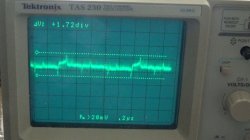
After finalizing the 40nm swap and modifying voltages, I have attempted to use an old analog scope to measure the ripple noise before and after installing additional tantalums (which I took out of a slim board JSD-001). Now bear in mind, this scope is very old and probably needs to be recalibrated internally(I got it for free when school was throwing them out). It isn't very stable on channel 1, so I used channel 2 for the measurements. This model is from the 90s, so I don't know how much abuse it got in school and if its guts are half out of specs... It's got a nice cursors feature, however not perfect enough for precise measurements like this. My point is take these readings with a thick grain of salt. With such an ancient scope of unknown history I can't know if it's showing the truth or producing completely bogus readings.

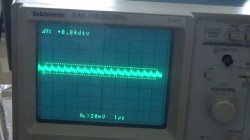
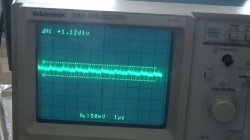
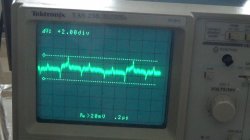
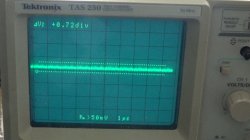
The cursor number at the left top is a multiplier of whatever Volts knob was set to. It will calculate the number based on how you position the two lines. I was trying to set them to the lowermost and highermost peak, essentially getting a multiplier for peak to peak ripple voltage.

Now, it would be good if somebody could repeat these measurements with a higher quality digital scope. Because if my results are close to reality, then soldering method could make a bigger difference than just connecting more capacitors with wires like Felix did.

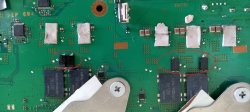
Frankie tantalums.jpg

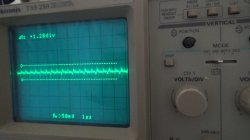
So the first measurement I took with the cursor was this. However, you can notice the top line
was set a bit too high . in reality the multiplier would have been closer to 1.00, so I say it's 1.00x50mV= ~50mV ripple
RSX before adding Tantalums (ver.1).jpg

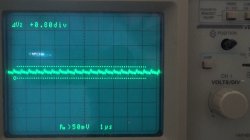
I took another measurement later and the result was the following: 0.8x50mV =40 mV.

RSX before adding Tantalums (ver.2).jpg

Conclusion: Ripple value is somewhere between 40 and 50 mV.

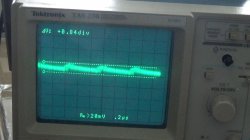
First measurement I set to 0.2 microsecond and 20 mV per div. Ripple would be 16,8 mV (0.84x20)

RSX after adding 2x470 Tantalums (ver.1).jpg

It showed the same result with a higher 1 microsecond setting.

RSX after adding 2x470 Tantalums (ver.2).jpg

So I think this is the most significant difference I managed to see here. More than double less ripple noise reduction after adding 2 extra tantalums. But then again, I am very unsure in this half working oscilloscope...

With a 50mV setting it appears to be about 56 mV (1.12x50).

Cell before Tantalums (ver.1).jpg

But with higher div/sec and lower volt/div it would appear to be 40mV (20x2).

Cell before Tantalums (ver.2).jpg

Conclusion: ripple is somewhere between 40 to 56 mV.

50x0.72 =36 mV
Cell after adding 2x470 Tantalums (ver.1).jpg


20x1.72 =34,4 mV
Cell after adding 2x470 Tantalums (ver.2).jpg

Result: ripple noise was reduced down to somewhere between 34 and 36 mV. Not as big difference as on RSX, but still a difference...
 
Last edited:
Yeah, I didn't try soldering parasitic caps directly to the MB, which creates the lowest possable impeedane. I suspect my results suck compared to yours because of parasitic inductance in the leads I used. Clearly it is much better to solder them directly in. That's what I found when I soldered my tantalizers in too. I did try them with the leads and the effect was garbage compared to directly attaching them.

Good work. It's a nice companion piece to the tests I did. Between them we can see that adding caps as you are fond of is effective. Perhaps not as effective as replacing the tokins with them, but clearly it's good enough. Especially considering the convenience factor. It's easier to leave them and do what you have. I still recommend replacing the tokins with tantalizers, but if it works, hey...who cares?!
 
Yeah, I didn't try soldering parasitic caps directly to the MB, which creates the lowest possable impeedane. I suspect my results suck compared to yours because of parasitic inductance in the leads I used. Clearly it is much better to solder them directly in. That's what I found when I soldered my tantalizers in too. I did try them with the leads and the effect was garbage compared to directly attaching them.

Good work. It's a nice companion piece to the tests I did. Between them we can see that adding caps as you are fond of is effective. Perhaps not as effective as replacing the tokins with them, but clearly it's good enough. Especially considering the convenience factor. It's easier to leave them and do what you have. I still recommend replacing the tokins with tantalizers, but if it works, hey...who cares?!

It is great if that's how it truly is, but I think for the clarity of the results you should conduct the same experiment with soldered parasitics and see what your digital scope shows . I still have doubts if mine was precise enough.
 
... you should conduct the same experiment with soldered parasitics and see what your digital scope shows .
Your scope looks ballpark, but I suppose I could replace the last RSX tokin on PS3#15. Take a before with 3 tantalizers, and after with the last one installed.
 
There has been some discussion already around the reports in webman. Some members believe it may reset when it reaches one thousand hours but there is no evidence that this is actually the case. If you have the original harddrive you can check how long it's been used for by connecting it to a computer (not sure what software you use). What's unusual about the information webman is displaying is the high amount of time it's been turned on and also the high amount of improper shutdowns it has had.

If it was me I would open the console to see if the stock paste is still wet. A system that has hardly been used will have wet thermal paste, I know because every system I have opened up for referbishment with low power on time has had wet or slightly tacky thermal paste on the CPU and GPU heat spreaders.

Hope this helps

Sent from my SM-G988B using Tapatalk
 
There has been some discussion already around the reports in webman. Some members believe it may reset when it reaches one thousand hours but there is no evidence that this is actually the case. If you have the original harddrive you can check how long it's been used for by connecting it to a computer (not sure what software you use). What's unusual about the information webman is displaying is the high amount of time it's been turned on and also the high amount of improper shutdowns it has had.

If it was me I would open the console to see if the stock paste is still wet. A system that has hardly been used will have wet thermal paste, I know because every system I have opened up for referbishment with low power on time has had wet or slightly tacky thermal paste on the CPU and GPU heat spreaders.

Hope this helps

Sent from my SM-G988B using Tapatalk
Thanks for sharing this knowledge.
 
Hi everyone, can I 100% trust the information that says, 13 days on? that there is no error.


5SjiUR2.png
The first boot after unplugging the clock battery will not report correctly in webMAN. But once you set the time and restart, webMAN then agrees with SYSCON.

Because your startup and shutdown count is so far off, no! You cannot trust that this console only has 13d of use. All those improper shutdowns represent time the console was on, but that didn't get recorded. The console was most likely used in a server array.
 
The first boot after unplugging the clock battery will not report correctly in webMAN. But once you set the time and restart, webMAN then agrees with SYSCON.

Because your startup and shutdown count is so far off, no! You cannot trust that this console only has 13d of use. All those improper shutdowns represent time the console was on, but that didn't get recorded. The console was most likely used in a server array.
thanks
 
Hello everyone, I'll let you know about my nec tokin capacitor repairs. My repairs on my CECHL failed. By wanting to remove the 6.3 v capacitors to replace them with 2.5 v, it no longer worked. I soldered in different ways but nothing changed. After a while, I lost my patience and banged the soldering iron on the motherboard in anger, which caused her death again. So I gave up on this one. On the other hand, I still wanted to manage to repair a console with a Ylod (probably caused by the nec tokin) for my own satisfaction. So I bought another PS3 (CECHK) that I paid very cheaply, with the same symptoms. I proceeded as follows: 1. In order to know if the failure is really caused by the nec tokin, before any disassembly, I applied to the back of the console, a session of 3-4 min with a hair dryer to warm up the capacitors. She started. 2. Despite its instability, I took the risk of flashing it to install a CFW 3. I then installed ps3 tools to access the error log and the diagnosis displayed the well-known errors 1002x29 and 1001x2, at this time there was almost no doubt about the malfunction of the nec tokin. 4. I waited long enough to be sure the capacitors had completely cooled, causing the YLOD. I opened the console but unlike the previous console I didn't want to completely remove the nec tokin, because I'm convinced that even if they no longer have the same numbers of microfarads, they still have a little bit. So I proceeded to the "piggyback" technique 5. I started by placing 2 capacitors (470 uf 2.5 v) next to the first nec OE108 of the RSX and 2 capacitors (470 uf 2.5 v) next to the first nec OE128 of the CELL (top side of the motherboard of course ). I reassembled the console to test and there, no need for a hair dryer to start it, they are stable on the XMB. Second test I launch a game (fantastic four) and I leave the cinematics on a loop (30min), it is always stable. Third test, I launch Motorstorm and barely arrived on the menu, it cuts. So my capacitors are not enough. 6. I dismantle the console again, I realize that one of the capacitors at the level of the CELL was badly welded, I resolder it. I take this opportunity to add 2 other capacitors (470 uf 2.5v) next to the second nec tokin RSX. I reassemble the console and I always test with Motorstorm, I arrive at the menu, I start a game, it works, but unfortunately 3-4 minutes later, it goes out, damn it. 7. I disassemble again, and I decide to add 2 capacitors (bottom side of the motherboard) like this photo at the RSX. I also take this opportunity to add a capacitor (top side) on the second Nec tokin of the CELL. I reassemble the console to test and there drum roll. I run Motorstorm, start a game and leave the game on the graphics engine for 10, 20, 30, 40, 50 mins, no stability issues, yessss. Then I launch a slightly more graphically complex game (Assassin's Creed) and I played for more than 3 hours with no problems. I think I'm on the right track. I'll try with even more complex games like Uncharted 3. Anyway thank you all for your experience.

Hello everyone,
I'll let you know about my CECHK. I waited a little over a month because some had predicted that in general, this kind of repair (nec tokin) lasts on average about 15 days. In conclusion, I tried uncharted 3 for about 2-3 hours with no problems. Assassin's creed 1 about 25 hours and no issues. I wanted to test a game requiring a lot of resources and so I tested GT7 and there indeed after 20 min, extinction of the console followed by 3 beeps, damn it. So I added 2 weeks ago another cap (470 uf) at the level of the nec tokin cap gpu and now GT7 no longer crashes. In short, for now the console is stable. I also wanted to try on a slim, so I bought a CECH2004b 3 weeks ago at 10 euros sold as hs, I carried out the same operation (piggy back technique) and it works very well for the moment. I will give you news in a few weeks of the evolution of these consoles. thank you
 
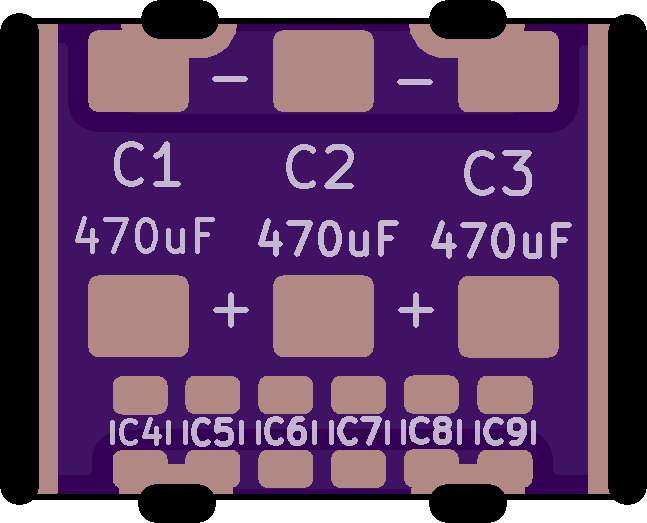
PS3 Tantalizer - Beta Release (v0.6b)
(Order or Download from OSH Park HERE)


EDIT: OSH Park had trouble manufacturing v0.3b, which is not much different than 0.6b. I've been in contact with them about what's going wrong. Apparently, there's not enough room for support tab placement allowing the board to twist and fly off during routing. Because of this I revised the design to have a little more room for them to place tabs, but it's not easy to keep this design doing so. I have been trying to make a revision that will improve manufacturability, but that hasn't been going well.

So my recommendation is that you Download the Gerber files and have PCBway or JLCPCB make it instead, since they haven't complained about manufacturing issues.
View attachment 36416
Notes:
  • If you choose to use this PCB, you are doing so at your own risk! I cannot be held responsible for any damages.
  • This PCB is designed to make it easier and safer to attach tantalum/MLCC capacitors to your PS3. Removing the NEC/TOKINs and replacing with Tantalum/MLCC capacitors is an experimental mod not guaranteed to fix the problems you are experiencing. You must properly troubleshoot your console to decide if this mod is right for you.
  • MLCC pads are meant for 0805 case size.
  • You must choose 0.8mm board thickness in the options during checkout. This ensures it'll fit underneath the RF shield when you reassemble the console.
  • You must buy 2mm height capacitors or shorter. This ensures it'll fit underneath the RF shield when you reassemble the console.
  • Tantalum pads are for 7343 (7.3 x 4.3 x 1.9mm, LxWxH). You can use other types of capacitors that fit this footprint, such as aluminum polymer, tantalum polymer, etc. However, they must be low ESR/ESL processor decoupling capacitors. The PCB takes up 0.8mm of height, so caps need to be low profile (less than 2mm). Each one should be less than 9mΩ ESR, 4.5mΩ ideally. I recommend...
  • You do not need to buy the MLCC capacitors. The 470uF capacitors are enough on their own. However, the MLCC capacitors help to attenuate the higher frequency noise component up to around 2MHz, better mimicking the NEC/TOKIN proadlizer it's meant to replace. This is probably overkill on PS3's with 1000uF tokins. I still recommend using 470uF caps, because 3x 330uF is only 990uF and may not be enough. It's better to have more capacitance than less, but not too much more. The MLCCs are more needed on 90nm CPU/GPU early models (A-H). They have noisier switching VRM and higher load, which requires more decoupling than later models. Use them if your tokins are OE128 models. You probably don't need them otherwise.
  • You can download the Gerber files from OSH Park if you perfer to have another board house manufacture your Tantalizers. Just be sure they know the edges are castellated and that you need 0.8mm board thickness. In fact I recommend you do this since OSH park has been having trouble making them lately.
Pictures:
8f47fb88bf9483379a2481fcc3ce4e70.png
996f4273a87adf5ffd1d51275e889000.png


Note: The following pictures are of v0.3a I made with 7x MLCC pads. I decided to remove C10 because there was too little clearance between +/GND. v0.6b linked above will not have 7 MLCC pads. It has 6. And instead of a long edge for the GND connection, it now has 4 plated vias. These changes where needed to make it easier to manufacture. But the following pictures will give you a general idea of what they look like.
View attachment 35177 View attachment 35178
View attachment 35179 View attachment 35180

Discussion:

It's fine if you don't want to participate in the beta, potentially burning down your house or damaging your PS3. Once others and I have installed it and confirmed they work, I'll update the listing on OSH park with the v1.0 monker, indicating a fully tested/working PCB.

Hello Rip- Felix can you convert this file that is attached to Gerber format? This is Tantalizer (v0.3b)

I already have Tantalizer (v0.6b) in gerber format, and I would like to have tantalizer 0.3b also in gerber format, could you help me with this?

Thanks.
 

Attachments

Back
Top