agree this seems like only 1 motherboard u have fixed so please dont come here stating false statistics and guesses because at the end of the day u are doing the same assuming as people that are claiming the re-balling issues too. Dont forget these consoles have aged now so more than likely these caps will pop up more so now than what they did b4 they had done their operating hours (1000 Hours) so theres still a fair few variables to consider here.
If anything u should be putting those caps on an oscilloscope like its been suggested to confirm this is the issue and also to back up the same claims so we can all jump on the oscilloscope band wagon if thats all it takes to test them.
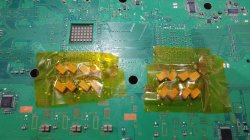
you only need 2 bridges, 1 for cell and 1 for RSX, the vias on the opposite side connects each positive side together as is. tho its not going to hurt if u have more its just not needed to act the same way an original tokin does.
Thanks for tip about the bridges, I'll be definitely keep that in mind.
So about what you said, yes that is true this is the first console I've fixed with the capacitor method. But there are many other people out there with the same experience and results. That should mean something.
The oscilloscope is a complete and 100% legitimate way to test out components nobody should think otherwise.
But not everybody has access to an oscilloscope which is unfortunate. We must make do with what we have. So unless somebody is willing to put in the time and research into that and generate some results about how there is no such thing is bad caps for the PS3.
So I guess what somebody should do is:
- bust off the plastic top of the NEC caps (all of them on the ps3) and take some readings while a ps3 is running the Last of Us and other games.
- If the PS3 already has YLOD hopefully it still retains its original caps post whatever repair method was done (reflow, reball)
"Capacitors are at great risk for failure. While it is certain that over time some wear out and no longer adequately serve their purpose, capacitors can also fail prematurely.
This article will show the various points where capacitors can be damaged and are at the highest risk of failure. Designers that are aware of these points will be better suited to choose the right capacitors for their applications and possibly avoid failures.
A component fails when it no longer meets the requirements of the application"
Link:
https://www.electronicproducts.com/Passive_Components/Capacitors/Failure_modes_in_capacitors.aspx
Specifically the part where it says "A component fails when it no longer meets the requirements of the application" a PS3 that has bad caps on the motherboard meets this criteria thus changing it shouldn't be such a big fuss. Not being able to run intensive titles proves this.
Link:
http://www.repeater-builder.com/tech-info/pdfs/replacing-capacitors-from-emerson-corp.pdf
"Capacitors have an end of life The aging process in the capacitor can be visualized by considering a water dam with 4 5 a small leak. Over time, the small water leak grows. The movement of the water through the dam causes deterioration within the dam structure. In spite of the growth in the leak rate, the leak rate is still small and the dam still functions as a dam. As water continues to leak, the structure of the dam is compromised. When sufficient damage occurs, the probability for a near term failure becomes very high and the dam needs to be taken out of service. During the capacitor aging process the electron leakage current and the chemical reactions both cause a decrease in the capacitance value and an increase in the resistance value. Both of these changes (decrease in capacitance and increase in the resistance) are tied to damage taking place inside of the capacitor. Once sufficient damage to the capacitor has been sustained, the probability for the capacitor to fail increases and when this probability becomes high, the capacitor should be taken out of service."
Seems like changing caps is a normal procedure for basic electronics. The capacitor is working pretty intensively and maybe there were some flaws in the NEC/TOKIN design that we'll never fully investigate but if you want to do that you're going to need some intact NEC/TOKIN to dissect and investigate. I am sure this bit about capacitors is general rule for many capacitors everywhere.
As I have stated in my prior post:
- A PS3 with BAD CAPS but with intact SOLDER BALLS ON BGA can be fixed with changing the caps.
Likely hood of occurrence: HIGH
- A PS3 with GOOD but with non-intact SOLDER BALLS ON BGA can be fixed by reballing but given that the cracks are dislodging the RSX from the PCB. Though even if the cracks are non-dislodging you should still reball to be sure.
Likely hood of occurrence: LOW
Maybe you don't agree with the occurrence part of it which I understand.
Do cracked solder balls cause YLOD? - Yes they do 100% they do but the crack must be in some way disconnecting the contact of the RSX from the PCB. If it's a transverse, oblique, spiral, rotated or impacted in a way for the RSX to still make contact with the PCB chances are the PS3 is still going to work though if there was a way to 100% verify this you best do a reball anyways.
There is a time for reball and there isn't.
I paraphrase Louis Rossman – Reball repair is for weak willed people who are looking to make a quick buck. - End paraphrase.
Yes, this is true! But this comes with the understanding that reball does have a proper place in electronic repair when;
- You need to replace the Chip because you know it has failed
- You know there is physical damage on the chip that prevents it from working
- You are repairing a device where you know 100% and have indisputable fact that there are damaged solder balls (cracked, corrosion and everything else under the sun)
- You want to repair the device long enough for the customer (or whoever has to retrieve data )can retrieve data quickly off it and the customer is aware of this fact and will not use the device for anything else other than retrieving their data in the short amount of time they don't know they have but are willing to take this risk anyways in the hope they'll be able to get that data off as quick as possible in the hope of no hardware failure.
Aside from these points as stated above I cannot see any other reasons into reballing as a legitimate permanent repair.
What really allows me to believe in the capacitor more so than the cracked solder ball is through simple deduction.
- If I cannot get past the first level of MW3 and the console fails at pretty much the same exact place in the level but I can play through half of black ops 1 campaign then there is something strange happening with the capacitors.
- If this was the solder balls cracking (cracked in a way where
it is disconnecting the contact of the RSX from the PCB)
the PS3 shouldn't even be able to boot let alone play the game because of Lead free's 217 C average melting point.
- If the solder balls are melting and reforming at sub 100c underneath a chip we should see some more proof about that one. This one is going to take some equipment and some to prove.
If anybody wants to feel free to take off the plastic top of the NEC/TOKIN caps and measure some results when the ps3 is under load but other than that I'm pretty confident changing the caps will often solve the YLOD than reballing will.
I've seem posts from 2014 of cap replacement. Seems like this only being relevant here due to the attention this post and Displaced Gamer's video.
I hope I didn't come across as condescending.
Thanks again for the suggestion about the bridges!
I cannot find some from 2014 but I have seen it. Here is one from 2016 and it appears that other countries have figured this out a long time ago.