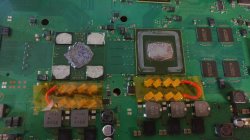
PS3 (Research/Experimental) - NEC/TOKIN Capacitors Replacement - YLOD

There is no point including things that are impossible to happen on a PS3. > solder balls melting during use.

Things like cracked and deformed solder balls can be included, these are generally manufacturing defects.

Cracked can mainly happen 2 ways > cold soldering and user mistreatment> ie they dropped the effing thing or bash it about when moving it. Deformed is also in manufacturing defects> improper machine calibration or the solder being to hot.

And these things are impossible to control during manufacturing 100% of the time and would pass a QA inspection/test as the product would work but is liable to early failure down the line. And sometime's a product can have these defects and also never fail.

This type of stuff is basically like Alice tumbling down the rabbit hole to go down lol.


I can agree with that. The manufacturing part.

Solder melting during operation is about as ludacris as the examples get for the solder balls to actually get shifted in any way in operation. Had to mention it. I am sure the example speaks for itself and as you instantly picked it up it's ridiculous.

as I mentioned above:

"- If the solder balls are melting and reforming at sub 100c underneath a chip we should see some more proof about that one. This one is going to take some equipment and some to prove."

Aka the melting solder balls.


So other than corrosion, contamination and anything else that typically doesn't happen normally during heating cycles I'd say the solder balls being at fault here are unlikely.

Corrosion is if the user maybe leaves the motherboard underwater or something who knows... This is unlikely for a lot of people here. And if you did there are probably other parts of the motherboard you'll need to be replacing.

User induced cracked solder balls - you should probably reball if you know that but chances a typical ylod ps3 has been sitting most of its life so it's unlikely. But if you know then you know.

but these two examples are very niche and can happen while I understand that it's simply not the norm.
 
u got buckles chances of anyone owning and providing xrays just for ps3's, im sure if u done ur research u will see what costs are involved to own one let alone get another company to do some for u. but ur right time tells all and atm we just dont simply have it in the results or any documentation of it to know for sure whats what a part from what we see here really so again all im saying is leaving out statistics coz it seems u were only guessing these as well.


As I said above, if we are talking statistics we'll need people dedicated to this cause and quantifiable results. This would definitely take sometime. We'll need some x ray pictures at one point I am sure so we can examine and deduce anything from it. Actually analyze results.

This is already sounding like a crazy venture and yes it is and for a very niche market and this is going to take time too. But as I said if somebody wants to they can go right ahead. Otherwise talking statistics, actual legitimate statistics is far too unfeasible. Users vouching or maybe some small posts here and there with oscilloscope pics sure but nothing on a grand scheme level of taking thousands or brokens ps3s and coordinating a team to work on them.

Hence I recommend getting in touch with some repair shops that have been doing this well before 2019 I am sure we can learn a lot from them. It'll probably be from a person who doesn't speak English as their first language but I am sure they'll be able to post their experience with changing caps. Good thing google translate exists.
 
hi,first of, new to the forum, and, thanks to the creator of the tutorial, dont know how to tag him, yesterday i bougth a slim2001A for really cheap, got it mainly for parts, when i tested, it had RLOD, HDD had no issues, i found this topic, took it apart, taking the NEC Tokins was harder than expected, but with a cutter and a hot air station, work was done without damaging anything aside the tokins, replaced them with 2.5V 470uF tantaliums that i salvaged from a GLOD 2501A JSD-001 Slim, 3 tantaliums for each NEC tokin, bridged as reccomended, insulated all caps, assembled the machine, turned it on, and, boom, it booted with no issues, applied MX4, its been on for like 4 hours and everything seems fine, will give a good larger test later, i must say i was skeptical if it was going to boot, because i was very obvius it had been opened before, and by someone with no care at all
 
I already posted multiple personally taken pictures of common BGA issues that are apparent after chip lift on a PS3. You can also do the pressure test. You can also use the scope - inspection or oscilloscope. I've seen the x-ray images before, but it was more than 10 years ago. No idea where I'd find them now. I emphasize again that my sample size is small, but since I've been looking at it with the scope or from when I was changing the caps out regardless from a few years ago (after reballs that didn't work so there are no variables), I've only confirmed 2 bad sets out of over 40. You're also talking mostly about electrolytic capacitors. Different types have entirely different lifespans and reasons for failures. MLCC caps, for example, will usually outlast the device they are in. Even most electrolytic cap failures aren't due to lifespan issues. They are from poor circuit design like putting them directly next to high temperature heatsinks, or from bad production runs.

The 1000 hour rating is at 105c. The rule of thumb is that it doubles for each 10 degrees below the rating. From seeing posts in this thread, it looks like the chips generally run around 70 from their internal reading, so components right next to them maybe we assume to be at 55c? That means the lifespan at their operating temperature inside a PS3 is probably around 32,000 hours (1,333 full days) of playing time. That currently comes out to almost 7 hours a day of playing time every single day since launch in 2006.

The whole point of my posting here was to get people to stop blindly doing a repair that has a very high likelihood for a novice to damage their console for low odds of success. I refer you to many of the videos and images now posted here of things like people using chisels to remove the caps, knocking off other components, or shorting things out.

Since the scope images now seem to have everyone playing nicely, let's move on to identifying a cheap oscilloscope that has enough precision to show the issue. I keep seeing DIY kits on Amazon for $20 that come close, but so far the cheapest I've seen that definitely looks up to the task is somewhere around $50. If you're ordering good, name brand tantalum from a reputable supplier, you may end up paying more than the cost of one of those kits, so if we can find a cheap scope that works, it's a no brainer. Let me sell the oscilloscope harder for anyone on the fence: you're fixing a game console right now. You'll probably be doing it again. Cheap replacement lasers from China are almost always out of spec. If you have an oscilloscope, you can adjust the RF eye pattern on any system that you know the test point on so you can dial in those new lasers perfectly.

I'm in the process of starting my notes over from scratch, and getting a fresh set of reference images now that I'm certain of what I'm looking for and what it means. When I have all 3 sets (and some real idea what that data signal means), I'll post them again all at once. At least one of my base ones was measured wrong anyway. I'll check back in periodically until then to see if anyone posts links to scopes, and I'll do my best to guess if they will work. Anyone that wants a very good bang for you buck scope that definitely works for this application, I use a Rigol DS1054Z. Otherwise, you just want to make sure you at least break the 50mV/div and 1us/div barrier.
 
I know I'm a newb around here, but I really do think that going down the scope path is the way to go -- I've seen several posts by now of people that have little to no experience with repairs, blindly replacing the caps and still ending up with a failed ps3. That may be cheaper than buying all the proper tools, but it doesn't gets us any closer to fully understand what's going on.

I, for one, am going to buy a scope and start documenting my findings. I've already replaced my tokins with tantalums and my ps3 is still dead, so I'm highly motivated :)
 
I agree using scopes to measure is fine. By all means we will not disregard those results.


I still believe seeing results of changed caps and games causing the ps3 to ylod is still good reason to believe its the caps going bad at load.


I agree that people can easily screw up their boards when removing the caps but that's just the nature of the work. Just be careful and remember this is always at your own risk.

Professionals started somewhere at a time and regardless how many years of experience somebody has they still must take precaution and bad results can still happen.

This should all be going without being said but because people are mentioning it I said it.


Risk vs risk what can you do?

- try DIY
- pay somebody else to do it

pick your poison

regardless either or not testing with a scope will lead to a result it's not going to change the fact that some YLOD ps3s were able to run GT6 and The Last of Us perfectly after having more caps replaced.


At this point using the scope is really just gaining a better understanding of the caps which is great and I encourage this. But it's not going to change that by simple deduction the caps are the problem for some YLODs.


Please feel free to post more scope images as a separate addition to understanding the ps3 more but not as a way to disprove that changing caps is an inherently terrible idea to fix ylod.
 
Here the two pictures that I managed to take off one of my busted play station that extraction is possible without flux and with 2000w heatgun and tweeters with fine tip they have variable reading from 1.114mf to 1.324mf. As you see in the picture that the plastic only barely deform but didn't break apart.

The trick is to take photos of before and after of the board before you attempt to take off the nec tokin as if you managed to knock off any of the small caps and you didnt see them disapperaring that when you know the ps3 is a paperweight as i learnt that the hard way.

The next time I get another ylod cechc03 or c04 I will tape up all the areas that needs protecting with kapton tape and aluminium tape for heat/knockoff component protection as a small sudden mistake by prying it and slipping the knife can be the last thing you want to see missing component surrounding the NEC tokin

IMG_20200127_222332.jpg
IMG_20200127_222259.jpg
 
Last edited:
I agree using scopes to measure is fine. By all means we will not disregard those results.


I still believe seeing results of changed caps and games causing the ps3 to ylod is still good reason to believe its the caps going bad at load.


I agree that people can easily screw up their boards when removing the caps but that's just the nature of the work. Just be careful and remember this is always at your own risk.

Professionals started somewhere at a time and regardless how many years of experience somebody has they still must take precaution and bad results can still happen.

This should all be going without being said but because people are mentioning it I said it.


Risk vs risk what can you do?

- try DIY
- pay somebody else to do it

pick your poison

regardless either or not testing with a scope will lead to a result it's not going to change the fact that some YLOD ps3s were able to run GT6 and The Last of Us perfectly after having more caps replaced.


At this point using the scope is really just gaining a better understanding of the caps which is great and I encourage this. But it's not going to change that by simple deduction the caps are the problem for some YLODs.


Please feel free to post more scope images as a separate addition to understanding the ps3 more but not as a way to disprove that changing caps is an inherently terrible idea to fix ylod.
IMO people should test their PS3 to see what kind of YLOD are they facing, and like i did myself using a heat gun to heat only the NEC/TOKIN capacitors to see if the issue was NEC's related and not GPU/CPU BGA problems, if heating the NEC's doesn't work and still ylod them try heating the GPU and the CPU to see any result if still ylod maybe ur PS3 has a nice life now in heaven !
 
IMO people should test their PS3 to see what kind of YLOD are they facing, and like i did myself using a heat gun to heat only the NEC/TOKIN capacitors to see if the issue was NEC's related and not GPU/CPU BGA problems, if heating the NEC's doesn't work and still ylod them try heating the GPU and the CPU to see any result if still ylod maybe ur PS3 has a nice life now in heaven !

Has there any PS3 where heating the CPU+RSX+NECs still gave YLOD but then swapping out the NECs brought it back to life?
 
Glad to hear, you cant say its 100% not the solder balls, there are some case cenarios where the solder-balls are the issue due to physical damage or corrosion, mind stating the model on which you worked with?

I was further testing the ps3 out and I guess at more intensive scenes in MW3 the ps3 ylod again.

I took it upon myself to remove all the caps and bridge the bottom for the rsx and Cell.


The ps3 is getting the delayed YLOD now.

6 seconds in

I think the gauge wire is not thick enough.

any thoughts?

I checked continuity and everything is good. I checked multiple times and it's good.


I noticed that without bridging the continuity is messed up with the positive and negatives. So bridging is definitely good since everything is showing good continuity.

anybody have a clue as to what's going on?

Glad to hear, you cant say its 100% not the solder balls, there are some case cenarios where the solder-balls are the issue due to physical damage or corrosion, mind stating the model on which you worked with?
 

Attachments

  • 20200127_204833.jpg
    20200127_204833.jpg
    7.5 MB · Views: 225
You want to double check if the soldering is not touching under the tan caps it a small margin for error is my guess


that may be the case but I checked for continuity and it was good with all the caps.


I'll have to double check again but this ylod is 6 seconds delayed. Kinda proves there is somewhat sufficient power but not quite. I read something about gauge wire thickness early on so it might be it.
 
I just remembered the first time I did this one cap came loose and the ps3 ylod immediately so that's always an indicator of a loose cap.

This ylod is 6 seconds after powering on

Maybe these caps are bad?

Maybe there is a defected cap?

or the wire gauge thickness isn't enough
 
I just remembered the first time I did this one cap came loose and the ps3 ylod immediately so that's always an indicator of a loose cap.

This ylod is 6 seconds after powering on

Maybe these caps are bad?

Maybe there is a defected cap?

or the wire gauge thickness isn't enough
Hi, maybe it is that there is just 1 piece of wire per set of caps, what i did was use wire from non-working pc power supply, not sure what gauge it is, soldered 1 piece per set of caps, and only on the side of the board where CPU/RSX are not present
 
I never trusted those yellow caps tbh.
Why don't you try electrolytic to see if it boots up and then go buy the proper ones.
Too much over spec hurts in the end.
Make sure you got the v2.5 and 330uf and place 4 for each tokin.

Sent from the Island of Venus
 
I never trusted those yellow caps tbh.
Why don't you try electrolytic to see if it boots up and then go buy the proper ones.
Too much over spec hurts in the end.
Make sure you got the v2.5 and 330uf and place 4 for each tokin.

Sent from the Island of Venus


I thought PHAT models were supposed to use "470uF"

Don't have any electrolytics on hand atm.
I just followed the guide and got the same ones.

But yeah they were from China but I have seen other people who got them working so I am not sure what gives here.
 
4 x 330 = 1320(120uf over)
4 x 470 = 1880 (680uf over)
I would suggest remove one so 3 x 470 = 1410(210uf over)

Sent from the Island of Venus
 
4 x 330 = 1320(120uf over)
4 x 470 = 1880 (680uf over)
I would suggest remove one so 3 x 470 = 1410(210uf over)

Sent from the Island of Venus

One of my first attempts at this repair when I only did the bottom side of the motherboard only with the NECS stil intact beside the RSX and CELL one of the 4 caps came loose and the PS3 had an instant YLOD. Fixed it by resoldering the loose cap.

note that my YLOD is delayed by 3 extra seconds than the normal ylod.

I think the ps3 is receiving enough power to boot but not to proceed into loading the XMB.

The caps I got are:

"D 477 6.3V 470UF"
 
One of my first attempts at this repair when I only did the bottom side of the motherboard only with the NECS stil intact beside the RSX and CELL one of the 4 caps came loose and the PS3 had an instant YLOD. Fixed it by resoldering the loose cap.

note that my YLOD is delayed by 3 extra seconds than the normal ylod.

I think the ps3 is receiving enough power to boot but not to proceed into loading the XMB.

The caps I got are:

"D 477 6.3V 470UF"
All the PS3 i did the replacement was with tantalums with value 330uf 2.5v (the black ones), on a CECHA01 , CECHE01 and a CECHL01 they are all working fine with those caps. Also when i was welding the tantalums i scratched the masking varnish on every tokin space to have more freedom soldering and to have better contact between the soldering tin and the motherboard (i never trusted the negative rail of the nec's in the mobo).

All i want to do now is a delid on my A01 and my E01 but im not confident in myself to do that because is risky. Also im hoping to buy a ylod B01 and a PSU APS-231 for my A01.
 
Back
Top