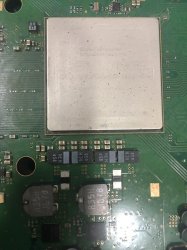
PS3 (Research/Experimental) - NEC/TOKIN Capacitors Replacement - YLOD

As expected, the electrolytic ones are the worst. but let me get this right, by the analysis on the scope, do you believe @squeept that the best setup would be having half NECs and put 16x330 2.5v on CELL and 16x330 2.5v on RSX (it has less period I believe)? By looking the images they look pretty similar to the OG NECs. If that the case, the only problem I see would be the remaining NECs, they won't last much.

6.3v tantalums work just fine, but it depends a lot of the brand, some of them are not reliable. You did an awesome job, and you actually saw how a YLOD looks on a scope too. Now I know that a PS3 full of tantalums isn't working as the original, but how bad could be these on performance? Since I didn't notice anything when playing.

"Conclusion: you're probably not going to get anything cleaner than the original NEC/TOKIN caps. Another reason to please leave them alone unless you've checked them with a scope."

But that's the meaning of this thread. Most people don't know what is a scope, and only know the basics. And instead of giving their console to a guy that only will do a rework (or reflow), this is a nice practice to learn a little about how to repair your own console. The most important thing here.
 
So based on Squeepts findings the 2.5v 330uf with the lowest reasonably possible esr is the way to go? Is it even possible to get ahold of the proper nec tokins brand new?

Lord knows I can't seem to find them listed from any reputable/reliable seller like mouser or digikey. So wouldn't that mean long term shifting to Tantalum is going to have to happen regardless of if necs might (in good shape) be superior?(I can't even find any information that suggests they still make them)
 
As expected, the electrolytic ones are the worst. but let me get this right, by the analysis on the scope, do you believe @squeept that the best setup would be having half NECs and put 16x330 2.5v on CELL and 16x330 2.5v on RSX (it has less period I believe)? By looking the images they look pretty similar to the OG NECs. If that the case, the only problem I see would be the remaining NECs, they won't last much.

6.3v tantalums work just fine, but it depends a lot of the brand, some of them are not reliable. You did an awesome job, and you actually saw how a YLOD looks on a scope too. Now I know that a PS3 full of tantalums isn't working as the original, but how bad could be these on performance? Since I didn't notice anything when playing.

"Conclusion: you're probably not going to get anything cleaner than the original NEC/TOKIN caps. Another reason to please leave them alone unless you've checked them with a scope."

But that's the meaning of this thread. Most people don't know what is a scope, and only know the basics. And instead of giving their console to a guy that only will do a rework (or reflow), this is a nice practice to learn a little about how to repair your own console. The most important thing here.

If you're going to bother, I'd change them all out. Whatever conditions might have led to a failure would have affected them all similarly, so they may all be on the way out. It just seems like a hassle to disassemble and reassemble multiple times instead of doing it all at once.

I doubt it will impact functionality or performance at all. The problem is the few I've changed over all run at a higher average voltage. It will hasten the electromigration that will eventually kill all of the chips. I couldn't even begin to guess at the timeframes involved, I just know that it's bad. Ask around on some of those hardcore PC overclocking forums if you want some realistic guesses.


So based on Squeepts findings the 2.5v 330uf with the lowest reasonably possible esr is the way to go? Is it even possible to get ahold of the proper nec tokins brand new?

Lord knows I can't seem to find them listed from any reputable/reliable seller like mouser or digikey. So wouldn't that mean long term shifting to Tantalum is going to have to happen regardless of if necs might (in good shape) be superior?(I can't even find any information that suggests they still make them)

I've seen some on eBay and Aliexpress, but I have doubts that they're genuine.

2.5V, as close to 4800uF as possible, and as close to 1 mOhm ESR (per TOKIN replaced) as possible. When using all identical caps, ESR calculates like capacitance in series (a single caps' ESR divided by the total number of caps). So, if replacing a single TOKIN, four caps with an ESR of 4 mOhm each will equal 1 mOhm ESR when in parallel.
 
Last edited:
Conclusion: you're probably not going to get anything cleaner than the original NEC/TOKIN caps. Another reason to please leave them alone unless you've checked them with a scope.

Otherwise, to the surprise of probably nobody, get as close as possible to all of the major original specs (capacitance, voltage, ESR). No good comes of any change in either direction.

Electrolytics do not work. If you had some success from replacing half and half with them, it's definitely because you removed the bad cap (or the microscopic shift from reassembly :butterfly:), not because you added electrolytics. Stop it.
The waveforms of NECTokin are beautiful. Probably the best to replace a truly dead one with a fresh one and not this shady tantalum cap fix
 
The waveforms of NECTokin are beautiful. Probably the best to replace a truly dead one with a fresh one and not this shady tantalum cap fix

That's the problem though. They don't make these capacitors anymore. It is literally impossible to buy a new one. At best you will get New old stock.
 
If you keep it as he said @ 2.5V and as close to 4800uF as possible then i don't see any issues to be honest.
And also i haven't seen any tantalums failure yet so for the time being all is going good.
If you guys know any failures let us know.

Στάλθηκε από το POCOPHONE F1 μου χρησιμοποιώντας Tapatalk
 
When the specs are matched well it's clean, but for whatever reason, it's all about 0.1V higher than the originals. Granted, the schematics list the GPU being supplied with 1.2V, but then there's the real world under load. Every system with the originals that I've measured is closer to 1.1V.
 
As you most possibly know 0.1v difference is neglectible so i would consider it a safe option.
What you are suggesting here is the path i followed and is unmistakable. Big bow to you for your verification of my findings.

Στάλθηκε από το POCOPHONE F1 μου χρησιμοποιώντας Tapatalk
 
0.1v is pretty massive when overclockers seem to talk about raising in 0.01v steps. The first couple of google results for "overvolt cpu" have anecdotes of people insta-cooking their processors with 0.2v extra.

Again, this is not something I'm well versed in, I'm just passing on what I've read. Ask the fellas on the forums at Anandtech what their real life experiences have been with the reliability of overvolted processors.
 
Alright long time no see eh? Anyways I haven't really touched my CECHB01 since i last posted in the summer of 2019

I recently took it out of storage and wanted to see if it would maybe work. I didn't really, same issues i had since i replaced all NECs.

today I decided to buy flux and redo my entire soldering job
And that's exactly what i did for 2+ hours. put her all back together and i got the GLOD and usual graphics junk. I let it play a PS2 Disc for about an hour just to let it heat up. After that i quit the PS2 game and i poped in LEGO Batman TVG (PS3 Version) and it worked fine i even tried GTA 5 and that ran almost perfect for a half hour(until i quit the game). This was the longest the PS3 has ran without issue since the all NEC replacement(i might let it sit overnight and see what happens). Whenever i closed the game or application it would give me a pink screen quickly or a static screen for a moment. So far though after the whole unit got warm system is reporting around 75c for an hour it seems to be working fine. Idk how or why that is? But im not complaining. I know this luck will run out once i turn it off and let it rest for hours, then it will go back to the good ol GLOD/scramble graphics so yeah any ideas? This kinda reminds me of how the system wouldn't crash or have issues when it got warm with all the NECs intact
Currently as I write this im installing a game to the HDD and its doing that fine

anyways if you have any ideas how this is happening let me know im interested in your thoughts, Cheers everyone

EDIT: i had moved the system vertically and it instantly froze in game. Reboot wouldn't show a picture while vertical. Moving back horizontally fixed all those issues. Very strange

@Naked_Snake1995
 
Last edited:
Sounds like your rsx is bad man. Graphic artifacts are a key sign of tha . You may try a reflow with some flux to see if it changes anything. That will tell you if you need a reball If not that rsx is going dead.
 
Thanks for contributing all of that info and testing @squeept That's great as t we have actual baselines now to compare against for better diagnosis in the future. Thank you
 
@squeept what if we mix the tantalum with the ceramic capacitor like the picture... will it be clean signal as nec tokin?
 

Attachments

  • WhatsApp Image 2020-03-18 at 11.41.58 PM.jpeg
    WhatsApp Image 2020-03-18 at 11.41.58 PM.jpeg
    108.9 KB · Views: 207
@Revak3115 Sounds like you have problems on RSX's BGAs. If you want to make it run as it does now, just bend a little the RSX's clamp, that will help to make some extra pressure on those BGAs, so you won't have any bad contact, since that is actually what I think you are facing. If you wanna do it "full job" style, delid both processors, and do that clamp thing on RSX, 'cause your temps aren't that good.
 
@Revak3115 Sounds like you have problems on RSX's BGAs. If you want to make it run as it does now, just bend a little the RSX's clamp, that will help to make some extra pressure on those BGAs, so you won't have any bad contact, since that is actually what I think you are facing. If you wanna do it "full job" style, delid both processors, and do that clamp thing on RSX, 'cause your temps aren't that good.
Ah yes I understand why you guys think this is a RSX issues.
Ever since i did a full NEC replacement it started doing artifacts so i think it has to do with the chips not getting proper power from the tantalums.
Since everytime i did touch up my solder work it would fix it temporarily. Before i did all the NECs it was perfectly fine

also it froze when I turned it on again but a reboot worked and I played COD ghosts for a half hour perfectly fine. Currently playing Lego batman again no issues
If it was the RSX it doesn't explain how if i stand it up it will crash and stop showing a picture
Its the tantalums. I had none of these issues before the replacement so something isnt right about them or how i am doing it
 
Last edited:
@squeept what if we mix the tantalum with the ceramic capacitor like the picture... will it be clean signal as nec tokin?

This is a design question that I long ago drank away the required knowledge, but those hundreds of ceramics that are in parallel at various points on the board are serving a different function. I can experiment a little more this weekend and see if I can figure out anything, but I'm guessing ceramics don't have the right qualities to help anything in this spot.

Ah yes I understand why you guys think this is a RSX issues.
Ever since i did a full NEC replacement it started doing artifacts so i think it has to do with the chips not getting proper power from the tantalums.
Since everytime i did touch up my solder work it would fix it temporarily. Before i did all the NECs it was perfectly fine

also it froze when I turned it on again but a reboot worked and I played COD ghosts for a half hour perfectly fine. Currently playing Lego batman again no issues
If it was the RSX it doesn't explain how if i stand it up it will crash and stop showing a picture
Its the tantalums. I had none of these issues before the replacement so something isnt right about them or how i am doing it

This is the exact description I gave (and was mocked repeatedly...) of what would happen when there is a BGA defect and how replacing the caps could temporarily fix it, right down to how it could even work just from being set on a desk at a different angle.

Sorry, you've got a crack. It was either there before but still had mechanical contact, or it finished cracking when you took the system apart.
 
This is a design question that I long ago drank away the required knowledge, but those hundreds of ceramics that are in parallel at various points on the board are serving a different function. I can experiment a little more this weekend and see if I can figure out anything, but I'm guessing ceramics don't have the right qualities to help anything in this spot.


This is the exact description I gave (and was mocked repeatedly...) of what would happen when there is a BGA defect and how replacing the caps could temporarily fix it, right down to how it could even work just from being set on a desk at a different angle.

Sorry, you've got a crack. It was either there before but still had mechanical contact, or it finished cracking when you took the system apart.
So in your experience how often is the case internal die transistor failure vs substrate failure/warping vs actual cracking in the solder points/balls between the substrate and the main board?
 
This is the exact description I gave (and was mocked repeatedly...) of what would happen when there is a BGA defect and how replacing the caps could temporarily fix it, right down to how it could even work just from being set on a desk at a different angle.

Sorry, you've got a crack. It was either there before but still had mechanical contact, or it finished cracking when you took the system apart.
hmm interesting. maybe it is that then. either way i will try and fix my solder job again whenever i feel the time is needed, atm it takes 5+ tries to even boot the system into a game. it will play GTA 5/COD Ghosts for as long as i want it to its weird and it wont give any issues in game. but if i close the game sometimes it will freeze and i have to try and boot it again. tbh it seems like i have a lose connection on a tantalum. since after "fixing" my solder job yesterday using flux and time etc it will actually play for hours and thats the first time it will do so since before i did all the NEC replacements. as much as this seems like a BGA/GPU failure i dont believe so. maybe im wrong but im optimistic about this becoming 100% working again, i would say its 90% back to normal
 
Hey all, I've been reading through this entire thread for the past week in my spare time and wanted to try to contribute to this thread by taking a basic analytical approach to this topic.

I have an 80GB PS3, model CECHE01 that i obtained from eBay for $30. I have another CECHE01 sitting in my closet that I've owned, but I got one from ebay to practice on.

So with this PS3 I want to take a more analytical approach to fixing the YLOD. It seems everyone is going directly to replacing the NEC/TOKIN capacitors and you guys are having mixed results, with the majority being successful. Others seem to have other underlying issues that are contributing to the YLOD.

My goal for today, is essentially break down this PS3, make some notes on its condition, clean it up, and start with what is known to fix - temporarily - the YLOD; The Heat Gun trick.

So first off, I connect power to the PS3. Flip the Power Supply switch.

We got a Red Light. Cool. This means there isn't anything out of order at the moment.

Now its time to press the Power button.

Immediate YLOD - roughly within 1-2 seconds of pressing the button.

So lets disassemble this unit and see if theres anything out of the ordinary.
Right off the bat, the rubber plug on the Security Torx screw is missing and warranty sticker is gone. This was definitely opened previously. And as I keep taking it apart I see more evidence of what looks like a quick job: The tape that holds the ribbon cable to the memory card reader is ripped. I don't care that the tape is ripped to be honest as its actually required so you have some slack on the cable so that you dont rip it out of the connector, or worse, rip the connector off.

So while I have the upper shell off, before breaking it down further, I noticed a couple posts that they were able to get the PS3 to boot to the XMB taking multiple attempts to boot by repeatedly pressing the power button over a period of time as the time to YLOD eventually gets longer until it fully boots. I did this over the course of 10minutes, it goes yellow immediately.

As I keep disassembling, I see more and more evidence of a possible reflow - there are smudges of thermal paste on the shield below the power supply (Which is an APS-226)

kJaOhTq


5h2mlcd


pCb2PoU


As someone who works on cars, and over 10 years ago I was modding PS1's and PS2's, when I do any work - I make sure to clean up after myself and make everything look like it was never touched. So the smudges of the previous guy on the motherboard shield, in one area even having some thermal paste smudged on one corner of it... It bothers me. Keep yourself clean and clean any mess. I'm OCD about cleanliness. Like honestly... if your job with the PS3 is done and you're about to close it up for the last time.... take some alcohol with a soft pad and wipe everything down. /rant

Anywho, keeping on to the teardown... brown dust, very minor buildup however, almost imperceptible smell of smoke (yuck), hdd cage has the highest buildup of this brown dust.

xA5zLyf


AsOXUch


p0Zh7zv


Here's another rant for you.... I used to smoke, I smoked for about 10 years and I finally quit. Cold Turkey. Pure Will-Power. No gums or pills to help. Its a disgusting habit and completely unhealthy. I have never smoked inside my house, nor indoors anywhere. The stench of stagnant smoke lingering everywhere makes me puke. Yes, I still smoked, but never indoors. Once I clean up all this nasty stuff from the metal components, you'll see exactly why its just terrible to be smoking indoors.
How did I quit? I came to the realization that I don't like the smell on my clothes and fingers, I like being able to breathe freely, I love to smell when people cook and love to be able to taste the food I eat. Sure smoking made me feel great after dinner but that's more of a psychological thing. So I just quit. It was rough for a little bit, but eventually I came to feel better than I can remember.

This looks like normal dust, just grey, but seems like this is quite old as its embedded in there in a few areas.

JhMEvZz


Even the crevices in the eat pipes have this old dust, so whoever and however many people took this console apart, they don't clean everything like I do.

Can't say I didn't expect this. This connector is so tiny and apparently it wasn't installed very well at the factory to begin with for this to happen. This was done by Mr. Thermal Goopy-Hands I would imagine.

kqJilNZ


When I was re-assembling the PS3 I was able to reinsert the pin into the connector plug with no issue, except the pin is easily removed from the plug, and the connector on the motherboard is pulled out, so its hard to separate the male/female connection (like two dogs mating :beguiled:)

Keeping into the theme of finding more dust/tar buildup on the motherboard shield. The buildup was enough to cause heavy pitting on any metal surface, such as the HDD cage and the heat-sink assembly. The pitting is likely caused by the minor acidic properties of cigarette smoke particles (this is why your teeth get stained)
All of this dust/dirt/tar/smoke was cleaned off using 91% IPA but the damage was done.
V833iBR


WQNulAc


7Lvwf9t


It took a lot of time to clean partly because I had YouTube on the TV and would get distracted, but you do want to take your time with this since you don't want to mess anything up. Even if you're practicing repairing PS3's. Going slow helps make sure you keep track of what you're doing, and who knows, if you manage to fix it.... you can sell it on eBay for a nice profit. Photos of the cleaned up PS3 will come if I manage to repair this unit.


S2Z4sOj

While taking all of the thermal pads off the motherboard, I noticed that the NEC/TOKINS had some very thin type of pad. More like a thick paper with adhesive. On the top side of the motherboard (installed in the shell) this "paper" on the NEC/TOKINs of the RSX had bubbled up. Is this evidence that the RSX or the capacitors, or both, had heated up enough that it caused it to bubble? In my experience with working on soldering audio wires for custom car audio, and then burning electrical tape by mistake - it would take a tremendous amount of heat for this to happen. Could this also just be the characteristic of the 'paper' when it reaches a certain temperature? this is surely an indication of some sort of overheat condition. However the capacitors look in great shape with no warping or damage. But now that I had time to think about it as I took a break from typing this post out, its definitely the result of a reflow. the one on the CELL looks perfect. I just threw them out because once i removed them, they had no adhesive left and were just stuck to the capacitors with the ink on their lettering.


Now comes the fun part. Stage 1 of YLOD repair.

As we all know, the 'heat gun trick' has been the go-to, albeit, temporary solution. Most who have done this method came to the conclusion that its a temporary measure at best and only really used to backup your data at the time, so that you can replace the PS3.
For this post, i will focus on the "heat gun trick" ONLY on the RSX as this was the age old, go-to method to revive a YLOD PS3 - for an hour, day, week, month, or year. Eventually, you'll get the YLOD again.

To make sure i didn't damage anything surrounding the RSX, i used kapton tape around it and as close to the GPU as possible, then added some aluminum foil attached to the first application of kapton tape so that i dont make a mistake and apply heat where I don't want it.

I used a Yihua 82BD+ soldering station. I set the hot air to as low as it will go, which for this unit was 212*C and using 35% airflow. Slow and steady movements for 15minutes.
I left the work area and ate dinner to let it all cool down. By this time I was at hour 4 of working on this PS3.

Assembled it all up, still YLOD.

It was a long day today and I'm not going to bother doing anymore work. Today was a lazy day off from work.
This weekend, i'll bring it back out to see if only heating the NEC/TOKINs for the RSX has any effect on the YLOD. Of course, if that doesn't work. Then we'll need to dive a little deeper.
I know my temp on the hot air was low, but I wanted to see what would happen. Very first thing I'm going to do before trying another alternative is to up the temp of the hot air to 350*C and some flux for another reflow attempt maybe.

One of the other things is to check all fuses and if any are blown, to find the cause and replace the component - such as this video that was shown earlier which fixed the YLOD.


Thats all for today folks.

 
Back
Top