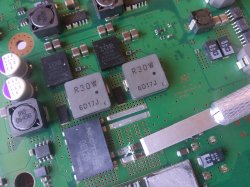
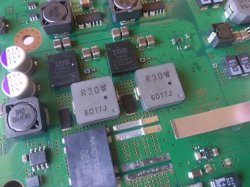
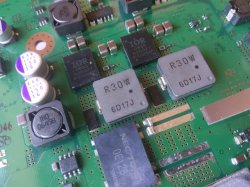
PS3 (Research/Experimental) - NEC/TOKIN Capacitors Replacement - YLOD

by the way, is it really that neccesary to use 470uf for ps3 phat? i mean, 330uf x 4= 1320uf. I know that another user said this was okay, but i keep wondering if it really is. @RIP-Felix
Depends on the model and processor (RSX or CPU). J-Q models use the 1000uF NEC/TOKINs on the RSX (4000uF total). For those models you can use 3x 330uF for each RSX, totaling 3960uF which is close enough. A-H models used the 1200uF (4800uF total). So 3x 470uF for each tokin is 5,640uF. It's significantly higher, but there doesn't seem to be a detrimental effect. We've experimentally determined the sweet spot is at 4800uF, and going crazy over (like 10,000uF) actually results in worse performance, not better.

One thing to keep in mind is that all PHAT PS3 CPU's used the 1200uF NEC/TOKIN. So you could use 4x 330uF or 3x 470uF, doesn't really matter. Except my PCB only fits 3. So that limits you to 470uF. The point here is that we're trying to mimic the tokins. Provided an equivalent replacement. As close to the same Capacitance, ESR, voltage, frequency response curve. That's not possible, but it can be adequate.

If you want to learn more about the specifics read pages 167-168. I dove deep! Also, here is a link to the caps I used and can confirm do work (on an A model). 2R5TPE470M7. They are about $40 for 24 of them, but they are guarinteed to work as advertized.
 
Last edited:
Connecting to the SYSCON is accessible for everyone and can help you isolate a tokin problem if there actually is one.
So even for preservation it's probably a better idea to get ready to diagnose instead of messing with the tokins which will probably be fine.

Thank you for the info! It's easy to get caught up in these repair threads and want to fix it even if it's not broken. You are probably right. If Tokin failure really is that rare, then it's probably not worth being proactive. Also, I have never even tried using SYSCON, this seems like a more practical place to start the repair process. I was never really a fan of don't fix it unless it's broken. I more like the ideal fix the flaws so it doesn't break. However, it does seem pretty rare from what I'm reading so, I guess it's not such a big deal. Maybe a lead-based reball would be more beneficial. :highly amused:

  1. This if for the intermediate moder (not beginner) that needs a NEC/TOKIN replacement. 80 1002 SYSCON code

Ok, thanks for all of the great information! That is what I thought. I still really like the idea of being prepared, but it may not be practical for me to experiment with working systems... then break them. Although, it would theoretically be better to test this way to eliminate conflicting results and to test stability.lol It's still great to see how far this has come. I still really want to get some of these to keep on hand just because I think it is cool! but I'm thinking it might be best to wait for when there is a bit more information about which caps are best or to wait for fully populated boards... If that becomes a thing.:excitement: Best of luck with the experiment! I'm excited to see where this goes!
 
...I more like the ideal fix the flaws so it doesn't break. However, it does seem pretty rare from what I'm reading so, I guess it's not such a big deal. Maybe a lead-based reball would be more beneficial. :highly amused:
Here are my preventative maintenance recommendations by experience level...

Novice (every PS3 owner should do) or have done:
  • Delid the CPU/RSX and apply high quality thermal paste.
  • Jail-break the console to install webMAN mod and get off the INSANE fan curve SONY used! Alternatively, the SYSCON script allows you to edit the fantables if you want to change it manually, without jail-breaking. However. it's an intermediate mod and is on the hackier side.
Intermediate:
  • Extreme Thermal Interface Materials: I just bought some indium foil (CoolLaboratories MetalPad) that I'm going to try using. It's like liquid metal except it melts at 57C and has a much lower volatilization rate (won't evaporate like LM) and doesn't contain corrosives, like gallium (which alloys with Copper and Nickel, soaking in and drying up). It remains a solid below 57C, and if you use webMAN mod to keep the temps around 55C then it's safer to use.

Those will stave off the YLOD for as long as possible. Once you get it however, then you have an excuse to continue down the expert mods path. Why not, the console is already broken! That includes trouble shooting to discover and fix the problem. If tokins then tantalizers will do. If RSX then...

Expert:
  • Check out the Frankenstein PHAT with a 40nm RSX thread! Basically there is a mod chip from indonesia that now allows us to swap out the BC killing 90nm RSX for a 65nm or 40nm. Not only does this mean YLOD consoles that couldn't be repaird in the past, due to a shortage of replacment RSX chips, can be now, but it also means they will run WAY cooler. This has the potential to keep BC console running as reliably as the slim models! It's difficult! Only for expert moders, but it's the most exciting development in PS3 modding IMO.
 
anyone know if there a cleaner looking type of capacitor that compliments the board? That would be suitable?
 
Here are my preventative maintenance recommendations by experience level...

Novice (every PS3 owner should do) or have done:
  • Delid the CPU/RSX and apply high quality thermal paste.
  • Jail-break the console to install webMAN mod and get off the INSANE fan curve SONY used! Alternatively, the SYSCON script allows you to edit the fantables if you want to change it manually, without jail-breaking. However. it's an intermediate mod and is on the hackier side.
Intermediate:
  • Extreme Thermal Interface Materials: I just bought some indium foil (CoolLaboratories MetalPad) that I'm going to try using. It's like liquid metal except it melts at 57C and has a much lower volatilization rate (won't evaporate like LM) and doesn't contain corrosives, like gallium (which alloys with Copper and Nickel, soaking in and drying up). It remains a solid below 57C, and if you use webMAN mod to keep the temps around 55C then it's safer to use.

Those will stave off the YLOD for as long as possible. Once you get it however, then you have an excuse to continue down the expert mods path. Why not, the console is already broken! That includes trouble shooting to discover and fix the problem. If tokins then tantalizers will do. If RSX then...

Expert:
  • Check out the Frankenstein PHAT with a 40nm RSX thread! Basically there is a mod chip from indonesia that now allows us to swap out the BC killing 90nm RSX for a 65nm or 40nm. Not only does this mean YLOD consoles that couldn't be repaird in the past, due to a shortage of replacment RSX chips, can be now, but it also means they will run WAY cooler. This has the potential to keep BC console running as reliably as the slim models! It's difficult! Only for expert moders, but it's the most exciting development in PS3 modding IMO.

do u have a name and photo for that mod chip
 
Thank you for the info! It's easy to get caught up in these repair threads and want to fix it even if it's not broken. You are probably right. If Tokin failure really is that rare, then it's probably not worth being proactive. Also, I have never even tried using SYSCON, this seems like a more practical place to start the repair process. I was never really a fan of don't fix it unless it's broken. I more like the ideal fix the flaws so it doesn't break. However, it does seem pretty rare from what I'm reading so, I guess it's not such a big deal. Maybe a lead-based reball would be more beneficial. :highly amused:


Ok, thanks for all of the great information! That is what I thought. I still really like the idea of being prepared, but it may not be practical for me to experiment with working systems... then break them. Although, it would theoretically be better to test this way to eliminate conflicting results and to test stability.lol It's still great to see how far this has come. I still really want to get some of these to keep on hand just because I think it is cool! but I'm thinking it might be best to wait for when there is a bit more information about which caps are best or to wait for fully populated boards... If that becomes a thing.:excitement: Best of luck with the experiment! I'm excited to see where this goes!
Well, remember that removing the Tokins blindly is a bad idea for more reasons than that.
Not just because they are probably fine and are not causing problems... Which is reason enough of course.

The procedure itself can go wrong and even if it doesn't, is very intrusive and non reversible. Especially if you use hot air (which you shouldn't at all), the whole board will be put under stress, and the main processors are sitting right there.
Soldering them in properly can be tricky for novice too. And it probably affects performance as well.

But also, these Nec Tokins were high end. It's not easy to match their electrical parameters. As Felix says, there aren't even tantalum capacitors in the market than can surpass or even match the ESR and other specifications of the Nec tokin proadilizers. They just don't really exist. Imagine then if your capacitors are poor quality then.

You will always be aiming for something that is "close enough". Yes it will surely work, and probably more than good enough. But not better than original. Will this matter in the long run? Who knows? And if you don't have an oscilloscope, you will never know if you are actually making it better or not. Probably worse.

As a funny anecdote, the guy NakedSnake1995 himself of all people reported not long ago that he did something interesting:
He eventually got rid of his tokin fixed system and got another untouched one.

Cheers
 
do u have a name and photo for that mod chip
There are no silly questions, only silly answers.
As for rude, both exist.

He already pointed you to more information. But you probably noticed already since you read everything. Which is good.
Don't forget the part that says "for Expert technicians only (Reballing x4, good sacrificial boards required, fluent indonesian helps)" either.

Still, it's a victory of course
 
Here are my preventative maintenance recommendations by experience level...

Thank you for the info. I'm still hesitant to attempt a delid. I practiced on a dead board recently and it didn't turn out too well. quite a few scratches on the CPU. I would definitely want to get a tool from NSC if I did a second attempt myself. It's pretty pricy, especially with overseas shipping. I think he quoted $40 plus shipping... for a modified nail file. It is a good tool though, better than what I made. :congratulatory: I should probably do this soon though. As for jailbreaking. I have done this with all my systems already and have Webman mod. There are too many good features to not jailbreak IMO. :chuncky:

As a funny anecdote, the guy NakedSnake1995 himself of all people reported not long ago that he did something interesting:
He eventually got rid of his tokin fixed system and got another untouched one.

That's really good to know. It is probably best to not mess with those on a working system then. I have been looking up repair services and what they offer. I was thinking of being proactive with just one of my systems and getting the flaws "repaired" before failure. I found this shop:

https://ps3specialist.com/playstati...years-warranty-you-choose-your-warranty-term/

I've been wondering if it's worth it to get them to do a lead-based reball and delid for me on a working system for prevention. It is pricy, over $200.

$134.99 - for a reball
$40.00 - for a delid
$35.00 - for shipping
? - to ship to them

I'm comfortable doing a delid on the RSX, but not the CPU, since I have screwed it up on my one attempt. I definitely am not comfortable with doing a reball myself or have the equipment to even do it.

I can do other mods like power supply relocation or even replacement like the dell power brick mod (360 style). :chuncky: I'm thinking if I can get the PSU out of the way I can have an internal fan there. I think the board should have a fan on both sides. It's just a giant heat trap on the one side as it is IMO. Of course, I can do these mods without a delid or reball too.

I'm kind of torn though. Reballs/delids can always be done later, but I'm worried to do a delid myself, and If I'm paying for the other three parts or a $40 tool from NSC why not go all out for a reball and delid from a professional now?

I have been very lucky and have paid very little for my systems, but I have a ton invested in accessories and games which is why I don't mind the cost so much for the system to last a lifetime. It's crazy how old systems like the NES can easily last almost 40 years now with basic care, while new systems are expected to die in less than 20 years even with intrusive maintenance. I guess heat and complexity really add up.
 
Well, remember that removing the Tokins blindly is a bad idea for more reasons than that.
Not just because they are probably fine and are not causing problems... Which is reason enough of course.

The procedure itself can go wrong and even if it doesn't, is very intrusive and non reversible. Especially if you use hot air (which you shouldn't at all), the whole board will be put under stress, and the main processors are sitting right there.
Soldering them in properly can be tricky for novice too. And it probably affects performance as well.

But also, these Nec Tokins were high end. It's not easy to match their electrical parameters. As Felix says, there aren't even tantalum capacitors in the market than can surpass or even match the ESR and other specifications of the Nec tokin proadilizers. They just don't really exist. Imagine then if your capacitors are poor quality then.

You will always be aiming for something that is "close enough". Yes it will surely work, and probably more than good enough. But not better than original. Will this matter in the long run? Who knows? And if you don't have an oscilloscope, you will never know if you are actually making it better or not. Probably worse.

As a funny anecdote, the guy NakedSnake1995 himself of all people reported not long ago that he did something interesting:
He eventually got rid of his tokin fixed system and got another untouched one.

Cheers

I wish I had read more into all this before I replaced 4 of mine. Now I'll probably be stuck with this dead board. Because even after doing that it still didn't work. But I've learned a ton since then haha.
 
...I was thinking of being proactive with just one of my systems and getting the flaws "repaired" before failure. I found this shop:

https://ps3specialist.com/playstati...years-warranty-you-choose-your-warranty-term/

I've been wondering if it's worth it to get them to do a lead-based reball and delid for me on a working system for prevention. It is pricy, over $200.

$134.99 - for a reball
$40.00 - for a delid
$35.00 - for shipping
? - to ship to them

I'm comfortable doing a delid on the RSX, but not the CPU, since I have screwed it up on my one attempt. I definitely am not comfortable with doing a reball myself or have the equipment to even do it...
There are too many bad reports about that PS3 specialist guy, so I'd stay away!

I would say the only flaw in the PS3 phat model is the 90nm RSX. I wouldn't say that lead-free is the problem either.
True lead solder has better elasticity and will last longer, but lead balls will crack eventually too. It's maybe a 1000 cycles later, but not the miracle cure people think it is. The CPU is lead free and it doesn't have problems! And it routinely runs hotter. It doesn't have nearly as many heat-up/down cycles like the RSX does, however, so that's probably why the RSX dies sooner despite having lower max temps. There might also be something peculiar to the RSX design and how it interfaces with the Motherboard that makes it prone to failure. All of this is simulated and planed, down to the mean thermal cycles to failure based on delta T's and average play time. SONY conveniently set the warranty just outside this projected death time. This is standard simulation testing and iterative design for teams of engineers. Everyting from materials and thermals can be computer simulated for durability and they can test out minor tweaks here and there to dial in the performace goals. They balance these design goals such as reliability and sound performance, with profits. You have to take into consideration warranty repair expenditures and liability if you push it too close to the thermal limits, but building in too much reliability eats into profit margins. To give you an idea of how close to the edge companies ride, SONY they narrowly avoided a recall debacle similar to the one MS had with the XB360. MS lost 1Billion dollard recalling the 360! It's a hard job to project these costs and ride the line.

So far as I have been able to tell, the NEC/TOKINs have meet specification for performance and longevity. The SYSCON allows us to check brignup and shutdown cycles, and the power on time. From what I can tell the YLOD seems to occur around the 150-300day mark (3600hr-7200hr). The tokins are only guaranteed to 2000hrs, which would have put the console just oustide the 1 year service window SONY had for warranty repairs. So the tokins aren't defective, they are performing well past their rating.

This is the problems of allowing companies to regulate themselves. The incentives often run contrary to public interests. When you spend $600 on a console, you expect it to last more than 1 year, but from SONY's perspective making a console that's reliable for more than 1 year is a waste of profit. So long as they ride the line of maximizing profits whtiout driving customers away, they don't care about anything else.

No the real problem here is the consumer electronics industry being able to get away with BGA packages that operate above 50C. It's an inherently unreliable technology that both the military and automotive industries do not allow, because safety and reliability are more important than profits in those industries. Regulators don't care about protecting consumer products in the entertainment industry. It's a toy, not that important! However, if they requires all chips above 50C to be PGA, like the CPU socket on your PC, provides strain relief and thermal isolation of the hot processor, then the PS3 would last much longer and replacement of the processors would be an easy repair. But over the last 50 years there has been a concerted effort by elctronics manufacturers to destroy the electronics repair industry as a whole. This include the DIY enthusiast at home and small business repair shops all over the world. They resort to tactic like, soldered on BGA packages to make it harder to repair, propriatary chips and not providing replacements for, withholding schematics, and slandering anyone who attempts to repair. They call them pirates, thieves who clone their hardware and steal their intellectual property. It's been going on since the late 80s and has all but destroyed the TV repairman in the USA. Now we have to throw out old electronics, which has greatly contributed to the e-waste problem, and directly lead to increasing profits for companies like SONY who get to sell 2 TV to the same person, when in the past you could have had it repaired for less than the cost of a new TV. Consumer end up paying more, the small business dies, big cooperation get richer, and the earth gets twice the toxic waste.

I can do other mods like power supply relocation or even replacement like the dell power brick mod (360 style). :chuncky: I'm thinking if I can get the PSU out of the way I can have an internal fan there. I think the board should have a fan on both sides. It's just a giant heat trap on the one side as it is IMO. Of course, I can do these mods without a delid or reball too.

I'm kind of torn though. Reballs/delids can always be done later, but I'm worried to do a delid myself, and If I'm paying for the other three parts or a $40 tool from NSC why not go all out for a reball and delid from a professional now?

I have been very lucky and have paid very little for my systems, but I have a ton invested in accessories and games which is why I don't mind the cost so much for the system to last a lifetime. It's crazy how old systems like the NES can easily last almost 40 years now with basic care, while new systems are expected to die in less than 20 years even with intrusive maintenance. I guess heat and complexity really add up.
If you want a PS3 to last a lifetime get multiple and store them. Replace as needed. So long as hot chips are used reliability will suffer. This is no surprise.

So I left out other mods for a reason. Yes there are more extreeme mods, ike watercooling an cut mods, but at what point do you draw the line? About 8 years ago when I got my first A model from GameStop (for $250 refurbished...ugh!) I thought it would be a good idea to prevent the YLOD as best I could. I was able to pop the RSX off but not the CPU. I followed a guide that said cutting a hole in the bottom shell allowed cool air into the fan directly, keeping the CPU and RSX cooler. That does work, but it circumvents SONY's airflow design which uses suction that draws cool air in the front, through the PSU and over the RF shield before going through the heatsink and out the top and back. You can see how they used foam inside the console to rout the air around. It's actually a pretty efficient design and does a good job of keeping the entire console cool. I tested with a temp probe and the PSU stays about 50C when I cover the hole I cut with paper so it performs like stock. When I remove the paper and air goes directly in the bottom, the PSU and RF shield on the top side becomes a heat trapa and goes up to 65-70C! Doing this causes the PSU to overheat and die sooner unless you put a fan on it...lol! So for that console I designed a 40mm fan shroud that took the place of the media card player and taps 12v from the BluRay player. This workaround drops the temps fine, but It's not necessary if you just leave the console's stock airflow design alone. I may have gained a few degrees Celsius better temps, but it's not worth the trouble IMO. And I wonder if the RF shield is being cooled adequately (which itself cools the PS2 chips, coils, and DC-DC converters using thermal pads). I'm a bit concerned about that.

I'm not a fan of cut mods for this and other reasons.
 
There are too many bad reports about that PS3 specialist guy, so I'd stay away!

Wow! Ok... Well that's not what I thought. I'm glad I asked. I'll scratch the preventative repair idea! :encouragement:

If you want a PS3 to last a lifetime get multiple and store them. Replace as needed. So long as hot chips are used reliability will suffer. This is no surprise.

It seems like there is really no good option for a PS3 to last a lifetime from what you are saying. I'm glad I was able to pick up the three I have then. I will probably keep my extras stored then if that's really the only best solution. I will have to think about deliding and if I can learn from my mistake and do it correctly next time. I'm going to do some temp tests and see if I can get any data on "Console Total Powered On Time" to see where I'm at in my life cycle.

*fun fact about the CECHH01 I have though. When repasting I noticed there was a large gap between the plastic housing and the heatsinks. I covered these gaps with electrical tape to force the air through the heatsink and out, to have less recirculation that stays in the system. Temps were really good and the system is quiet. I don't remember the exact numbers, but I know it is my coolest system atm compared to my repasted and non-repasted CECHA01's. But there are also lots of design changes with the cooler and power supply as well on that model. However, you may be right about $onys design not being too bad on the airflow part.

So I left out other mods for a reason. Yes there are more extreeme mods, ike watercooling an cut mods, but at what point do you draw the line?

As far as, how far I want to go. Well, I wanted to go as far as reliability and sustainability requires. To have a lifelong system and not a stack of disposable cameras. lol I mean that line is not really drawn seeing how I was considering spending over $200 for an unnecessary reball and then some. :excitement: I would say watercooling and extreme mods are not off the table if it is a solution.

I'm not a fan of cut mods for this and other reasons.

I see where you are coming from. It does make sense to not make unnecessary cuts that have little to no benefit. I just wish there was a way to prevent the inevitable YLOD instead of waiting for it.

I noticed that you didn't mention the power supply relocation as a viable solution or not. This does seem like one of the more beneficial solutions to me just to remove a heat source. So if not a fan or cut mod would a PSU mod be a worthy modification? lol I know one of my CECHA01's has an APS-226 PSU. It still gets pretty hot though. I don't know about my unpasted unopened system (still has the warranty sticker that has never been removed).
 
There are no silly questions, only silly answers.
As for rude, both exist.

He already pointed you to more information. But you probably noticed already since you read everything. Which is good.
Don't forget the part that says "for Expert technicians only (Reballing x4, good sacrificial boards required, fluent indonesian helps)" either.

Still, it's a victory of course

I gotta say, your devotion to trolling this thread in such a unique way has a certain charm to it. "Ah, that comment is soooo Joe!"

are you both mocking me?
 
I noticed that you didn't mention the power supply relocation as a viable solution or not. This does seem like one of the more beneficial solutions to me just to remove a heat source. So if not a fan or cut mod would a PSU mod be a worthy modification? lol I know one of my CECHA01's has an APS-226 PSU. It still gets pretty hot though. I don't know about my unpasted unopened system (still has the warranty sticker that has never been removed).
Yeah, there is some benefit of doing that, but getting a 400W power supply is easier said than done. I prefer to keep the console intact, so I haven't seriously considered it. Power Supply are hard to get right and very important for longevity. So I really don't trust other options but SONY's official solution. The APS-226 is the most efficient PSU for BC models, so it'll run the coolest and longest. I recently found a ZSS and while it's less efficient I like it's heatsink design better (which keeps the PSU cool, but since it's less efficient it'll dump more heat into the console).

IMO the only exception to the old adage, "if it ain't broke, don't fix it," is to delid and repaste. That and custom fan curve. This is like changing the oil on a car, it's something cheap that most people can figure out how to do. A lot of people have reported success deliding the CPU using a palate knife (with edges sanded blunt), but I ground a fingernail file thin and it works great. CPU is easy to delid now...just need the right tool. I posted about it here:
So the USB adapter I linked has a connector on the end designed to be connected to the pins on a raspberry pi. It's the same square connector used for PC's HDD LED +/- , PWR btn +/GND, and front I/O. Since you've worked on PC's you'll know what I mean. So you just need to be able to connect to that. Breadboard wires are ideal, but you could hack something together using your own wires and a JST connector or something. You'll figure it out with a little ingenuity.

And for the delid tool...
Make one of these to delid the CPU:
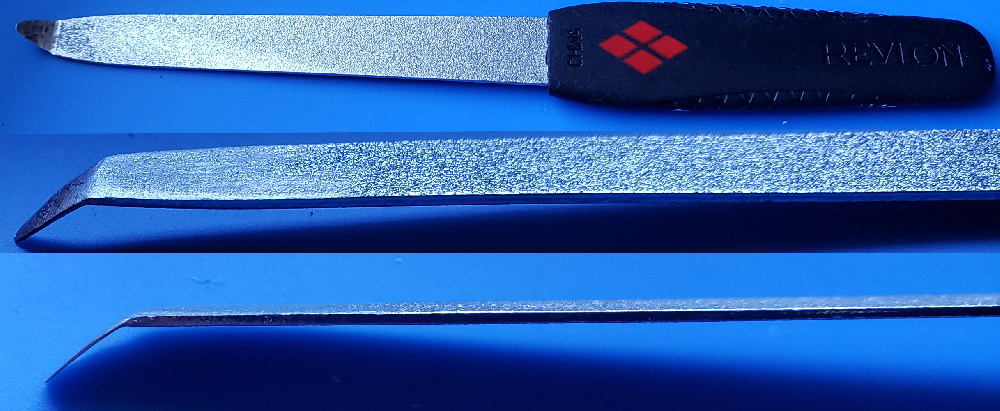
Heat up the end of a fingernail file (buy one from the store, don't grab one from the GF or Misses unless you have a death wish). Use a lighter to heat the tip up and make the metal malleable, then bend ~1cm of the tip to an angle with pliers. Now use a dremel with a sanding stone to grind away the bottom of the tip and make it very thin. It needs to be able to fit underneath the heat spreader on the CPU. Notice there is a gap in the silicone glue on one side:

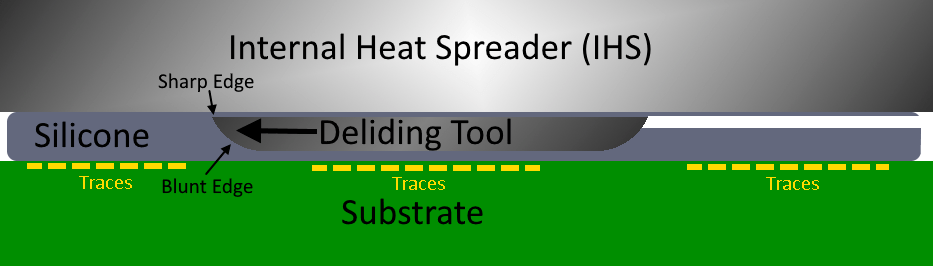
Use sand paper to blunt the bottom edge of the tool so it can't dig into the substrate, where the traces are on the CPU. That'll destroy them. Just rub the tool along some paper and if it glides smooth you'll be fine. Now use some vasoline or grease to get the tool started. Place it under the edge of the heat spreader and use firm steady pressure. Brace with both hand so you don't slip. Once the tool begin cutting it will ride along a cushion of silicone and the blunt edge will force the sharp cutting edge against the Heat spreader. Now just cut along the edge of the chip, all the way around it. Be careful at the end, when you're about to cut through or you can slip and cut something you don't want to. Just watch this video and you'll have a good idea how to do it.
For the GPU, you need to use a different method:
NSC is pretty long winded, but he shows how to safely delid the RSX earlier in the video. His method is good for doing it cold, but I don't really like his method. It's longer and hard to get a good angle. And his hammer scares the sh!t out of me! I prefer to use hot air (hair drier works too) to warm the RSX for a minute or so (not directly on the chip, but in circular motions 4-5 inches above it just, to get the glue warm, not hot). This softens the thermal adhesive enough so you can pop off the RSX heat Spreader. I use a card and a thin butter knife. The side that faces the CPU, with traces going between them, doesn't have any SMD components like the other 3 sides do. So you can only do this on that side. Heat, insert the card, then use the butter knife to get under the edge of the heat spreader. Be sure you get under the heat spreader, not just on the edge of it. You actually need to get underneath it so you can gently add prying force. Slowly add pressure until the glue gives and the heat spreader pops off. The card protects the substrate from the blunt metal edge of the butter knife. Use something thinner if you can't get under the edge with your butter knife, but be sure it's blunt or it can ding into the substrate (even digging through the card first). It need to be thin enough to get under, but have enough girth to not bend when you pry up.

Sounds complicated but the process is actually quite easy, only takes a few minutes. The hardest par is making the proper CPU deliding tool. It took me about an hour shaving down the tip to get it thin enough to fit under the IHS. I'd shave it a bit, test. Shave away a bit more, then test. Sand, test. eventually I got it to work. I have delided about six consoles now and the CPU is the easiest because of that tool. Most people can delid their RSX pretty easily, but are deterred by the silicone on the CPU. The CPU really needs it or the console will suffer from overheating.

If we're talking about extreme mods, then frankenstein's RSX mod chip allows a 40nm RSX to be placed on a BC model. That will be super reliable and remove the major cause of YLOD. @DeadEnd recently successfully installed a 40nm RSX on his BC model and it's easily holding under 68C with 20-30% Fan (which is more driven by CPU temps now). There is no one currently outside Indonesia offering the mod install service yet. And it's difficult to DIY. I just destroyed my 40nm RSX today attempting to reball the chip! But if you want to take a trip to Jakarta it's $50 including the replacement RSX. We're currently in talks with the guy who makes the mod chip and perhaps soon it'll be more available internationally (currently have to buy it through a middleman on Fiver). Most likely they would be sold as pre-modded consoles in the $400-500 range. I don't know if or when you would ever be able to send a console in for the service (in the US or Europe). So maybe now is a good time to start looking at a vacation in Indonesia! Anyway that's the most extreme mod, but it's the best solution IMO.

Otherwise, you could always try water cooling. I've seen it done and yeah it works. It's a major pain and ugly AF, but if it can keep the temps under 50C the BGA will last much longer.
 
are you both mocking me?
Let me consult a dictionary...

Mocking - making fun of someone or something in a cruel way; derisive.

...No, that's not it. Hold on, let me look at a thesaurus...

Flippant; not showing a serious or respectful attitude. "a flippant remark"

...Yeah that'll work.
 
Let me consult a dictionary...

Mocking - making fun of someone or something in a cruel way; derisive.

...No, that's not it. Hold on, let me look at a thesaurus...

Flippant; not showing a serious or respectful attitude. "a flippant remark"

...Yeah that'll work.
i'm here to find a solution for my ps3 who has ylod not for fun
 
this will probably get lost in the void but does anyone know which is the best install method, the cleanest install I seen was in a video where the guy had what looked like a smaller 330 tantalum shaped like a flattish little square which had the 4 lined up in a row on the 2 pads closest to the chips. Looked very clean though did leave a naked looking part of the board though looking at it you could probably install in many ways, I was considering ripping the old ones out without using heat then fixing the capacitors down to the side and wiring them in though even with quality wire I feel like that would cause a delay, any opinions. Also can someone give advice on best install method as heat gun looks cleaner but I worry about heating that part up on the board on the slim as it is really close to the BGA points.

I kinda like the idea of using a knife and using wires but as I said that seems like it could have issues be removing it and installing though in saying that so long as nothing pulls where intended or cracks near by I think I could get away with it on my own system.

Though people with experience will likely know the answer to this, the slim I found I am 200% sure this is the issue as it turns on a times and after its been sitting it doesn't work and you gotta keep trying or long press the button which to me seems similar to what happened with my old xbox before I replace the capacitors as when they heated up they would work then cool they wouldn't. I know I should dump the syscon but I am 95% sure this is the case in this case. Though I don't have a multimeter to double check other components but in saying that this is my practice board anyways as I got the system for free years ago.
 
this will probably get lost in the void but does anyone know which is the best install method, the cleanest install I seen was in a video where the guy had what looked like a smaller 330 tantalum shaped like a flattish little square which had the 4 lined up in a row on the 2 pads closest to the chips. Looked very clean though did leave a naked looking part of the board though looking at it you could probably install in many ways, I was considering ripping the old ones out without using heat then fixing the capacitors down to the side and wiring them in though even with quality wire I feel like that would cause a delay, any opinions. Also can someone give advice on best install method as heat gun looks cleaner but I worry about heating that part up on the board on the slim as it is really close to the BGA points.

I kinda like the idea of using a knife and using wires but as I said that seems like it could have issues be removing it and installing though in saying that so long as nothing pulls where intended or cracks near by I think I could get away with it on my own system.

Though people with experience will likely know the answer to this, the slim I found I am 200% sure this is the issue as it turns on a times and after its been sitting it doesn't work and you gotta keep trying or long press the button which to me seems similar to what happened with my old xbox before I replace the capacitors as when they heated up they would work then cool they wouldn't. I know I should dump the syscon but I am 95% sure this is the case in this case. Though I don't have a multimeter to double check other components but in saying that this is my practice board anyways as I got the system for free years ago.
Hmm, I will quote a post of mine from some time ago. Maybe it's helpful.
Here is a slim 2000 with a proper tokin fault.
It had about 2s short YLOD; this is the 09 3004 error. But the signature 80 1002 also appered in the log.

It's working stably now in games too. Second time this works for me, so it can't be such a bad idea after all. 0 of the original tokins touched. I didn't even remove the heatsink. Original paste still on.

So guys please stop removing tokins, especially if you are not sure! Even when there is actually a confirmed tokin fault... Removing should be last step. Much less when it is not.

I had posted about it in syscon diagnosis thread but I guess it belongs here more.

Cheers, and please always talk to SYSCON first. There is no excuse for not doing so. Guides and help are available. The dongle is 2$. No need to destroy anything.
(if you can't see the pictures, click on it and go to the page to see the real post)

And yeah I don't recommend removing anything especially if you are not 100% sure they are actually bad.
But if you still want to have fun with the poor board, at least use a knife. No hot air. It will be "clean" too and you'll only destroy the tokin and nothing else hopefully ... Then again if you want clean, clean your room hehehe.

Yeah I'm not telling anybody to do it, but this is the best way to remove In my opinion. I don't like talking about this because people always get the wrong impression. But at least it's better if they do the wrong thing properly I guess.
IMG_20210318_154936.jpg IMG_20210318_155434.jpg IMG_20210318_155555.jpg
 
Though people with experience will likely know the answer to this, the slim I found I am 200% sure this is the issue as it turns on a times and after its been sitting it doesn't work and you gotta keep trying or long press the button which to me seems similar to what happened with my old xbox before I replace the capacitors as when they heated up they would work then cool they wouldn't.
That is what I call a "Warm-Start YLOD." That is when a console will only start when it's warm. It's usually cause by mechanical reconnection of a BGA defect through thermal warping, and it's the most common false positive on this thread. If I hear anyone even mention a console only starting when thet console warms up, I immediately think BGA defect!!! I've heard it the other way around too, where the console will only start when the console is cold and once it warms up it YLOD. What's funny is that these people convince themselves it's the caps too..lol! Actually their problem is closer to the behavior of a genuine tokin failure (Delayed YLOD, usually associated with and YLOD during gameplay), which can understandably be confused with a cold start YLOD. (which would YLOD onec the console gets up to temp regardless of gameplay). Your 200% sureness is based on the idea that the capacitance increases when caps are warm, allowing the console to boot. That is a myth!
...I know I should dump the syscon but I am 95% sure this is the case in this case. Though I don't have a multimeter to double check other components but in saying that this is my practice board anyways as I got the system for free years ago.
Let me break this down for you. You don't know shit until you dump the error codes! It's cheaper than dirt, so you loose noting by doing it! The only explanation for your desire to jump strait into this mod without knowing if you need it is known to psycologits as confirmation bias. Other names for it are wishful thinking, gamblers ruin, and believing whatever TF you want regardless of reality kicking you in the face.

With that disclaimer out of the way...currently I like the 470uF tantalum caps better than B-Case caps. I was not able to get PS3#7 stable using the correct amount of B-Case caps on the RSX. I had to use the 470uF caps. However, I still have 4860uF of B-Case caps on the CPU. IMO the cleanest and easiest way overall is this:

c6232-jumper-jpg.31199

It's the easiest method to attach and remove...period! My PCB provides a "better" way to install the TaPol caps I recommend, but this way doesn't require a PCB and is easier to remove. It has disadvantages in the maximum current it can handle and that the leads are close to the RF shield, which make it easier to short. But it solders on and off easiest of all the solutions. It's great for testing arrays of different caps. And you can do it with any cap you want to test out.
 
Last edited:
Back
Top