Best wishes to all my friends here, this time I will share the analysis method that I usually do in the analysis of ps3 damage, which I have previously shared, this time only as a complement, hopefully useful.
As we all know that syscon plays an important role, he controls the ps3, if he feels there is a problem, the usual problem syscon checks:
1. CellBe problem
2. RSX problem
3. BootOS problems
If there is a problem with the 3 points above then he will turn off the ps3, in the form of YLOD / Lost Power.
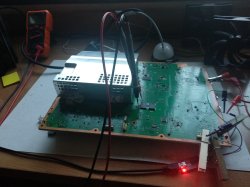
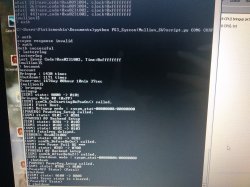
As I usually do, I will check the "pulse clk", and will analyze the pulse into "what number rule", specifically this time I will discuss rule1,2 and 3
Let's start...
Example of "pulse clk" that goes to rule1 and 2
You can see that the needle on the analog meter only reaches the highest point up to 1.5v then drops again quickly, this condition is included in "rules 1 and 2", I will explain further
1. Rules 1 (CellBe to syscon)
"Pulse clk" as above indicates there is a problem in the cellbe section, the problem can be:
A. Voltage problem
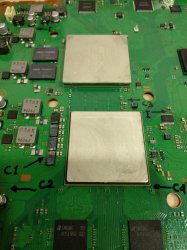
The input voltage that goes into the cellbe, look at the picture below
I will give an video example of the problematic C1 voltage
it looks like the needle on the analog meter only goes up a little, as if there is no kick power, then I will call it "no kick power"
now pay attention to the video for the voltage that I say is normal, at the voltage C2, C3, C4, I measure alternately
in the video it can be seen on the analog meter, the increase in the needle looks like it has power, there is a kick in the voltage, which in the future I call "voltage kick"
This characteristic of needle movement on an analog meter is my benchmark in determining which part of the voltage is problematic.
each input voltage that enters the cellbe has a different voltage source, in this case the damage to the C1 voltage is in the image below
the cause of the weak voltage "no kick voltage" is due to damage to the resistors around the power ic that is drawn, the size of the resistor greatly affects the output produced, I also never memorized the ohms of the resistor, usually I only compare it with other ps3 resistors normal, if there is a difference in the number of ohms, that is what I replace.
B. The tin ore under the cellbe is no longer good, with us reballing will solve the problem
C. CellBe damaged, must be replaced, replacement cellbe must be accompanied by replacement of nor/nand and syscon
Before entering Rules 2 (RSX to Syscon)
Take a break first while drinking tea ....
Ok, let's start again ...
2. Rules 2 (RSX To Syscon)
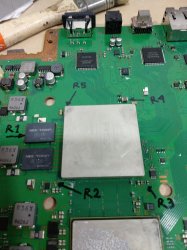
In the RSX part that goes into "rules2" usually only occurs in the problematic Voltage Section
The voltage that enters the RSX can be seen in the picture below
I will give a video example of the problematic R1 voltage
Pay attention to the analog meter, the needle increases only a little, "no voltage kick"
I will give a video example of the voltage R2, R3, R4 which I consider normal, the one with "kick voltage", I measure alternately
as I explained earlier, the movement of the needle on the analog meter is my benchmark for determining the problematic part of the voltage.
Now our way to fix the damage to the voltage section R1
I will divide it into 2 parts based on RSX
+RSX CXD2971x, CXD2982x, CXD2991x:
This type of RSX uses NEX TOKIN, if the needle on the analog meter shows movement as in the video, you can be sure that NEC TOKIN has a problem.
Usually occurs on the NEC TOKIN which has the numbers 102 and 108 (Type CECHI,J,K,L and Slim DYN-001), on the number 128 (Type COK-SEM-DIA) there are also but rarely has a problem.
How to fix it?
a. replace with the good NEC TOKIN (I rarely do)
b. add 2 pieces of tantalum 470uf as shown below (DYN-001
+RSX CXD2971x, CXD2982x, CXD2991x, CXD530xx
This type of damage can also be caused by the input voltage coming from the power ic as shown below
Image is taken from DNY-001 (as an example only)
The weak R1 voltage is caused because there is damage to the resistor around the power ic that is drawn, as usual I have never memorized the number of ohms of each resistor around the power ic, so I only compare it with the resistor on the normal PS3.
3. Rules 3 (CellBe To RSX)
We arrived at rules 3, below I will give a 2 video "Pulse CLK" : video1 enters "rules3" and video2 final of "rules3"
When entering "rules3" you can say there is no problem with the voltage in CellBe and RSX, so the problem that occurs with "rules3" is usually only a problem with the relationship between CellBe and RSX, CellBe and sub (CXD9964)
I will give examples of problems that are often encountered from ps3, especially on the RSX CXD2971, I took pictures from the DIA-001

remember !!!, this is just an example, in my picture the pin-pin connection data from CellBe to RSX, a common problem that occurs in the CXD2971, when measuring resistance in IC using a digital meter (fluxe) pin 1 and pin 2 is drawn shot , pin1 and pin2 are connected internally in RSX, which shouldn't happen, that's what causes PS3 YLOD. Then I heat the RSX CXD2971 with a temperature increase of max 200c for 15 minutes, after it cools down I re-measure pin1 and pin2 that were previously connected, the RESULT? pin1 and pin2 separate back to normal, no longer connected, from such conditions I conclude that using heat can change the conditions inside the RSX CXD2971, but such repairs cannot last long, 2-3 days later pin1 and pin2 are shot again, reconnected Internally in RSX, there are a lot of similar cases like this with different results, but from the many ps3s that have been treated like this, I conclude:
1. RSX that has never been HEATED, will last quite a long time, approx. 3-6 months, will have a longer lifespan if it is used frequently, harvested continuously
2. RSX that has been HEATED, DON'T WASTE YOUR TIME, REPLACE RSX CXD530XX IMMEDIATELY !!!!!
That's why my brother("KIAW'S) made the MODRSX IC so that the old CXD2971 could be replaced.
how to heat RSX like this can only be done on RSX CXD2971, does not apply to other RSX, why? Ask Sony ...(what is clear is that the make is different)
BUT if you don't have a problem doing that, it's okay too, in principle heating to 2,3,4,5 makes the PS3's life time less and less, it's good that it doesn't interfere with other components, until it's time you replace the RSX ...
other than heating (CXD2971 only), repairing ps3 that enters "rules3" is by:
1. Replace tin ore, reballing either RSX or Cellbe, just one of them
2. Replace RSX or Cellbe because it is damaged
It seems that I also explain it for a long time, I leave it up here, hopefully it will be useful and keep up the spirit, as usual, no method is perfect, take the important parts, combine it with other methods, make it more perfect, that too is my hope , I am 47 years old, my ability to service has decreased, my eyes are also myopic, I like your enthusiasm in finding and learning something new, I hope that in the future you can produce more perfect methods I pray everyone will be well always (