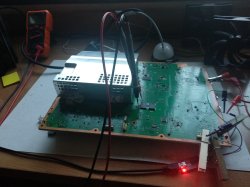
PS3 Frankenstein PHAT PS3: CECHA with 40nm RSX

simply the IC will not work if:
1. The voltage is mismatched
2. bad contactor
3. There is damage inside the IC
cellbe ic gets 4 voltage inputs, ramcellbe ic gets 2 voltage inputs, rsx ic gets 5 voltage inputs of which 1 voltage input is specifically for ramRsx ic. to bypass "rules no.1 and 2
the input voltage that cellbe and rsx can have must be good, otherwise it cannot enter "rule" no.3, The needle "clk pulse" will only reach around 1.5v then drop the shotdown.
if you pay attention later when entering "rule" no.3, you will be able to measure the incoming voltage.
Thank you so much for sharing this valuable information.

Now it occurs to me that maybe you would be interested in learning some things from our side of the language barrier too. In case you didn't know already.

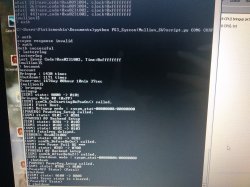
To complement your great "rules" we have the possibility to connect to the SYSCON UART interface using a special python script, and use some commands to retrieve error codes and help you diagnose the problems.
Like an official SONY technician would do.

The discussion is here:
https://www.psx-place.com/threads/f...first-steps-and-error-reporting.30100/page-64
But you feel like it's difficult for you to understand, don't worry we are happy to help you if you are interested. There are youtube videos coming soon in the future to help, but you can ask me if you want.

For example, talking about RSX voltages... I currently am trying to fix a COK 001 board like this, still in rule 1:
the input voltage that cellbe and rsx can have must be good, otherwise it cannot enter "rule" no.3,
My board has YLOD in 1 second, but the voltage to the RSX is over 2.3v!
So this is a problem that I need to solve. (Did you ever find this problem?)
But also, the syscon was already telling me that there is RSX POWER FAIL (error 23 1002)

My problem now is just an example. The Syscon connection is also useful for other things.

Cheers
 

Attachments

  • IMG_20210515_210415.jpg
    IMG_20210515_210415.jpg
    1.4 MB · Views: 184
  • IMG_20210518_204656.jpg
    IMG_20210518_204656.jpg
    6.2 MB · Views: 136
Thank you so much for sharing this valuable information.

Now it occurs to me that maybe you would be interested in learning some things from our side of the language barrier too. In case you didn't know already.

To complement your great "rules" we have the possibility to connect to the SYSCON UART interface using a special python script, and use some commands to retrieve error codes and help you diagnose the problems.
Like an official SONY technician would do.

The discussion is here:
https://www.psx-place.com/threads/f...first-steps-and-error-reporting.30100/page-64
But you feel like it's difficult for you to understand, don't worry we are happy to help you if you are interested. There are youtube videos coming soon in the future to help, but you can ask me if you want.

For example, talking about RSX voltages... I currently am trying to fix a COK 001 board like this, still in rule 1:

My board has YLOD in 1 second, but the voltage to the RSX is over 2.3v!
So this is a problem that I need to solve. (Did you ever find this problem?)
But also, the syscon was already telling me that there is RSX POWER FAIL (error 23 1002)

My problem now is just an example. The Syscon connection is also useful for other things.

Cheers
hallo pacorretaco, can you show me which area the voltage of the rsx part goes up to 2.3v?
example
view

later, I will make a method of analyzing ps3 damage, especially the ylod and lost power parts, maybe you are interested, related to the "rules 1,2,3"
 
I also worry that grounding the two pins will exceed current limit on pin 1. Really want to avoid the parasitic power loss and potential fire hazard.


Sent from my iPhone using Tapatalk
 
hallo pacorretaco, can you show me which area the voltage of the rsx part goes up to 2.3v?
example
view

later, I will make a method of analyzing ps3 damage, especially the ylod and lost power parts, maybe you are interested, related to the "rules 1,2,3"
Hello friend,

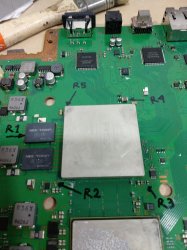
I am measuring the abnormal 2+volts when I put my multimeter probes like in my picture. (Black in GND and red on the positive side where the nec tokins are)
It would be "R1" in your picture.
The resistance there was 1.8 Ohms.

Of course, we would all be grateful if you want to talk more about solving problems. Maybe better a new thread or perhaps join the other repair threads for example SYSCON diagnosis thread. You maybe like it too.
 
Hello friend,

I am measuring the abnormal 2+volts when I put my multimeter probes like in my picture. (Black in GND and red on the positive side where the nec tokins are)
It would be "R1" in your picture.
The resistance there was 1.8 Ohms.

Of course, we would all be grateful if you want to talk more about solving problems. Maybe better a new thread or perhaps join the other repair threads for example SYSCON diagnosis thread. You maybe like it too.
did you also measure the voltage that comes out at the point R2, R3, R4, R5?
I think the voltage that occurs in the R1 area reaches 2.3v, it seems to be related to:
1. the connection is not good (ugly tin ore), especially on the connection related to the voltage R1, has the RSX Ic ever been rebounded?
2.The voltage R1 is generated from the power ic which is below the Nec Tokin, to my knowledge if it produces excessive voltage it will damage the ic itself accompanied by a break in the fuse connecting the 12v input voltage, the excess output voltage is usually caused by damage to the condensator. is around the power ic, if there is no fuse (which connects to 12v) which is damaged / broken, it can be ascertained that it is connected to no.1, the solution is with reball ic rsx
The measured 2,3v R1 voltage is only the apparent voltage that has not been loaded, when connected to the RSX IC, the R1 voltage will change automatically to 1.2 v
 
Last edited:
I also worry that grounding the two pins will exceed current limit on pin 1. Really want to avoid the parasitic power loss and potential fire hazard...
He is saying it's a different chip. The pinout or internals could be different, so IDK without a data sheet for the slims MOSFET. @botakompong , why doesn't it short when you GND pins 2&3? And why not just replace it and allow the Gate to be controlled by IC6200? Can you explain the circuit?
 
hello RIP-Felix, Q6200 which is on PS3-COK-001, not the same as Q6200 which is on JTP-001,
Q6200 (COK-001) pins 1,2,3 are connected internally, control pin4, pin5,6,7,8 are internally connected
while Q6200 (JTP-001) can be seen in the picture below
view

basically, I'm just looking for a component that can produce an output voltage of 0.95 volts in accordance with the voltage required by rsx cxd530xx, and I see a component that is on the PS3 type 250x-type300x-superslim, suitable for use on the PS3-Phat-COK-001- 002, because the shape is the same and how to change it is not too difficult
but why does it work? Thats what I'm trying to understand.
 
Think to reduce overclock like that. This will be increased by software needs later but on normal boot is not needed. Ps4 have 0.9v more specific on graphic side I see always 0.89 v and working on orbis but later is bit increased by game needs.
 
but why does it work? Thats what I'm trying to understand.
hello RIP-Felix, if you ask how the process works, I can't explain it (my base is not in electronics), I only place the legs of the Q6200 (JTP-001) according to the previous placement, if you pay attention to pin3 Q6200 (JTP- 001) indeed on the ground (if you look at the JTP-001 motherboard), I merged pin2 in the ground because pin2 did not work /
useless (Internal NC), same as pins 6 & 7 (NC).
pin 2,3 Q6200 (JTP-001) I increased it so it doesn't
short when installing on the COK-001 motherboard, if you notice Q6200 (COK-001) pin 1,2,3 on the motherboard is connected, pin4 Q6200 (JTP-001) I made NC gate because it does not match pin4 gate Q6200 (COK- 001).
Q6200 (COK-001) is a MOSFET.
Q6200 (JTP-001) included in the MOSFET category ??? I also don't understand
 
Last edited:
hello RIP-Felix, if you ask how the process works, I can't explain it (my base is not in electronics), I only place the legs of the Q6200 (JTP-001) according to the previous placement, if you pay attention to pin3 Q6200 (JTP- 001) indeed on the ground (if you look at the JTP-001 motherboard), I merged pin2 in the ground because pin2 did not work /
useless (Internal NC), same as pins 6 & 7 (NC).
pin 2,3 Q6200 (JTP-001) I increased it so it doesn't
short when installing on the COK-001 motherboard, if you notice Q6200 (COK-001) pin 1,2,3 on the motherboard is connected, pin4 Q6200 (JTP-001) I made NC gate because it does not match pin4 gate Q6200 (COK- 001).
Q6200 (COK-001) is a MOSFET.
Q6200 (JTP-001) included in the MOSFET category ??? I also don't understand
So its one of those, "it works, but I don't know why" kind of situations?

I have a dead KTE-001 board. Does it have one I can use? I might play with it on a breadboard to compare with Q6200 from a COK-001. I don't want to destroy it though, I have a mod chip and 40nm RSX coming in the mail for another attempt. But I do want to try and understand why it produces the correct voltage when hooked up the way you say.
 
So its one of those, "it works, but I don't know why" kind of situations?

I have a dead KTE-001 board. Does it have one I can use? I might play with it on a breadboard to compare with Q6200 from a COK-001. I don't want to destroy it though, I have a mod chip and 40nm RSX coming in the mail for another attempt. But I do want to try and understand why it produces the correct voltage when hooked up the way you say.
true, you can use the Q6200 which is on the KTE-001, you don't need to hesitate to try it because I have done it very often, and it doesn't damage your PS3 console at all
Note: pins 2,6 & 7 in the chip are NC so they can be connected to ground or to the input voltage
 
Last edited:
Does anyone know where Vcore is generated for the RSX? I'm assuming by looking at the buck converter than generates the 1.2V we can drop the voltage to 0.95V no problem. I think the easiest way may be to intercept syscon because it will most likely be an active power management IC that handles the voltage output and see how we can change the data to output lower voltage. Though that may require component swaps.

Hm, I'm thinking there must be a better way to do this than to pull a MOSFET from another board.
 
Does anyone know where Vcore is generated for the RSX? I'm assuming by looking at the buck converter than generates the 1.2V we can drop the voltage to 0.95V no problem. I think the easiest way may be to intercept syscon because it will most likely be an active power management IC that handles the voltage output and see how we can change the data to output lower voltage. Though that may require component swaps.

Hm, I'm thinking there must be a better way to do this than to pull a MOSFET from another board.
an interesting thought, it's nice to be able to see the inside of the working system from the console, especially in the syscon section where in the future we can set the controls as we want, the real example that can be seen is the control fan, my respect for those who have taken the time and his thoughts on making all these things possible ... salute.
 
So this voltage adjustment is really only for the RSX ram? Q6200 and IC6200 are to feed RSX VDDR (RAM). VDDC (RSX processor) is fed directly by the IOR switching VRM. Its voltage is...what, sensed dynamically by its pwm controller? Or are the 2 linked somehow?
 
Best wishes to all my friends here, this time I will share the analysis method that I usually do in the analysis of ps3 damage, which I have previously shared, this time only as a complement, hopefully useful.
As we all know that syscon plays an important role, he controls the ps3, if he feels there is a problem, the usual problem syscon checks:
1. CellBe problem
2. RSX problem
3. BootOS problems
If there is a problem with the 3 points above then he will turn off the ps3, in the form of YLOD / Lost Power.
As I usually do, I will check the "pulse clk", and will analyze the pulse into "what number rule", specifically this time I will discuss rule1,2 and 3
Let's start...
Example of "pulse clk" that goes to rule1 and 2
view

You can see that the needle on the analog meter only reaches the highest point up to 1.5v then drops again quickly, this condition is included in "rules 1 and 2", I will explain further
1. Rules 1 (CellBe to syscon)
"Pulse clk" as above indicates there is a problem in the cellbe section, the problem can be:
A. Voltage problem
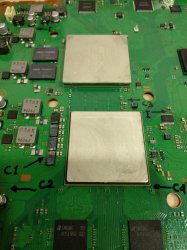
The input voltage that goes into the cellbe, look at the picture below
view

I will give an video example of the problematic C1 voltage
view

it looks like the needle on the analog meter only goes up a little, as if there is no kick power, then I will call it "no kick power"
now pay attention to the video for the voltage that I say is normal, at the voltage C2, C3, C4, I measure alternately
view

in the video it can be seen on the analog meter, the increase in the needle looks like it has power, there is a kick in the voltage, which in the future I call "voltage kick"
This characteristic of needle movement on an analog meter is my benchmark in determining which part of the voltage is problematic.
each input voltage that enters the cellbe has a different voltage source, in this case the damage to the C1 voltage is in the image below
view

the cause of the weak voltage "no kick voltage" is due to damage to the resistors around the power ic that is drawn, the size of the resistor greatly affects the output produced, I also never memorized the ohms of the resistor, usually I only compare it with other ps3 resistors normal, if there is a difference in the number of ohms, that is what I replace.
B. The tin ore under the cellbe is no longer good, with us reballing will solve the problem
C. CellBe damaged, must be replaced, replacement cellbe must be accompanied by replacement of nor/nand and syscon

Before entering Rules 2 (RSX to Syscon)
Take a break first while drinking tea ....

Ok, let's start again ...

2. Rules 2 (RSX To Syscon)
In the RSX part that goes into "rules2" usually only occurs in the problematic Voltage Section
The voltage that enters the RSX can be seen in the picture below
view

I will give a video example of the problematic R1 voltage
view

Pay attention to the analog meter, the needle increases only a little, "no voltage kick"
I will give a video example of the voltage R2, R3, R4 which I consider normal, the one with "kick voltage", I measure alternately
view

as I explained earlier, the movement of the needle on the analog meter is my benchmark for determining the problematic part of the voltage.
Now our way to fix the damage to the voltage section R1
I will divide it into 2 parts based on RSX
+RSX CXD2971x, CXD2982x, CXD2991x:
This type of RSX uses NEX TOKIN, if the needle on the analog meter shows movement as in the video, you can be sure that NEC TOKIN has a problem.
Usually occurs on the NEC TOKIN which has the numbers 102 and 108 (Type CECHI,J,K,L and Slim DYN-001), on the number 128 (Type COK-SEM-DIA) there are also but rarely has a problem.
How to fix it?
a. replace with the good NEC TOKIN (I rarely do)
b. add 2 pieces of tantalum 470uf as shown below (DYN-001
view

+RSX CXD2971x, CXD2982x, CXD2991x, CXD530xx
This type of damage can also be caused by the input voltage coming from the power ic as shown below
view

Image is taken from DNY-001 (as an example only)
The weak R1 voltage is caused because there is damage to the resistor around the power ic that is drawn, as usual I have never memorized the number of ohms of each resistor around the power ic, so I only compare it with the resistor on the normal PS3.

3. Rules 3 (CellBe To RSX)
We arrived at rules 3, below I will give a 2 video "Pulse CLK" : video1 enters "rules3" and video2 final of "rules3"
view

view

When entering "rules3" you can say there is no problem with the voltage in CellBe and RSX, so the problem that occurs with "rules3" is usually only a problem with the relationship between CellBe and RSX, CellBe and sub (CXD9964)
I will give examples of problems that are often encountered from ps3, especially on the RSX CXD2971, I took pictures from the DIA-001
view

remember !!!, this is just an example, in my picture the pin-pin connection data from CellBe to RSX, a common problem that occurs in the CXD2971, when measuring resistance in IC using a digital meter (fluxe) pin 1 and pin 2 is drawn shot , pin1 and pin2 are connected internally in RSX, which shouldn't happen, that's what causes PS3 YLOD. Then I heat the RSX CXD2971 with a temperature increase of max 200c for 15 minutes, after it cools down I re-measure pin1 and pin2 that were previously connected, the RESULT? pin1 and pin2 separate back to normal, no longer connected, from such conditions I conclude that using heat can change the conditions inside the RSX CXD2971, but such repairs cannot last long, 2-3 days later pin1 and pin2 are shot again, reconnected Internally in RSX, there are a lot of similar cases like this with different results, but from the many ps3s that have been treated like this, I conclude:
1. RSX that has never been HEATED, will last quite a long time, approx. 3-6 months, will have a longer lifespan if it is used frequently, harvested continuously
2. RSX that has been HEATED, DON'T WASTE YOUR TIME, REPLACE RSX CXD530XX IMMEDIATELY !!!!!
That's why my brother("KIAW'S) made the MODRSX IC so that the old CXD2971 could be replaced.
how to heat RSX like this can only be done on RSX CXD2971, does not apply to other RSX, why? Ask Sony ...(what is clear is that the make is different)
BUT if you don't have a problem doing that, it's okay too, in principle heating to 2,3,4,5 makes the PS3's life time less and less, it's good that it doesn't interfere with other components, until it's time you replace the RSX ...
other than heating (CXD2971 only), repairing ps3 that enters "rules3" is by:
1. Replace tin ore, reballing either RSX or Cellbe, just one of them
2. Replace RSX or Cellbe because it is damaged

It seems that I also explain it for a long time, I leave it up here, hopefully it will be useful and keep up the spirit, as usual, no method is perfect, take the important parts, combine it with other methods, make it more perfect, that too is my hope , I am 47 years old, my ability to service has decreased, my eyes are also myopic, I like your enthusiasm in finding and learning something new, I hope that in the future you can produce more perfect methods I pray everyone will be well always (

 
Last edited:
So this voltage adjustment is really only for the RSX ram? Q6200 and IC6200 are to feed RSX VDDR (RAM). VDDC (RSX processor) is fed directly by the IOR switching VRM. Its voltage is...what, sensed dynamically by its pwm controller? Or are the 2 linked somehow?
In this case I don't understand it very clearly, since RSX and RAMRSX are connected into 1 part, from the input voltage that goes into RSX there are 6 inputs, from R1, R2, R3, R4, R5 and C4 (information on the voltage in the cellbe) , my understanding is like this:
RSX accepts 4 input voltages R1, R2, R3, and R4
while RAMRSX gets voltage at R5 and C4.
If you pay attention to Q6200, it is on R2 voltage so I think Q6200 only provides input voltage to RSX, but that's just my understanding, maybe I am wrong, hopefully someone else will understand more about it, one of them may be my brother (RIP). but later I'll find out too, if I already know more clearly I'll let you know (usually I don't pay attention to details ..., hahaha)
tegangan rsx.jpg
TegCellBe.jpg
 
Awesome post there @botakompong . Tons of useful info there. I believe that working with you know all of these guys will break this down and begin to truly understand what is going on and what is wrong with these ps3 models that present ylod and the many , many causes it could be that is at fault. I look forward to seeing you guys work together. Thank you
Hallo nCadeRegal, Thank U too...
Hopefully it can be useful and understandable, moreover it can be developed, usually many methods are always based on electronic theory that can be learned in college, only different from the method I made, this method is formed from my experiences in the PS3 service.
Syscon Projeck is one that I admire, because the analysis that uses data has a high degree of accuracy and is reliable, such as the term "humans can lie but data cannot lie". Hopefully this Projeck Syscon apart from being able to repair the damage can also manipulate the system to "my ps3 is 100% my"
 
Would be nice if somehow someway an internal Sony tech would leak the actual tools used or nudge us along with the syscon side of things. Major, zecoxao, and a few other have made it possible for us to finally delve into that area. The thread here has made huge strides in discerning that information and pushing it further forward as it is today. Have gotten to witness some really cool things develop here over the years and I am very thankful to have been apart of it even from a bystanders perspective.
 
That would take all the fun out of reverse engineering. Besides, the cat and mouse aren't supposed to be friends! The cat is supposed to get fat and happy. The mouse comes along later and picks up the breadcrumbs he leaves behind. That's the natural way!
 
Back
Top