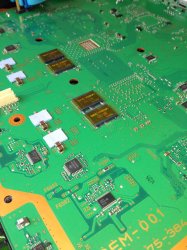
I just made an interesting discovery... I've been spending a lot of time getting familiar with my new, cheap-o scope and how it behaves. Since its output doesn't quite match higher-quality scopes, I decided to create my own "apples to apples" comparison. I removed all the caps from the cell (both top and bottom), but I left just the bridge in place. I also left all the RSX caps in place. Once i did all that, I did a ton of measuring between the two sets, until I was pretty sure I came up with my own set of "good signal" (the ones taken from the RSX) and "bad signal" (the ones taken from the Cell, because there weren't any caps

). All measurements are taken at 500mV/div, and 1uS/Div.
So here's the baseline "bad signal" from the Cell. You can see how jagged it is
And this is a baseline RSX signal. I'm calling this "Good" (the assumption being that my scope just doesn't have the resolution to read it any better than that). It looks very clean... it goes up, stays there and then goes back down.
Once I had those signals all documented (and I measured them at least 50 times over the last few days, just to ensure consistency), I proceeded to add caps back into Cell. For every cap installed, I mounted the power supply back on, and did a read with the same parameters.
Here's the "cap map"
So here's 1 cap added. The signal looks mostly like the baseline, but it's slightly cleaner -- those gaps between the peaks are mostly gone, and that's with just one cap
And then, from caps 2-8, the waves were pretty much the same! The gaps and the Peak to Peak are very consistent.
By this point, I ran out of space on the "near" side of the Cell, so then I added cap #9 (see the map cap above). Much to my surprise, once I added #9, the signal was almost as clean as the RSX baseline! Huge difference between #9 and #8
Adding caps 10-12 cleaned it even further. Every time I booted it, there was a little bit of noise that was difficult to capture. Probably adding another cap will fix it. My RSX has 15 caps 470uf caps, and the Cell has 12. Either one goes well above the 4800uf provided by the tokins.
11 caps -- even cleaner! but it has a bit of noise at the beginning
12 caps -- has a bit of noise at the beginning also, but it's just as clean as with 11
Here's the link to the entire collection --
https://imgur.com/gallery/0xeDIRL
So what's my conclusion? I don't think adding a 9th cap "made all the difference", because there was no difference whatsoever between having 2 and 8 caps (which is why I didn't bother posting them, but I can if anyone is interested). I think the difference is that I placed #9 on the "far" side of the rails, along with the caps that were on the "near" rail. I think that we need caps on both sides for us to get "clean" signals. That's just one theory, though! here's some others
* I reached a "minimum" amount of capacitance, and the signal "normalized". The tokins originally provided 4800uf between the four of them (4x1200uf). 8 caps at 470uf each adds up to 3760uf, and the 9th brought it up to 4230, which is not quite the original 4800uf, unless the "normalization magic" threshold is 4000uf. I highly doubt this theory, though.
* It's also possible that my baselines are meaningless!
* I might repeat this experiment later, but this time placing the caps on evenly on both near and far rails until I get clean signal... This would prove if the distribution of the caps is as important as this experiment suggests. This is tricky, though, I murdered 2 caps during removal because they're so freaking tiny and I don't have a heat gun.


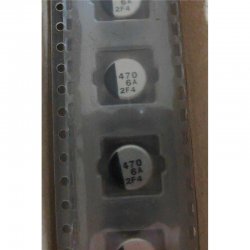


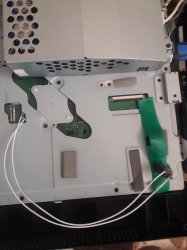




 ...and they all measured slightly above their 1200uF ratings.