PS3 (Research/Experimental) - NEC/TOKIN Capacitors Replacement - YLOD

Is anyone willing to run a test for me? I'm trying to confirm some information from psdevwiki that matches the service manual, but my board (a COK-001) is getting a different value.

Here's the page -- https://www.psdevwiki.com/ps3/Service_Connectors

According to the CN4009 section, pin 15 is supposed to be a +3.3V line. This also matches service manual. When I measure this pin, however, I get ~ +5.1V. According to the service manual, Pin 15 is tied to Pin1 and Pin 30, which are both 5V, so maybe that's why, but then why/how is pin 15 supposed to be 3.3V?
 
@Workz_777

You've got a link for those? Got a CECHL04 that I could use some on.

Sure, this is from an eBay seller in China i buy from often. So far they have always delivered, so i would recommend them. Also, they are slightly cheaper than the other sellers for the same item. However, it can take a while to arrive though, 2 - 3 weeks depending on where you live in the world.

Here is the link:- https://www.ebay.co.uk/itm/10PCS-Proadlizer-Capacitor-IC-NEC-TOKIN-QFN-OE128-0E128/162777888110

Please note:- although these "new" NEC/Tokins from China / Hong Kong say they are "new", i would say that might be true, but they come from different batches, some newer stock than others, even though they come sealed on a reel. I had many different batch numbers on mine. But they all checked out though when i measured them.

And they work just great at the moment on my PS3, but i needed all 8 x "new" NECs, full replacement, for me at least, because it didn't work with only 1/2 the amount needed when i first tested that.

EDIT: ...i forgot to mention, just incase, for those not aware:- NEC/Tokins aren't being made any more, so what stock we find will be old original 'stored-up' stock bought by different sellers. We can't buy NEC/Tokins from any authorized distributers, like Mouser, Newark / Farnell, Digi-Key etc, etc, they just don't have them anymore, nor stock them. So we have to get them from China, for now.
 
Last edited:
Yep, the artifacts respond directly to me pressing on top of the blu-ray drive, which is pressing down on the board. So i guess that means the guy before me just ripped the heatsink of the board.
When you did the reflow, did you try bumping the chips to make sure they were loose? I think i'll try reflowing it myself, when i buy a reflow station.
Also, i'd like to clarify that it goes back to normal if i let the system cool off, i get the artifacts every time after 3-5 minutes.
@evaldas256 Nop, because my heatgun is not that powerful, I warmed the mobo the most I could and that fix just last a few due I had to move the console from where it was, and that movement left me again with the same problem. Maybe If you can apply enough heat for the right quantity of time, then you could get the bgas soldered again, but that's hard to know without the right equipement.

@Workz_777 Strange. You were getting instant YLOD on a G and the only caps that worked were the NECs? You tried Panasonic's, the yellow ones and even B caps, and that didn't work, but for me some yellow chinese ones did the job. I'm starting to thing there's something else here apart of the NECs thing..
 
@Spawn ...on some PS3 board revisions, there is more than enough room to solder the new NECs. However, on some later boards, we need to scratch off the surface just a little. Also the legs of the NECs are tucked under the capacitor, so for soldering i would recommend using solder paste instead of solder wire, that way you can put a tiny blob (where you want to solder) under the capacitor (on its leg) then you just heat up next to the capacitor with the solder iron on the contact strips, and it melts underneath the solder paste. Otherwise with solder wire it could be a little tricky.
 
@evaldas256 Nop, because my heatgun is not that powerful, I warmed the mobo the most I could and that fix just last a few due I had to move the console from where it was, and that movement left me again with the same problem. Maybe If you can apply enough heat for the right quantity of time, then you could get the bgas soldered again, but that's hard to know without the right equipement.
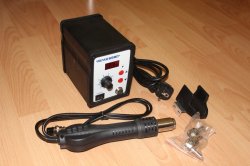
I was looking at the chinese hot air rework station model 858D+ in particular which is pretty popular, i wonder if it would be powerful enough to reflow the two main chips. Maybe someone here has tried, or would know if this one could do it?
 

Attachments

  • large_youyue858d_001.jpg
    large_youyue858d_001.jpg
    105.7 KB · Views: 60
I was looking at the chinese hot air rework station model 858D+ in particular which is pretty popular, i wonder if it would be powerful enough to reflow the two main chips. Maybe someone here has tried, or would know if this one could do it?
Nah, that won't work. Mine's something similar, you need a proper rework station, or maybe those big heatguns, but I can't tell how good they're when melting original bgas.

https://5.imimg.com/data5/SK/JJ/MY-786437/stanley-sxh1800-1800-w-heatgun-500x500.jpg
 
@evaldas256 Nop, because my heatgun is not that powerful, I warmed the mobo the most I could and that fix just last a few due I had to move the console from where it was, and that movement left me again with the same problem. Maybe If you can apply enough heat for the right quantity of time, then you could get the bgas soldered again, but that's hard to know without the right equipement.

@Workz_777 Strange. You were getting instant YLOD on a G and the only caps that worked were the NECs? You tried Panasonic's, the yellow ones and even B caps, and that didn't work, but for me some yellow chinese ones did the job. I'm starting to thing there's something else here apart of the NECs thing..

Yep bro, exactly, i even tried testing with external capacitors like esc0rtd3w showed, that too = ylod for me. But then with 8 x "new" NEC/Tokins the same PS3 is working really well, as of today.

As mentioned, i want to continue / experiment with a Tantalum solution, i made a messy proto-type (before these 'new' NECs) and it worked also but it needs re-working so all being well, i can show the results here for you guys. I think it could be useful for people who didn't get their PS3s to work yet with a full replacement using Tantalums. Will update soon hopefully on that.
 
Hiya All, hey-hey success!!

Even one of my tests with tantalum gave me YLOD with bad cap waveform. All the caps I got were name brand from Mouser. I think the fact that you have to use so many to replace them all gives you too many dice rolls to run in to a bad one in the batch.
 
Just keep in mind that the images I got from a dead short with no caps were different than the bad caps images. In other words, that image will only tell you that you have no caps.
Ah, that is a good point. I still don't know for sure why my system wont boot... I'll have to find those and compare with mine.

Why do you think my (theoretically good) rsx signals are flat? Would it really be just a lack of resolution on my cheap scope??
 
Yep bro, exactly, i even tried testing with external capacitors like esc0rtd3w showed, that too = ylod for me. But then with 8 x "new" NEC/Tokins the same PS3 is working really well, as of today.

As mentioned, i want to continue / experiment with a Tantalum solution, i made a messy proto-type (before these 'new' NECs) and it worked also but it needs re-working so all being well, i can show the results here for you guys. I think it could be useful for people who didn't get their PS3s to work yet with a full replacement using Tantalums. Will update soon hopefully on that.

you mean we should stop using tantanlum and reuse nec?
 
Hi, i have a problem with my SEM-001 board, the RSX/CELL positive line is shorted with the negative of the NEC. Even when there is no capacitor on both side, is there on the board some short?
 
Last edited:
Even one of my tests with tantalum gave me YLOD with bad cap waveform. All the caps I got were name brand from Mouser. I think the fact that you have to use so many to replace them all gives you too many dice rolls to run in to a bad one in the batch.

Yeah agree, ideally we would add some smaller MLCCs caps with the larger Tantalums, together in combination. Maybe even an array like:- 10uF, 1uF, 0.1uF, 0.01uF with every 4 x 470uF Tantalums, for each NEC replacement, maybe would be more ideal. Otherwise, the current arriving at the processors is gonna be too noisey without good filtering (bypass capacitors / decoupling capacitors for both low & different high frequencies). The CELL & RSX seem really senstive to wanting a nice clean power supply / line. I want to experiment with adding some MLCCs, soon all being well, and see what results we get.
 
Hi, i have a problem with my SEM-001 board, the RSX/CELL positive line is shorted with the negative of the NEC. Even when there is no capacitor on both side, is there on the board some short?

Hiya, yeah it's normal, because it's all connected together via the circuitry, even without the NECs on the board. The NECs are used there for de-coupling capacitors / by-pass capacitors. Filter capacitors.

I like to think of by-pass caps, where the "bi" means "two", so they have 2 x exit routes. As they receive the current, they have 1 route to pass the DC onto the processors / ICs, or they can filter any unwanted AC noise to 'ground' using their 2nd exit route. And like regular capacitors, they also fill up like water tanks, and then feed the RSX / CELL when the power line dips in current.

The RSX / CELL are senstive to only working when the power supply arriving has little, to no change, so the capacitors fill in the gaps and also filter the rubbish away (down the drain).
 
you mean we should stop using tantanlum and reuse nec?

Hiya, well "re-use" NECs is not really an option for the long term. Because they are no longer being made. The only stock left is old stock from when NEC/Tokin made them originally back in the past. Now there is the option to buy this old stock from sellers in China, until all that runs dry.

But yeah for the short term. But how long will the "new" old NEC capacitors last anyway, 1 year, 2 years, and then what?

We really need a solution with Tantalums, but Tantalums alone are not enough, even Sony added about 12 x small MLCCs in combination with every 7 x 470uF for each processor. But by then Sony had reduced the PS3's power consumption (Watts) by half.

If we want to copy what Sony did, when they replaced the NECs with Tantalums in later board revisions, then we would have to roughly base it from this example:-

Sony's version, no NEC/Tokins...

PS3 board using 80W - 100W (average Watts) needed the following:-

CELL - 7 x 470uF Tantalums + 12 x MLCCs*
RSX - 7 x 470uF Tantalums + 12 x MLCCs*

*Could be MLCC values of:- 0.01uF, 0.1uF, 1uF, or 10uF, or maybe a combination.

In theory, based on the above example, a COK-01 board, which consumes 200W (average Watts) and even has a maximum of 380W consumption (original PSU), would need something like a combination of 14 x 470uF per processor + (at least) 12 x small MLCCs per processor. Without the MLCCs, it could be the Tantalums are not enough to filter the power line efficiently for the sensitive processors to work, and the PS3 would likely give ylod.
 
Hiya, well "re-use" NECs is not really an option for the long term. Because they are no longer being made. The only stock left is old stock from when NEC/Tokin made them originally back in the past. Now there is the option to buy this old stock from sellers in China, until all that runs dry.

But yeah for the short term. But how long will the "new" old NEC capacitors last anyway, 1 year, 2 years, and then what?

We really need a solution with Tantalums, but Tantalums alone are not enough, even Sony added about 12 x small MLCCs in combination with every 7 x 470uF for each processor. But by then Sony had reduced the PS3's power consumption (Watts) by half.

If we want to copy what Sony did, when they replaced the NECs with Tantalums in later board revisions, then we would have to roughly base it from this example:-

Sony's version, no NEC/Tokins...

PS3 board using 80W - 100W (average Watts) needed the following:-

CELL - 7 x 470uF Tantalums + 12 x MLCCs*
RSX - 7 x 470uF Tantalums + 12 x MLCCs*

*Could be MLCC values of:- 0.01uF, 0.1uF, 1uF, or 10uF, or maybe a combination.

In theory, based on the above example, a COK-01 board, which consumes 200W (average Watts) and even has a maximum of 380W consumption (original PSU), would need something like a combination of 14 x 470uF per processor + (at least) 12 x small MLCCs per processor. Without the MLCCs, it could be the Tantalums are not enough to filter the power line efficiently for the sensitive processors to work, and the PS3 would likely give ylod.

you mean i should use tantalum
 
you mean i should use tantalum

Hiya , well, all i can say is from my own experience...

After trying many difference brands of Tantalums, in different combinations, using different bridge wire set-ups, it always resulted in the same ylod. Then when i tried with 8 x "new" NEC/Tokins it worked, and i tested the PS3 for days, playing around and it all worked fine.

But the problem with the "new" NECs is this...

Sooner, or later, there will be no more NEC/Tokins left to buy in the wild. Then later when original NECs, or "new" NECs run out of life-span, and naturally fail, we would need to use Tantalums then anyway. The good thing about Tantalums is, we can buy them new, fresh from the factory, so they should have a long expected life-span.

We know Sony replaced the NECs with Tantalums in later mother-board revisions, so for sure it works, the problem is we need to copy what Sony did, and they added smaller capacitors with the Tantalums, in combination. These smaller caps help to filter the high frequency noise on the power line, arriving to the RSX / CELL.

When the current arrives to a chip's voltage-in pin, the standard is to place a "by-pass" capacitor on the power line, as close as possible to the chip's V-in pin, to filter out any noise on the line. The capacitor dumps the rubbish down the drain (to ground) before it gets to the chip. Without this filtering out of the noise, some chips won't function correctly, and some chips won't function at all. The RSX / CELL seem very sensitive and need the filtering on the power line. Tantalums are good at filtering out low frequency noise, but they don't filter out high frequency noise so well, and that stuff gets past the filtering and arrives to the chip.

So the industry recommends using smaller MLCC (multi-layer ceramic capacitors) in combination with larger Tantalum, or Electrolytic capacitors. And that's what Sony did. Usually we can see on boards, a minimum of 1 x MLCC with every 1 x Tantalum together in combination. Infact if you look around your PS3 board for any Tantalums, you will see a little capacitor right next to him.

 
Hiya , well, all i can say is from my own experience...

After trying many difference brands of Tantalums, in different combinations, using different bridge wire set-ups, it always resulted in the same ylod. Then when i tried with 8 x "new" NEC/Tokins it worked, and i tested the PS3 for days, playing around and it all worked fine.

But the problem with the "new" NECs is this...

Sooner, or later, there will be no more NEC/Tokins left to buy in the wild. Then later when original NECs, or "new" NECs run out of life-span, and naturally fail, we would need to use Tantalums then anyway. The good thing about Tantalums is, we can buy them new, fresh from the factory, so they should have a long expected life-span.

We know Sony replaced the NECs with Tantalums in later mother-board revisions, so for sure it works, the problem is we need to copy what Sony did, and they added smaller capacitors with the Tantalums, in combination. These smaller caps help to filter the high frequency noise on the power line, arriving to the RSX / CELL.

When the current arrives to a chip's voltage-in pin, the standard is to place a "by-pass" capacitor on the power line, as close as possible to the chip's V-in pin, to filter out any noise on the line. The capacitor dumps the rubbish down the drain (to ground) before it gets to the chip. Without this filtering out of the noise, some chips won't function correctly, and some chips won't function at all. The RSX / CELL seem very sensitive and need the filtering on the power line. Tantalums are good at filtering out low frequency noise, but they don't filter out high frequency noise so well, and that stuff gets past the filtering and arrives to the chip.

So the industry recommends using smaller MLCC (multi-layer ceramic capacitors) in combination with larger Tantalum, or Electrolytic capacitors. And that's what Sony did. Usually we can see on boards, a minimum of 1 x MLCC with every 1 x Tantalum together in combination. Infact if you look around your PS3 board for any Tantalums, you will see a little capacitor right next to him.
Wasn't there an official statement by NEC on what tantalum and MLCC combination should be used to replace Tokins? Pretty sure i've read about it in this thread.
 
Wasn't there an official statement by NEC on what tantalum and MLCC combination should be used to replace Tokins? Pretty sure i've read about it in this thread.

Yep, here are the links, and as we can see in Test-3, the NEC is like having a Tantalum + an array of MLCCs (in combination) like the industry recommends:- 0.01uF, 0.1uF, 1uF, (10uF)

Data-sheet, Test-1
https://web.archive.org/web/2007121...-tokin.com/product/cap/proadlizer/test01.html

Data-sheet, Test-2
https://web.archive.org/web/2007121...-tokin.com/product/cap/proadlizer/test02.html

Data-sheet, Test-3
https://web.archive.org/web/2007121...-tokin.com/product/cap/proadlizer/test03.html

NEC/Tokins are actually really good, it's just every capacitor has a life-span of "X" hours, sooner, or later every capacitor will need replacing.

EDIT: ...i am currently trying to replicate this on my 2nd PS3 at the moment, i'm aiming to add (1 x 0.01uF, 1 x 0.1uF, 1 x 1uF, 1 x 10uF) MLCCs in combination with 4 x 470uF Tantalums, for every NEC replaced. Looking forward to posting some results here soon, all being well.
 
Last edited:
Hiya , well, all i can say is from my own experience...

After trying many difference brands of Tantalums, in different combinations, using different bridge wire set-ups, it always resulted in the same ylod. Then when i tried with 8 x "new" NEC/Tokins it worked, and i tested the PS3 for days, playing around and it all worked fine.

But the problem with the "new" NECs is this...

Sooner, or later, there will be no more NEC/Tokins left to buy in the wild. Then later when original NECs, or "new" NECs run out of life-span, and naturally fail, we would need to use Tantalums then anyway. The good thing about Tantalums is, we can buy them new, fresh from the factory, so they should have a long expected life-span.

We know Sony replaced the NECs with Tantalums in later mother-board revisions, so for sure it works, the problem is we need to copy what Sony did, and they added smaller capacitors with the Tantalums, in combination. These smaller caps help to filter the high frequency noise on the power line, arriving to the RSX / CELL.

When the current arrives to a chip's voltage-in pin, the standard is to place a "by-pass" capacitor on the power line, as close as possible to the chip's V-in pin, to filter out any noise on the line. The capacitor dumps the rubbish down the drain (to ground) before it gets to the chip. Without this filtering out of the noise, some chips won't function correctly, and some chips won't function at all. The RSX / CELL seem very sensitive and need the filtering on the power line. Tantalums are good at filtering out low frequency noise, but they don't filter out high frequency noise so well, and that stuff gets past the filtering and arrives to the chip.

So the industry recommends using smaller MLCC (multi-layer ceramic capacitors) in combination with larger Tantalum, or Electrolytic capacitors. And that's what Sony did. Usually we can see on boards, a minimum of 1 x MLCC with every 1 x Tantalum together in combination. Infact if you look around your PS3 board for any Tantalums, you will see a little capacitor right next to him.

you mean i should i use both of them do have photo for someone use both of them

ps: i have a question outside that thread i have a ps4 1st gen when i plugin it wont start up and even there is not a beep from what is that does it from the power supply or what?
 
Back
Top