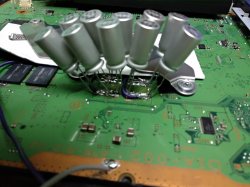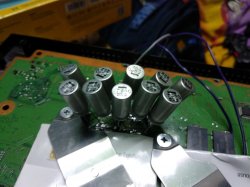
PS3 (Research/Experimental) - NEC/TOKIN Capacitors Replacement - YLOD

Yeah agree, ideally we would add some smaller MLCCs caps with the larger Tantalums, together in combination. Maybe even an array like:- 10uF, 1uF, 0.1uF, 0.01uF with every 4 x 470uF Tantalums, for each NEC replacement, maybe would be more ideal. Otherwise, the current arriving at the processors is gonna be too noisey without good filtering (bypass capacitors / decoupling capacitors for both low & different high frequencies). The CELL & RSX seem really senstive to wanting a nice clean power supply / line. I want to experiment with adding some MLCCs, soon all being well, and see what results we get.

I only buy backwards compatible models, so I'm also wondering if the higher nm process is more robust in terms of noise. I've run them missing half the caps with like 400mv peak to peak of noise and they ran GT6 and TLOU just fine. So a tantalum replacement is going to work better with them with no additional modifications to reduce noise. I think the console I was checking all the different tantalum specs on was a H or L, and it didn't like some of them.

The failed TOKINs aren't bad because they're allowing too much noise, though, it's something weird with their reaction to current flow. I never got to invite my EE buddy over that works in power electronics. Maybe next year when covid is over I can set him loose in my lab with the schematics and some beer.

Anyway, yeah, I'm on board with the idea that for whatever reason, later non-BC models might need some additional modification.
 
Ah, that is a good point. I still don't know for sure why my system wont boot... I'll have to find those and compare with mine.

Why do you think my (theoretically good) rsx signals are flat? Would it really be just a lack of resolution on my cheap scope??

I guess, I really can't say til I get my hands on one. I'm finishing some home remodeling projects for the next week or two then I'll start getting back in to the thick of it, so hopefully (I guess?) it won't be more than a few months before I get my hands on another failed TOKIN system.
 
I have been using and mixing ceramic with tantalums for some time now with great success. I even posted some pictures of my ceramics i use , if you search back am sure you will find it. I only use them when a system doesn't like the measured total capacitance and i was always assumed that i just had under speced tantalums that needed a helping hand to clean and stabilize the current

Στάλθηκε από το POCOPHONE F1 μου χρησιμοποιώντας Tapatalk
 
I have been using and mixing ceramic with tantalums for some time now with great success. I even posted some pictures of my ceramics i use , if you search back am sure you will find it. I only use them when a system doesn't like the measured total capacitance and i was always assumed that i just had under speced tantalums that needed a helping hand to clean and stabilize the current

Στάλθηκε από το POCOPHONE F1 μου χρησιμοποιώντας Tapatalk

i looked for your photos rgar your using mixing ceramic with tantalums i have not find them can u place them again
 
Yep, here are the links, and as we can see in Test-3, the NEC is like having a Tantalum + an array of MLCCs (in combination) like the industry recommends:- 0.01uF, 0.1uF, 1uF, (10uF)

Data-sheet, Test-1
https://web.archive.org/web/2007121...-tokin.com/product/cap/proadlizer/test01.html

Data-sheet, Test-2
https://web.archive.org/web/2007121...-tokin.com/product/cap/proadlizer/test02.html

Data-sheet, Test-3
https://web.archive.org/web/2007121...-tokin.com/product/cap/proadlizer/test03.html

NEC/Tokins are actually really good, it's just every capacitor has a life-span of "X" hours, sooner, or later every capacitor will need replacing.

EDIT: ...i am currently trying to replicate this on my 2nd PS3 at the moment, i'm aiming to add (1 x 0.01uF, 1 x 0.1uF, 1 x 1uF, 1 x 10uF) MLCCs in combination with 4 x 470uF Tantalums, for every NEC replaced. Looking forward to posting some results here soon, all being well.
what volt mlcc capacitor should I use? thanks
 
Hello!
One doubt. Could NEC-TOKIN cause a 0.5 seconds YLOD?

PS3 CECHA00
This is a screenshot between NEC-TOKINs and CELL
1-CELL_PRE_NEC.png


This is a screenshot between NEC-TOKINs and RSX
RSX.png
 
Hello!
One doubt. Could NEC-TOKIN cause a 0.5 seconds YLOD?

PS3 CECHA00
This is a screenshot between NEC-TOKINs and CELL
View attachment 26149

This is a screenshot between NEC-TOKINs and RSX
View attachment 26150


If you set it to 50mv, those look like they would completely match the images in my signature. I think all of your caps are toast. Maybe when both sets are bad it shuts down instantly.

Mind sharing the model of your oscilloscope if it's relatively affordable?
 
Hello, im a beginner.
How to know that our problem is on nec tokin? I mean which part that we have to measure or find too make sure before we replace the tokin?
Thankyou
 
Only in circuit with an oscilloscope. Capacitance/ESR/resistance are all still within tolerance on the failed ones.
what about out of circuit with multimeter?how can test the NEC when its not install on board?is there any way?
or the way is just install it on the board and oscilloscope?
 
If you set it to 50mv, those look like they would completely match the images in my signature. I think all of your caps are toast. Maybe when both sets are bad it shuts down instantly.

Mind sharing the model of your oscilloscope if it's relatively affordable?

My oscilloscope is 100MHz, 2 channels and it's like a some Rigol models but older interface.

I can't set to 50mv because I can't see the signal, I guess that I set a wrong configuration. Is input coupling AC or DC? And the trigger level? Trigger mode normal, single or auto?

oscilloscope: Minipa MVB-DSO 100MHz.
P_20200606_195801.jpg
 
what about out of circuit with multimeter?how can test the NEC when its not install on board?is there any way?
or the way is just install it on the board and oscilloscope?

Only under load with an oscilloscope.

My oscilloscope is 100MHz, 2 channels and it's like a some Rigol models but older interface.

I can't set to 50mv because I can't see the signal, I guess that I set a wrong configuration. Is input coupling AC or DC? And the trigger level? Trigger mode normal, single or auto?

oscilloscope: Minipa MVB-DSO 100MHz.
View attachment 26153

With my oscilloscope, all AC or DC coupling changed was the voltage that the signal was centered around. The trigger level shouldn't matter since you're saving it to memory instead of looking at the signal live. If it has a setting for 50mv, just remember that you'll need to adjust the vertical axis to see the same signal. Each vertical "square" would be 50mv, and the signal will be around 1.2V, so you'll need to move the vertical axis about 24 "squares" down to see it. On my scope, I can adjust the vertical axis after the image is saved. So you could try catching it at 200mv since it's easier to find, then once the image is saved see if you can change it to 50mv and find it again with the vertical axis knob.

Regardless, from the 2 images you posted, I'm 100% certain that both sets of your capacitors have failed.

edit: and if I am saying the caps are bad, they are DEFINITELY bad...
 
Last edited:
  • Like
Reactions: LSL
Hello everyone, I have a Cecha01 in my hands
It is defective: turn on the green light and turn off. the red light is not flashing.

Can anyone tell me if the cause could be the tantalum?
 
Hello everyone, i am novice at electronics and have carried out simple home repair. i have been reading this thread for last 2 months and although i have got a PS3 Slim running quite well but out of curiosity i bought fat model CECH0K with instant YLOD without any accessories for 750 Rs. = 10 $ approx.

I was able to run fan test on this model. I watched Vince My Mate video and removed one Nec cap on RSX side and added 4 x 470 µf electrolytic caps through wire using blank PCB which delayed the ylod for few seconds. I ordered 32 tantalum caps from aliexpress but the same didn't arrive and i got my refund, so i decided to go with electrolytic route.

After removing all the Necs from RSX side and adding 16 electrolytic caps in group of 4 x 470 µf using same approach, i could not get the system to boot. But as some of the members here using electrolyic caps in combination with NEC were able to boot their console. I decided to go with bigger caps. I bought few caps of 1500 µf, 6.3 volt and soldered 4 caps =6000 directly on to the bottom side of board with bridge on both side resulting in instant ylod.

After adding 6 caps the result was same but when i soldered 8 caps, the ylod delayed with black screen and system shut down when something is about to display on tv screen. i was very frustrated. i decided to let it go but don't know how it occurs to me that lets try to add 2 more caps. And i soldered 2 more caps i.e total 10 caps of 1500 µf each and the system boots up with xmb on the screen.

I updated the console to latest firmware and can move around in xmb but it shut downs after few minutes in time frame of 5 to 15 minutes.
1. Can you please tell if the working of electrolytic cap is attributed to the reduction in ESR due to addition of more number of caps in parallel ?
2. I haven't replaced any of the NEC on cell side, apart from directly connecting 4 x 470 µf electrolytic caps with wires on to the NEC. Can the same be replaced with 10 caps of 1500 µf each for the console to work properly?
3. Any side effect of using high capacitance of 15000 µf in place of 4800 µf for RSX/Cell?

I have again ordered the 50 pieces of tantalum from aliexpress .Hope to get it delivered this time. And will replace the electrolytic caps.
 

Attachments

  • IMG_20200608_195526.jpg
    IMG_20200608_195526.jpg
    1 MB · Views: 210
Last edited by a moderator:
Back
Top