PS3 (Research/Experimental) - NEC/TOKIN Capacitors Replacement - YLOD

Btw @Workz_777 not sure if your PS3 is working right now, but incase it works i would not modify what you did, your photos are probably some of the best solder jobs posted in this thread, the way how you used the kapton tape to prevent short circuits is nice, and the "shape" of the solder points is perfect, it can be seen it solidified very well, shiny and curvy :encouragement:

ps3_caps_desoldered-jpg.25672

avx_on_ps3-jpg.25717

Actually.. what you did with the wires in this photo is what i was suggesting, single core, and located in a symmetrical way :encouragement:
ps3_caps-jpg.25679
 
It looks like one of the black wires for CELL (located at south of your photo) is soldered to ground, thats a short circuit (and good news, because maybe by fixing it the PS3 is going to work)
The motherboard have protections for that kind of shorcuts, so probably there is no damage

But now you need to redo that wiring i suggest to use other wire for it, is better if it have a single core, incase is too big you can hammer it in the tips to make it more plane and easyer to solder it

And as you can see is needed lot of heat to solder that wires, and usually the plastic shield of the wire melts and you are not sure if is still isolating it electrically, and it becomes an annoyance

So... is more "clean" if you use a wire made with a single core of copper, and without plastic shield
If you have kapton tape you can do as suggested some posts ago (nice photos btw) sticking some kapton over the ground areas... then the "peeled" big copper wire on top... then another layer of kapton tape on top of it
This way you create like a sandwich of tapes with the big copper wire in between them

Thanks for your reply!

I went back and removed that wire to see if that was the problem. Unfortunately, even after removing that wire I still get YLOD in ~3 seconds. I also checked my previous solder work on the capacitors for any shorts to ground and I did not see any. Do you think replacing my current jumpers with solid core wire would make any difference? Also, is there an easy way to check for shorts to ground or that the capacitors are functioning properly?
 
Btw @Workz_777 not sure if your PS3 is working right now, but incase it works i would not modify what you did, your photos are probably some of the best solder jobs posted in this thread, the way how you used the kapton tape to prevent short circuits is nice, and the "shape" of the solder points is perfect, it can be seen it solidified very well, shiny and curvy :encouragement:

ps3_caps_desoldered-jpg.25672

avx_on_ps3-jpg.25717

Actually.. what you did with the wires in this photo is what i was suggesting, single core, and located in a symmetrical way :encouragement:
ps3_caps-jpg.25679

:sem blush: thanks bro, yep still working on my PS3, have 11 more (yellow) Tans to solder in and then i can test it. All being well tomorrow, but i'm nervous lol.
 
I killed the PS3 I was working on inn an attempt to delid the CELL and RSX.

Delidding the RSX was easy, just a little heat and it popped off really easy


Delidding the CELL was a challenge and I knew I failed when the IHS came off and saw 3 scratches on the substrate. Put new thermal paste on the die and instant YLOD.

This was at least a good practice for me so that I can replace the caps on my personal PS3.


I wanted to try a delid because the fan on this eBay PS3 was so damn loud. No matter what game it was, after just a few minutes of play the thing was at its highest speed and became ear piercingly loud so it would just be unplayable.

Personally, i don't think using any sort of metal tool - no matter how flexible or sharp it is - should be used when delidding. I used a .006" feeler gauge as it was very flexible but also not too stiff so that it's thin enough to get under the IHS as it's quite a small space between the IHS and the substrate. Unfortunately I knew I messed up when I saw the feeler gauge kink.

I saw someone a few posts back mention using some thin nylon fishing line which sounds way better and safer.

But alas, I have a PS3 for spare parts now unless someone is willing to replace the CELL. It's been a learning experience and well worth the $45 I paid for this PS3 just to get refamiliarized with soldering again.

RIP PS3

EDIT: Im not even sure if delidding was even necessary for my fan issue.
I'll find myself another PS3 from eBay, possibly just the motherboard and see if delidding with fishing line would go better

I wanted to do a delid because about a week ago while I was searching for thermal adhesive- so that the IHS can be re-attached the RSX and not just be loose I found this intriguing video of an engineer creating his own thermal adhesive epoxy. It seems to work really well and he does sell it at half the price of the current thermal adhesive we can buy. I figured an epoxy with a much higher thermal conductivity wouldn't hurt (other than the person trying to delid the IHS again) and probably lend itself to much better thermals overall for the RSX. The CELLs IHS is simply secured with a ridiculously strong silicone type of thermal material and doesn't actually do anything other than keeping the IHS on the die.

Awww RIP PS3, at least like you say it was a practise PS3 getting you ready for your personal one. And you were successful in changing the NEC/Tokins, just it was unfortunate about the CELL de-lidding. Well i'm looking forward to seeing your new posts when you get working on your personal PS3.

What kind of YLOD does that one have?
 
Thanks for your reply!

I went back and removed that wire to see if that was the problem. Unfortunately, even after removing that wire I still get YLOD in ~3 seconds. I also checked my previous solder work on the capacitors for any shorts to ground and I did not see any. Do you think replacing my current jumpers with solid core wire would make any difference? Also, is there an easy way to check for shorts to ground or that the capacitors are functioning properly?
Hi mate
Try and put the jumper wire on the other side of the board and see if it makes a difference. Remember only on the positive rails. Let us know how you get on
 
Awww RIP PS3, at least like you say it was a practise PS3 getting you ready for your personal one. And you were successful in changing the NEC/Tokins, just it was unfortunate about the CELL de-lidding. Well i'm looking forward to seeing your new posts when you get working on your personal PS3.

What kind of YLOD does that one have?

Ya sucks, but i at least have spare parts now lol

My personal PS3 was instant YLOD or about 2 second. It does work fine after heating the NECs so I just need to replace the caps. I won't be delidding this one since it's never given me any issues with fan noise or heat either.

I won't delid it until I am comfortable and found a good tool and technique. Ill eventually get a dead PS3 motherboard on the way that's never been touched and some fishing line that I'll practice delidding with.

But for now, I'll get a few YLOD PS3's to potentially flip
 
Last edited:
"These capacitors were used by Sony until the 65nm CELL/RSX manufacture era"
So, are they include the 65nm cell/rsx models ? which are CECH J,K,L,M,P,Q ?
Because I have 80GB CECHK and it is 11 years old now and to this day it has never gotten the YLOD, and I have never opened it or cleaned it or do whatever.
Also everywhere around the net I've seen many models with ylod, however they are all earlier models than the last gen phats 65/65nm ones.
Does the YLOD even exist on those last gen phat consoles ?
 
Hi mate
Try and put the jumper wire on the other side of the board and see if it makes a difference. Remember only on the positive rails. Let us know how you get on

I took your advice and I added more jumpers on the positive rails (as well as adding some electrical tape on the ground rail to try and prevent shorts). I removed the old jumpers and I instead used some solid core copper wire I had laying around (I unfortunately don't know what AWG...) I added four jumpers on both sides of the board for a total of 8. Adding the wires has delayed my YLOD to around 4 seconds now but I still have a YLOD. Should I keep adding more jumpers or try and get some thicker wire?
20200507_224457.jpg
 
I tried to fix YLOD yesterday with electrolytic capacitors. I solder 3 capacitors on RSX and made a "hedgehog" - no effects.

Because I have a lot of electrolytic condensers - I thought and thought and came up with.

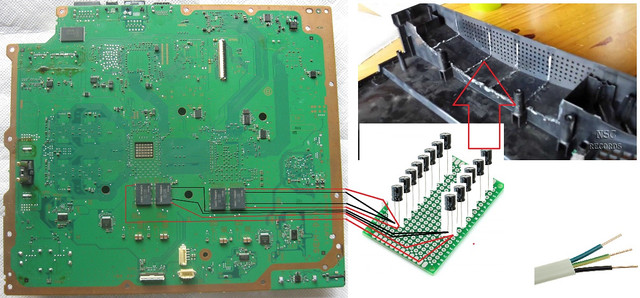
What do you think about soldering only the electric wire to the NEC feet, close the board and lead the condenser system out? Someone tried this solution? Does the distance immediately reject such a solution and it's a waste of time trying?

In case I found some free space. There you can fit a PCB with capacitors and in the meantime you can easily change the number of capacitors without disassembling the board.

I don't have time to test it at the moment, so please give me your opinion.

 
I tried to fix YLOD yesterday with electrolytic capacitors. I solder 3 capacitors on RSX and made a "hedgehog" - no effects.

Because I have a lot of electrolytic condensers - I thought and thought and came up with.

What do you think about soldering only the electric wire to the NEC feet, close the board and lead the condenser system out? Someone tried this solution? Does the distance immediately reject such a solution and it's a waste of time trying?

In case I found some free space. There you can fit a PCB with capacitors and in the meantime you can easily change the number of capacitors without disassembling the board.

I don't have time to test it at the moment, so please give me your opinion.


I actually toyed with that very early on, I had a small board and some electrolytic caps sitting around, and the board came out fairly nice, as far as that goes. The main issue, though, was soldering at thr legs... That spot is extremely small, there's really no way to solder there without damaging the tokins.

At the time, though, I didn't think of scratching the board to reveal the copper and solder directly there... I know a few people have had luck with that approach to install tantalums.
 
I had no problem soldering next to NEC. I did not damage the NEC because after heating the console started. However, when starting the electrolytic capacitors, sometimes the feet fell off the plate. However, when I soldered and did not move the electrolytic capacitors then there was a connection everywhere.

I plan to test consoles on TLOU and when YLOD reappears then I will test my theory - unless someone else does it for me during this time. The question is whether such long wires will not affect the proper operation of electrolytic capacitors
 
IPC section 6.1, starting on page 14 of the PDF - https://www.ipc.org/4.0_Knowledge/4.1_Standards/7721Change 1.pdf

Be as direct as possible without violating any other guidelines, didn't see a mention of angle. Really, the only thing I pay attention to is making sure to route perpendicular to any trace carrying power. If it is parallel, the power line can cause induced current to flow.
I meant, when the tokins are removed (originally soldered in rectangular copper surfaces), the corners of that rectangular surfaces becomes a problem in itself, and the wires we solder in them should be located in a symmetric way
Also, the tip of the thick wires that can be seen in many photos of this thread are a problem too because are not completly covered with solder, you know instead of having a spherical solder point with the tip of the wire completly covered by it there are many photos where can be seen the threads of the wire are "out" of the solder point
And also, the solders that solidifyed in a bad way (not shiny and not spherical) have the same effect
All that angles and peaks are problematic
 
"These capacitors were used by Sony until the 65nm CELL/RSX manufacture era"
So, are they include the 65nm cell/rsx models ? which are CECH J,K,L,M,P,Q ?
Because I have 80GB CECHK and it is 11 years old now and to this day it has never gotten the YLOD, and I have never opened it or cleaned it or do whatever.
Also everywhere around the net I've seen many models with ylod, however they are all earlier models than the last gen phats 65/65nm ones.
Does the YLOD even exist on those last gen phat consoles ?

Consider yourself lucky. YLOD is a common problem on the Fat PS3. Common enough that 10 years later people are still looking for ways to fix YLOD. So far, replacing the NEC/TOKINS are the most promising aside from performing a reball which requires expensive equipment and experience using it

A Fat PS3, especially if it's a backwards compatible model such as the 60GB CECHA-01 and 80GB CECHE-01 that have not YLOD fetch quite a premium.

I've personally seen a few 60GB models sell on eBay for over $700 USD - I know they sold because I bid $500 for one using snipe software and I was outsniped with a higher bid
 
I took your advice and I added more jumpers on the positive rails (as well as adding some electrical tape on the ground rail to try and prevent shorts). I removed the old jumpers and I instead used some solid core copper wire I had laying around (I unfortunately don't know what AWG...) I added four jumpers on both sides of the board for a total of 8. Adding the wires has delayed my YLOD to around 4 seconds now but I still have a YLOD. Should I keep adding more jumpers or try and get some thicker wire?
View attachment 25740


Hi
Mate put the jumper wire on the other side of the board, the side where the big CELL and RSX chips are
I am in the same situation where I put the jumper wire the same side as yours and did not work
Try the other side and report back please
I am really interested to see progress

Thanks
Look forward to the good news
 
Consider yourself lucky. YLOD is a common problem on the Fat PS3. Common enough that 10 years later people are still looking for ways to fix YLOD. So far, replacing the NEC/TOKINS are the most promising aside from performing a reball which requires expensive equipment and experience using it

A Fat PS3, especially if it's a backwards compatible model such as the 60GB CECHA-01 and 80GB CECHE-01 that have not YLOD fetch quite a premium.

I've personally seen a few 60GB models sell on eBay for over $700 USD - I know they sold because I bid $500 for one using snipe software and I was outsniped with a higher bid

I am talking specially for those 65/65nm revisions, which are most 80GB PAL units manufactured in late 2008 and early 2009.
I have not seen anyone with this models getting ylod, neither in person or on the internet, that's why I thing that they may have not the YLOD problem. I know about the first one and preety much every model with the chrome trim and even the first 40gb ones (which were 90/65nm, however I haven't seen even 1 case where a 65/65 unit is getting ylod, that's why I ask. I have friends with those revisions also who have their PS3s from many years and they also don't have any problems, even on the internet on ebay for example all the broken FAT units with CECHK or after have other problems but no YLOD.
 
Hi All, so here is the update, and what i have done until now:-

(1st attempt)
Replaced all NEC/Tokins...
Each one with 3 x 470uF - 2.5V (Vishay size B).
Using 3 x bridge wires on each side of the board, per processor.
(So 6 x wires each processor in total)
Wire was 23AWG solid core.
Result = YLOD.

(2nd attempt)
Added more caps, same type as above...
4 x 470uF - 2.5V per NEC/Tokin replacement.
Using 2 x bridge wires on each side of the board, per processor.
(So 4 x wires each processor in total)
Wire was 23AWG solid core.
Result = YLOD.

(3rd attempt)
Changed everything to the photos you see below.
4 x 470uF - 6.3V (AVX size D) per NEC/Tokin replacement.
Using 1 x bridge wire only per processor.
Wire was 16AWG solid core.
Result = YLOD.

Side Note:-
Then tried changing the PSU with another i had, but same result = YLOD. Then tried without Disc Drive, but again = YLOD. The YLOD now happens at about 2 - 3 secs, however before with all original NECs the YLOD was instant, like 1 sec.

Top Side (A)
PS3_AVX_Photo-1.JPG


Bottom Side (B)
PS3_AVX_Photo-2.JPG


I think i will try adding another wire (16AWG) to the other side of the board for each processor, just to see what results come from that. Will aim to update you guys once done. Meanwhile, i'm gonna go drown my sorrows with Kit-Kats & Coffee, for a few days, lol. :tongue new: :very drunk:
 
Last edited:
I see a COK-001 board being abused, i cry, you US lads are so lucky to have these, Sony screwed us Europeans big time, and i still hold them accountable for that [emoji23]

Is that some 3M Clay stuff? Reminds me when people used to reflow these in the oven by covering the Capacitors with 3M Clay and Aluminium Foil [emoji23]

Sent from my G8141 using Tapatalk

My CECHG has aluminum tape residue all over it, and the last person that "fixed" it left the RSX twisted clockwise, no capacitor replacement fixed this unit as it was fucked.
 
I am talking specially for those 65/65nm revisions, which are most 80GB PAL units manufactured in late 2008 and early 2009.
I have not seen anyone with this models getting ylod, neither in person or on the internet, that's why I thing that they may have not the YLOD problem. I know about the first one and preety much every model with the chrome trim and even the first 40gb ones (which were 90/65nm, however I haven't seen even 1 case where a 65/65 unit is getting ylod, that's why I ask. I have friends with those revisions also who have their PS3s from many years and they also don't have any problems, even on the internet on ebay for example all the broken FAT units with CECHK or after have other problems but no YLOD.

Hiya, just to add, i have another PS3 (not the one in the photos) it's a CECH-M (VER-001), which i think is the 2nd edition of the 65/65nm, (the first edition being the DIA-002).

And my CECH-M does have YLOD, just like my other PS3 (which i'm working on currently - SEM-001, 65/90nm)

Here are the board revisions:-
https://www.psdevwiki.com/ps3/Motherboard_Revisions
 
Hi
Mate put the jumper wire on the other side of the board, the side where the big CELL and RSX chips are
I am in the same situation where I put the jumper wire the same side as yours and did not work
Try the other side and report back please
I am really interested to see progress

Thanks
Look forward to the good news

No dice. I'm still getting a YLOD in ~4 seconds with all the jumps on the side of the board with the CELL and RSX chips (4 jumpers in total with 2 per chip). I'm thinking maybe I need to get some thicker wire? I think I might also try and pick up some 16 AWG wire to use as jumpers instead like Workz_777 is doing.
 
Back
Top