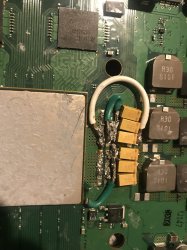
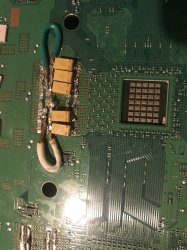
Any recommendations on how to remove the capacitors? Soldering iron still the best way?
Basically, is needed to overheat the area, the problem is that heat is dependant of how many metal is connected to the point you are heating
In general... ground points needs more heat because the ground lines are always big areas of metal
Here also the voltage lines are connected to lot of vias (holes) that tranfers the heat to the other side of the motherboard, and to internal layers (all made with copper)
So yeah... i never did this myself, but just by looking at the images im sure it needs lot of heat, thats the tricky part
Also, check some of the photos posted by people... it can be seen how some of the tokins was removed
before the tin was completly melted... thats very risky because you can lift (or break) a copper trace by pulling from the tokins
*This problem can be identifyed because it can be seen the shape of the tokin in the tin... it means the tin was not completly liquid
You know... the materials have 4 states... liquid, solid, gas and plasma
In betweem them there are intermediate states... like a "semisolid" where the tin is like a paste
If you pull from the tokin when the tin is in "semisolid" state you dont know the results, the only safe way is to pull from it when the tin is completly liquid... but as mentioned before for some of you this is going to be hard to achieve because is needed lot of heat
Tip: If you have 2 solder irons try use both together
Tip2: Add lot of tin (and i mean... a lot) over the factory tin to change his melting point
Tip3: Flux ftw
Yes, is fine
You are buying them in expensive brands and places btw, as i mentioned before (in general) the capacitors are not considered important components, and there is a wide range of values aceptable if need to replace one
As example, you can replace a capacitor that originally was 5v by other with 12v, or a capacitor with 700uf by another with 1000uf... or both things together a capacitor originaly 5v @ 700uf by another with 12v @ 1000uf
Im not sure if there is some exception to that, but i did it with monitors, tv's, PC power supplies and PC procesors, and my experience is that always works
So... the point is... if you already have some capacitors at your home (recycled from other device or because you bought them time ago for other stuff but never used them) then is fine to try with different values (always bigger)
But if you are going to buy them is better to match the factory values
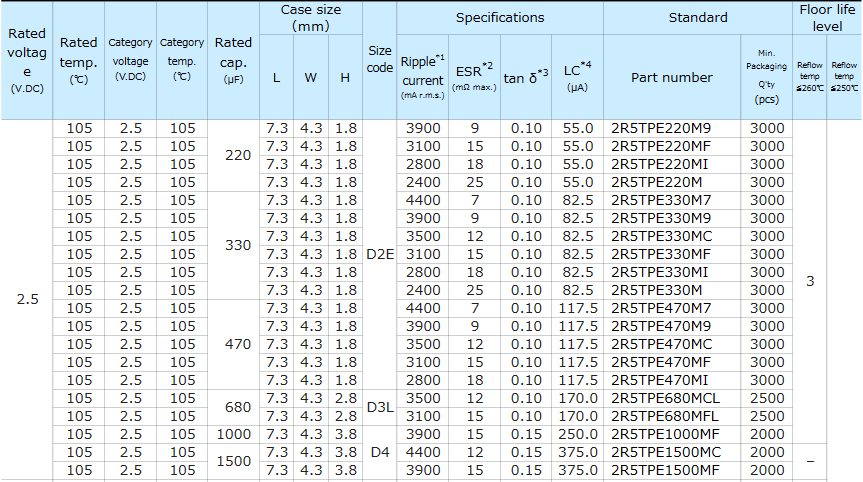
In this case the original voltage of the tokins is 2.5v so if you are going to buy them... yeah there is no doubt, 2.5v wins
About the capacitance... well... in the way you are soldering them (4 tantalums for each tokin) you need to equal or surpass a total capacitance of 1200uf (because this was the original value of everyone of your tokins)... so you can do it with... 330uf * 4 = 1320uf
Thats good enought, actually is a bit over the original 1200uf and thats fine
But if you use 4 * 470uf = 1880uf
Im not telling that doesnt works, we know it works, but is not needed, actually if you really want to use 470uf you can do it with 3 * 470 = 1410uf
This will make the solder job easyer because you only need to solder 3 tantalum capacitors for every tokin... but again is not needed
*Also keep in mind you have 4 tokins connected together for CELL.... and another 4 tokins for RSX, so when doing the calculations we need to multiply by 4 to get the total capacitance, as example, your PS3 from factory was using:
1200uf + 1200uf + 1200uf + 1200uf =
4800uf for CELL
1200uf + 1200uf + 1200uf + 1200uf =
4800uf for RSX
And you was replacing them by:
(4 * 470uf) + (4 * 470uf) + (4 * 470uf) + (4 * 470uf) =
7520uf for CELL
(4 * 470uf) + (4 * 470uf) + (4 * 470uf) + (4 * 470uf) =
7520uf for RSX
See the difference ? is huge 7520 - 4800 = 2720 extra (added by you, but not needed)
In my oppinion the "hotspot" is in 2.5v @ 330uf ...one of the reasons is because are cheapests, to make this repair is needed to buy a bunch of them so this is important
The 2.5v @ 470uf are fine though, all depends of how are you going to solder them... the suggestions made by littlebalup was interesting, there are several available







 Cypher Strikes Back...." I think you would love to watch that.....